Trump’s ‘peace deal’ leaves all the big questions unanswered
It does nothing to rein in Iran’s nuclear ambitions, its proxy armies or its brutal suppression of the people.

Want unlimited, ad-free access? Become a spiked supporter.
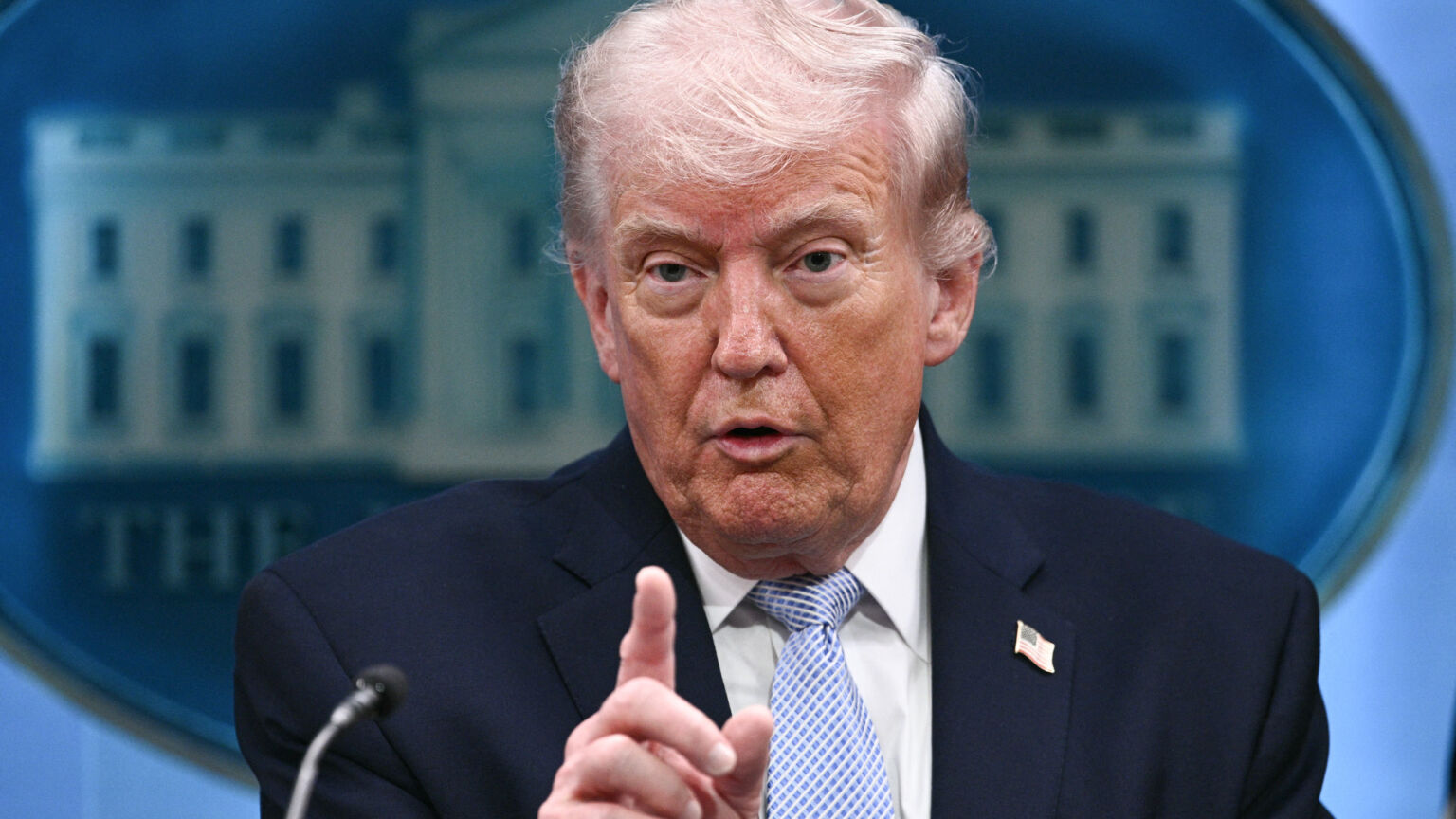
Three and a half months in, and it seems as if the joint US-Israel war with the Islamic Republic of Iran is finally drawing to some sort of close. That’s certainly the view from up on Capitol Hill. Writing on Truth Social, President Trump announced that a ‘deal’ with Iran was now ‘complete’ and that the vital trade route, the Strait of Hormuz, would immediately reopen. ‘Ships of the World, start your engines’, he trumpeted, ‘Let the oil flow!’.
Not for the first time during this deeply disillusioning conflict, Trump is guilty of overselling an agreement. For a start, it is not yet a ‘peace deal’, despite being championed as such by Pakistan’s prime minister, Shehbaz Sharif, whose administration helped mediate the latest US-Iran talks. It is, in fact, a ‘memorandum of understanding’ to negotiate the terms of any prospective deal over the course of the 60 days, following its official signing on Friday. During that period, the US and Iran will stop both their already intermittent fighting and their naval blockades of the Strait of Hormuz. Strictly speaking, then, it is another ceasefire to add to all the other ceasefires that have been declared since the US and Israel launched their assault on Iran on 28 February. It’s a two-month pause during which the US and Iran will try to hammer out an actual ‘peace deal’.
From the little it’s possible to gather at the moment, the terms of the memorandum of understanding raise the question: what was the point of this conflict? At its start, the US talked of putting a permanent end to the mullahs’ nuclear ambitions. Of forcing the Islamic Republic to cut ties with its proxy armies stationed across the Middle East. Trump even spoke of regime change, telling restive Iranians that their ‘hour of freedom [was] at hand’.
From what we can tell from the leaked information about the terms of the memorandum of understanding, these objectives have slipped from view. The Trump administration has so far remained tight-lipped on its efforts to deal with Tehran’s atomic dreams and its stockpile of highly enriched uranium. According to the New York Times on Sunday, Trump said Washington was still negotiating whether Iran would suspend its enrichment programme.
Likewise, there is little sign that the question of the Islamic Republic’s support for the anti-Semitic militias it has arrayed against Israel is being resolved. And, given the regime’s murderous clampdown on dissent and protest carried out under the cover of war, the Iranian people’s hour of freedom seems further away than ever.
The one clear benefit of this ceasefire, at least for the global economy, is the reopening of the Strait of Hormuz. But this was never an objective of the war when it was launched. It only became one during the conflict when Iran all-too-predictably weaponised this long-recognised geographic chokepoint. And despite Trump’s claims that the strait will be ‘permanently toll-free’ (as it was before the war), the Islamic Republic seems to have a different reading of the memorandum. According to Iran’s Fars news agency on Monday, Tehran claims it has added a clause on ‘imposing maritime service fees’ to the negotiating framework.
There is as yet no clear answer to any of the key questions that prompted the original military action. No solution to the Islamic Republic’s nuclear plans, its backing of proxy armies, its brutal oppression of the Iranian people, or even its control of the Strait of Hormuz. Indeed, no answer to the problem of the Islamic Republic itself, the Islamist source of so much instability in the Middle East and increasingly beyond.

Replete with potential for seeming concessions and fudges, this ceasefire does not appear to be a victory for the US. It looks and feels like a testament to the Trump administration’s desperate desire to end the war – which the vast majority of Americans now oppose – regardless of the cost to itself and to its chief regional ally, Israel.
Indeed, one of the main casualties of this conflict has been the White House’s relationship with Israel. Trump and Israeli prime minister Benjamin Netanyahu entered into this war in seeming lockstep in their opposition to the Iranian regime. But the two allies’ geopolitical interests have since diverged. Finding himself under increasing domestic pressure due in part to rising energy costs, Trump has zeroed in on reopening the Strait of Hormuz and therefore making peace with Iran. The Israeli state, meanwhile, has rather more existential concerns and has continued to focus on destroying Iran’s proxy armies, especially Hezbollah in Lebanon. It is understandably rather less interested in making peace with a regime that remains constitutionally hellbent on its destruction.
With Israel’s ongoing war with Iran’s proxies frequently intruding on negotiations between the US and Iran, Trump has even started publicly criticising Netanyahu – a tension that Iran, Hezbollah and the rest have frequently played on. That’s why Hezbollah continues to fire rockets into northern Israel when US-Iran peace negotiations appear to be reaching sensitive points. As Jake Wallis Simons has observed, it’s designed to elicit a response from Israel and further drive a wedge between the two allies. Just last week, Trump called Netanyahu a ‘difficult guy’ who has ‘no fucking judgment’.
So we now have a situation in which negotiations to end the joint US-Israeli war with Iran seem to have sidelined Israel almost entirely. And no wonder. There is little about the mooted deal that Israel would deem worth supporting. Not least the demand that Israel cease operations against Iranian proxies – something that, according to Haaretz, the Israel Defence Forces will not do. The Times of Israel put the matter succinctly a couple of weeks ago:
‘The Iranian regime still exists. It still possesses much of its ballistic missile arsenal and its stockpile of enriched uranium. And it also controls the Strait of Hormuz.’
From Israel’s perspective, the Islamic Republic, armed with the Strait of Hormuz, looks more threatening now than it did a few months ago.
None of this is to suggest that the Islamic Republic, already an economic horror show, is emerging from this conflict unscathed. The military assault of the past few months has devastated Iranian sea and air power, and has wiped out a whole stratum of leadership, including the Ayatollah Khamenei himself. Nevertheless, it has survived in the face of the Great Satan, and that is more than enough for it to feel emboldened.
In the next couple of months, the US and Iran may well reach an agreement that both the White House and Tehran can dress up as a victory. But for as long as the Islamic Republic and its proxies menace what they deride as ‘the Zionist entity’, peace in the Middle East will remain as elusive as ever.
Tim Black is associate editor of spiked.
You’ve hit your monthly free article limit.
Support spiked and get unlimited access.
Support spiked and get unlimited access
spiked is funded by readers like you. Only 0.1% of regular readers currently support us. If just 1% did, we could grow our team and step up the fight for free speech and democracy.
Become a spiked supporter and enjoy unlimited, ad-free access, bonus content and exclusive events – while helping to keep independent journalism alive.
Monthly support makes the biggest difference. Thank you.





Comments
Want to join the conversation?
Only spiked supporters and patrons, who donate regularly to us, can comment on our articles.