Sagrada Familia: why we can’t live without beautiful buildings
Gaudi’s still-incomplete masterpiece is a sublime rebuke to modern architecture’s bland utilitarianism
Want unlimited, ad-free access? Become a spiked supporter.
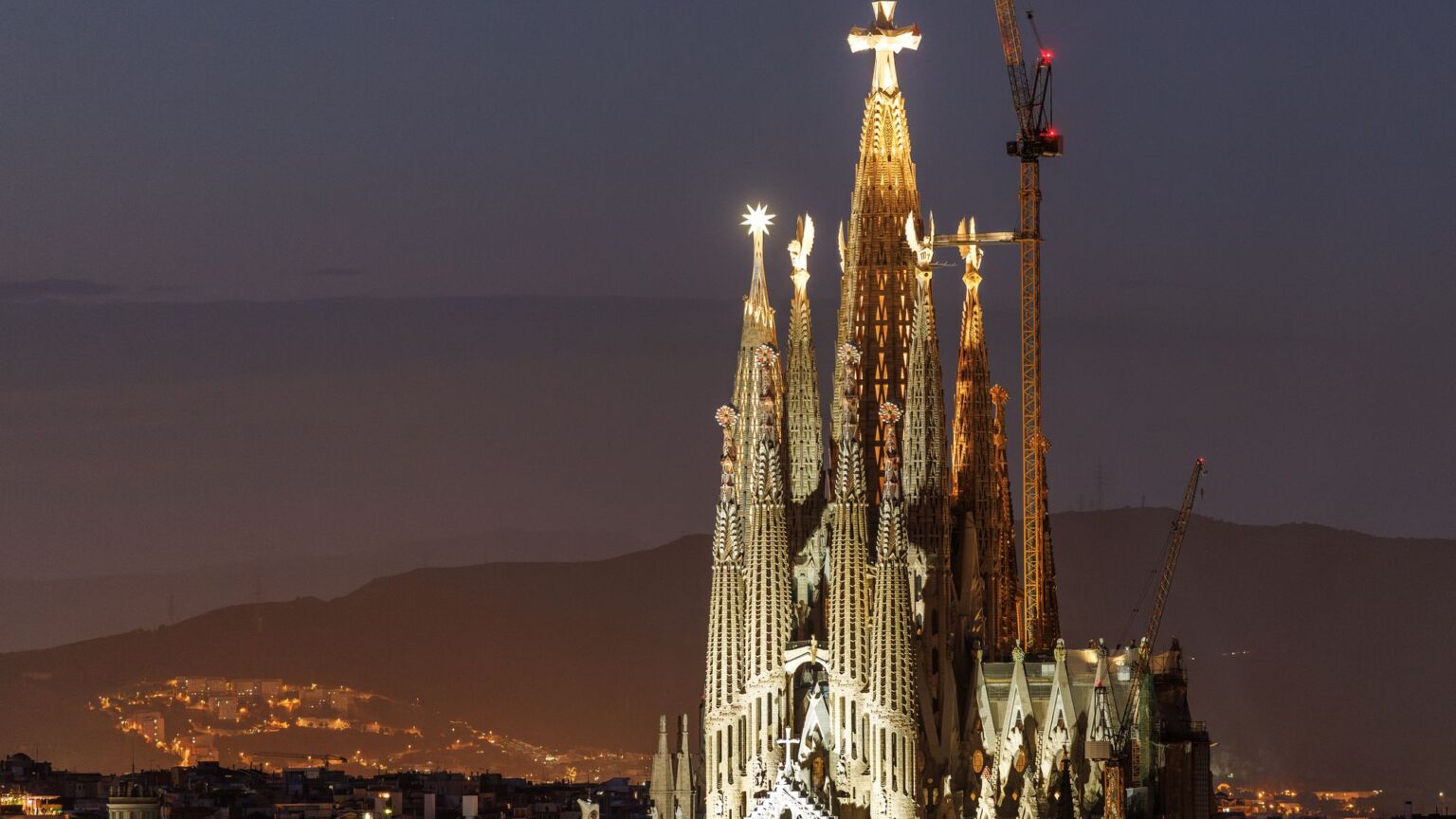
You may be forgiven for casting an envious eye in recent days towards the Iberian Peninsula. This is not just for the usual reasons – a desire for decent weather, sunburnt mirth, magnificent seafood in late-night restaurants and coffee for one Euro a pop – but also for the scenes around Pope Leo’s recent visit to Barcelona.
In Britain, our relationship with the built environment has collapsed into an apparent slough of timidity and self-loathing. We can’t even fix potholes in the roads. And, when it comes to new public architecture, our aspirations rise no further than identikit riffs on hypertrophic slats of concrete and glass, devoid of decoration, any sense of place, history, or human scale. The Pope’s blessing of the recently completed Jesus Christ Tower of Barcelona’s Sagrada Familia Basilica has thrown into striking relief an entirely different attitude towards architecture. Which, to our great detriment, we have lost.
Such an attitude defies all contemporary norms. It does not see simple utility or the satisfaction of a balance sheet as being the capstone of an architectural endeavour. Rather, it desires that a building should, beyond any immediate utilitarian function, move one to a consideration of human dignity, the inheritance of the civilisation from which the work is sprung, and above all to a sense of the transcendent. If we have to look at these buildings every day for years on end, why should we expect anything less?
These ideas were taken as read by Antoni Gaudi, Sagrada Familia’s architect. Not for him throwing up some speedy heap. Work to the glory of God needed dedication, rather than haste. When Gaudi took up the project in 1883, he paid little attention to concerned questions about the slowness of the work: ‘My client is in no hurry’, he would respond, looking heavenwards. Indeed, its final completion, with the adornment of the Glory façade, is unlikely to be before 2035.
In pursuit of God’s glory, Gaudi followed a number of vital principles. He drew on an ancient idea, going back at least to Pope Gregory the Great in the seventh century, that art should be a ‘bible for the unlettered’. He saw Sagrada Familia as a cathedral for the poor, and that it should act to teach them of the Christian story by sight. Thus, ornament, heavy with significance, became a fundamental part of it. He made the basilica rich with decoration – statues, carvings, stained glass – to narrate the life of Christ in pictures and symbols.
More than this, both the character of the ornament and the wider design were grounded in two main sources.
First, he drew deeply from architectural tradition. He took into account ideas from the earlier gothic cathedrals, but also the local Catalan heritage, as well as the wider Arab, Moorish and Middle Eastern influences. He treated these as part of a living inheritance, grounding his work in them, but also using these roots as an assured way to move forwards – for instance, drawing from the form of the pre-Islamic Arch of Ctesiphon in modern-day Iraq to offer a different means for dealing with the problem of grounding the weight of high walls and towers, instead of the gothic flying buttress, which he saw as an aberration of the style.
Second, Gaudi looked to the example of nature itself. He described it as a grand book, always open, that we should strive to read. He created new forms of columns which imitated branching trees or the twisting one might find in the stems of oleander, as well an abundance of fruit, foliage and flowers to signify the abundance of creation.

These ideas were once widely understood. The great 19th-century writer John Ruskin was similar in spirit. He said that artists should ‘go to nature in all singleness of heart’. Nature in itself was a reflection of God. The artists who went to it, laboured with devotion in careful observance of its strangeness, specificities and even imperfections, and then took pains to reflect this in their own work, were drawing from a well of holy truth. The effort they put into such endeavours was a sanctifying, elevating sacrifice. Such was a valid work of praise, and also a proclamation of the beauty that was, as God’s handiwork, an intrinsic part of nature.
For millennia, thinkers and prophets have known that humans have a need for beauty. The idea goes back a long time before Ruskin. In the Old Testament, beauty was seen as fundamental in the relationship with God. ‘O worship the Lord in the beauty of holiness’ is a refrain of the Book of Psalms. Beauty was necessary to the design of the Jerusalem Temple – its decoration, proportions, routines, prayers, and even the vestments of the priests – because the holiness of God was thought to be manifest in the splendour of such beauty.
The extraordinary response to Gaudi’s work shows us that these ancient ideas are far from outdated and esoteric. People respond to them. Over 120,000 people turned out for the papal blessing of the Jesus Christ Tower, and the Basilica receives nearly five million visitors a year. Its continued building work is funded not by the state, but simply by receipts from visitors and donations. People are crying out for the ideas of transcendent and devotional beauty that such architecture expresses. They come regardless of any Christian faith. Even for those who are not of faith, the vision of such a work and its beauty feeds a desire for the sublime. Gaudi, with his artistic sights fixed on the transcendent, calls out even beyond the boundaries of the religion and can give that joy and wonder to all, regardless of their background.
We are not short of such sublime works in Britain. The great cathedrals, churches, castles, stately homes, civic buildings – many of which were created on the principles that Ruskin articulated – are testament to this. It is a scandal that so many of their custodians now treat them as vehicles for divisive and petty identity politics, and mere twee attractions rather than visions of absolute beauty – think of the recent graffiti exhibition in Canterbury Cathedral.

For all this, these buildings still have the power to move us and bring us together – but imagine what joy we might get to experience if contemporary architects, instead of defaulting to carbon-copy concrete, took a leaf off Gaudi’s drawing board and actually gave some thought to the idea that new buildings should draw from tradition, and elevate us with their beauty and decoration. Perhaps we wouldn’t be wanting to run off so frequently to Spain if they so obliged us.
Bijan Omrani is the author of God is an Englishman: Christianity and the Creation of England.

spiked summit 2026 - SOLD OUT
10am-6pm, Saturday 27 June
Emmanuel Centre, London, SW1P 3DW
With Lionel Shriver, Brendan O'Neill, Katharine Birbalsingh, Toby Young, Allison Pearson, Paul Embery, Tom Slater, Andrew Doyle, Fiyaz Mughal and more
The spiked summit has now SOLD OUT. To join the waitlist, email:
[email protected]
£80 or £50 for supporters
You’ve hit your monthly free article limit.
Support spiked and get unlimited access.
Support spiked and get unlimited access
spiked is funded by readers like you. Only 0.1% of regular readers currently support us. If just 1% did, we could grow our team and step up the fight for free speech and democracy.
Become a spiked supporter and enjoy unlimited, ad-free access, bonus content and exclusive events – while helping to keep independent journalism alive.
Monthly support makes the biggest difference. Thank you.







Comments
Want to join the conversation?
Only spiked supporters and patrons, who donate regularly to us, can comment on our articles.