David Hockney’s lifelong battle with the dreary, joyless nanny state
The proud chain-smoker championed the joys of living over the fear of death.
Want unlimited, ad-free access? Become a spiked supporter.
When David Hockney died last Thursday, Guido Fawkes ran with the headline ‘Anti-nanny state campaigner David Hockney dies aged 88’. It was a little light trolling, firstly by omitting to mention that he was one of the most popular and significant painters of the past hundred years, and secondly by highlighting his age. Dying a month short of his 89th birthday, the chain-smoking Hockney lived longer than most anti-smoking campaigners ever have or ever will.
Hockney beat the odds, but that is not the point. He was here for a good time, not a long time. His critique of the nanny state was not based on questioning ‘the science’ or warning of unintended consequences. He did not appeal to economics. He did not rely on sophisticated philosophical arguments about rights and liberty. For Hockney, it was a battle between beauty and ugliness, individualism and conformity, freedom and regimentation. While the ‘public health’ lobby only wanted to talk about death, he talked about life. As he said in 2004, ‘the opposite of fear of death is love of life.’
Hockney’s celebrity status meant that he was one of the few critics of the nanny state to be given a fair hearing by the media. Awed by the presence of a national treasure, the BBC gave a rare platform to someone who was not just tolerant of tobacco but actively pro-smoking. Hockney was so obviously not an industry lobbyist or right-wing libertarian that his opponents did not know how to deal with him. He was not there to say, ‘smoking is terrible, but…’. Instead, he went for the jugular. ‘I think you are too bossy, chum’, he told a hapless Labour MP in a debate about the smoking ban on Radio 4. ‘You are absolutely dreary. Some people want to live and they don’t want to live like you do. It doesn’t matter if I die early.’
‘Dreary’ is a word Hockney used a lot when he spoke out against lifestyle regulation. For him, dreariness was the antithesis of the ‘Bohemian’ lifestyle that he said he enjoyed and wanted other generations to enjoy. On the issue of tobacco, two things particularly irked him. As an artist and aesthete, he was repelled by the state-sanctioned vandalism of cigarette packs that culminated in plain packaging. When millions of ‘No Smoking’ posters went up in the summer of 2007, Hockney said: ‘The uglification of England is underway by people with no vision. I detest it.’ As a tobacco consumer, he loathed the ‘comprehensive’ smoking bans that gave him nowhere to go. Having lived for decades in California, he was no stranger to smoking restrictions, but the weather was sunny enough for him not to be inconvenienced too much. The prospect of a ban in every ‘public’ place in cold, rainy England was, he said, ‘the most grotesque piece of social engineering’ and would leave him nowhere to go. ‘Why must every place be suitable for you?’, he asked his tormentors on Radio 4, ‘What about me? Can’t there be some place suitable for me? You destroy Bohemia.’
Hockney had better things to do than engage in politics. Beholden to no one and in no need of money, he shot from the hip. Tony Blair couldn’t be trusted, he said, because he had been in a rock band but had never smoked cannabis. Hillary Clinton couldn’t be trusted because she banned smoking in the White House. Gordon Brown was ‘grotesque’ and did not ‘understand life’. Public-health minister Dawn Primarolo was ‘as naive as the Women’s Christian Temperance Union’. Rishi Sunak was ‘humourless’ and a ‘bossy boot’. David Cameron, Nick Clegg and Ed Miliband collectively represented ‘a meanness of spirit that pervades everywhere in England. Pettiness, meanness, dreariness.’
Much of Hockney’s defence of smoking was of the ‘you could get hit by a bus tomorrow’ variety. His critics accused him of being an addict trying to rationalise his habit. But he had legitimate fears about the regimentation of society and saw smokers on the frontline in a battle for freedom of choice. A billion people still smoke tobacco. It is not, in itself, a mark of Bohemianism. Of all Hockney’s quirks, it seems the least remarkable and yet, by the end of his life, it had become genuinely subversive to be a proud smoker.
The world changed and Hockney refused to change with it. When he came out as gay in the early 1960s, homosexual acts were illegal and cigarettes were advertised on television. He could scarcely have imagined that he would die while the government was celebrating Pride Month shortly after having an advertisement for an exhibition banned on the Paris Metro because his self-portrait depicted a cigarette. For some ‘liberals’, this was all part of the march of progress, but by this time, liberalism meant whatever they wanted it to mean. For Hockney, the crucial difference was that the gay-rights movement added to the sum of human freedom while the anti-smoking movement took freedom away.
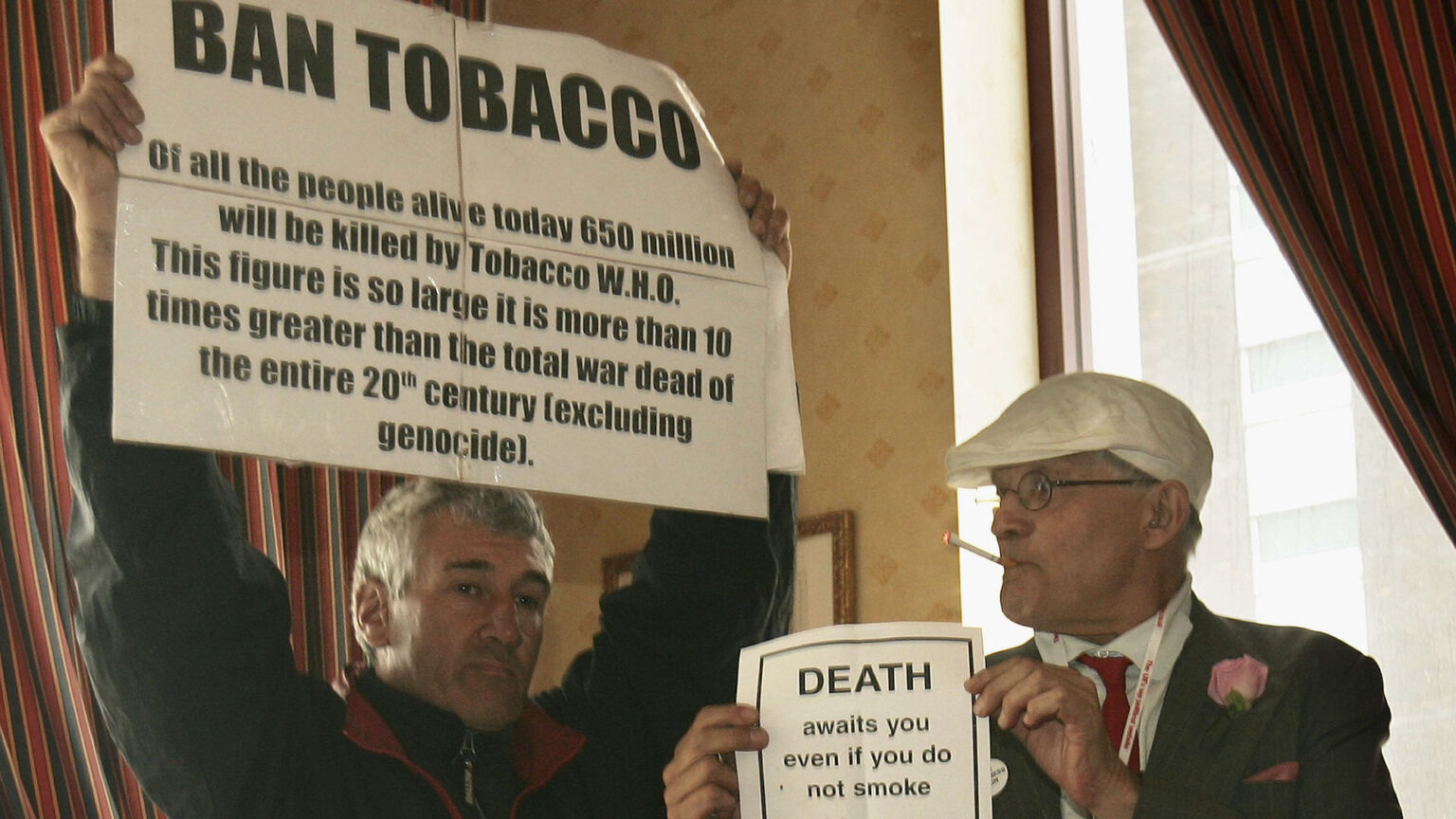
For those who fondly remembered the Swinging Sixties, Hockney was like Banquo’s ghost, a constant reminder of their betrayal of liberal ideals. The Guardian, in particular, did not know what to do with him. Transgressive, gay, working-class artists were supposed to share the values of its readers, and yet Hockney kept lecturing them on their prissiness and it touched a nerve. He did it all with a laugh, a lightness of touch and a West Yorkshire accent that half a lifetime in America could not soften. It was not enough to talk about joie de vivre. You had to flaunt it. You do not fight the dreary by being dreary. Hockney wore a badge that said ‘End bossiness soon’ and explained that he had considered using the slogan ‘End bossiness now’ but thought that would be too bossy. There is a wonderful photo of him standing in front of the perennial protester Stuart Holmes (whom Hockney admired as a fellow eccentric), who is holding a placard calling for a complete ban on the sale of tobacco. Hockney is smoking impishly and holding a much smaller piece of paper on which he had written ‘DEATH awaits you even if you do not smoke’.
The contrast between the playfulness of Hockney’s bouts of libertarian activism and the po-faced outrage he received in response only served to underline his point. After Hockney sent the Guardian a piece of art criticising ‘anti-smoking fanatics’ in 2012, its readers responded by making drawings of their own – the artistic equivalent of bringing a knife to a gun fight – to whine about how ghastly smoking is. Unsurprisingly, they were the height of cringe.
After the Guardian ran a sycophantic interview with the Australian anti-smoking academic Simon Chapman, Hockney wrote a letter to the newspaper explaining why it would have been better off talking to him. Hockney listed all the things that he was and Chapman wasn’t, including being ‘a good and satisfied customer of the tobacco companies’, ‘not a professional agitator’ and ‘someone who prefers the centre of Bohemia to Australian suburbia’. As Chapman’s flaccid reply showed, it was the charge of not being Bohemian that stung him the most. It was hard to believe that a septuagenarian living in Bridlington was more edgy than a sociologist living in Melbourne, and yet we all knew it to be so.
The puritans and killjoys of ‘public health’ had no answer to him. He was a living legend and they weren’t. Spending all day painting and smoking is not everybody’s idea of a fulfilling life, but it sounded better than whatever Chris Whitty was doing. By shifting the debate from the risks of death to the joys of life, Hockney had taken them out of their comfort zone. All they could do was ignore him. It must have pained them to see him live too long for them to say, ‘I told you so’, but he was bound to die eventually. And now he has, and the world is a drearier place for it.
Christopher Snowdon is director of lifestyle economics at the Institute of Economic Affairs and the co-host of Last Orders, spiked’s nanny-state podcast.
You’ve hit your monthly free article limit.
Support spiked and get unlimited access.
Support spiked and get unlimited access
spiked is funded by readers like you. Only 0.1% of regular readers currently support us. If just 1% did, we could grow our team and step up the fight for free speech and democracy.
Become a spiked supporter and enjoy unlimited, ad-free access, bonus content and exclusive events – while helping to keep independent journalism alive.
Monthly support makes the biggest difference. Thank you.
Comments
Want to join the conversation?
Only spiked supporters and patrons, who donate regularly to us, can comment on our articles.