The Gen Z protests are nothing like 1968
The modern omnigrievance wants to destroy society, not build a new one.
Want unlimited, ad-free access? Become a spiked supporter.
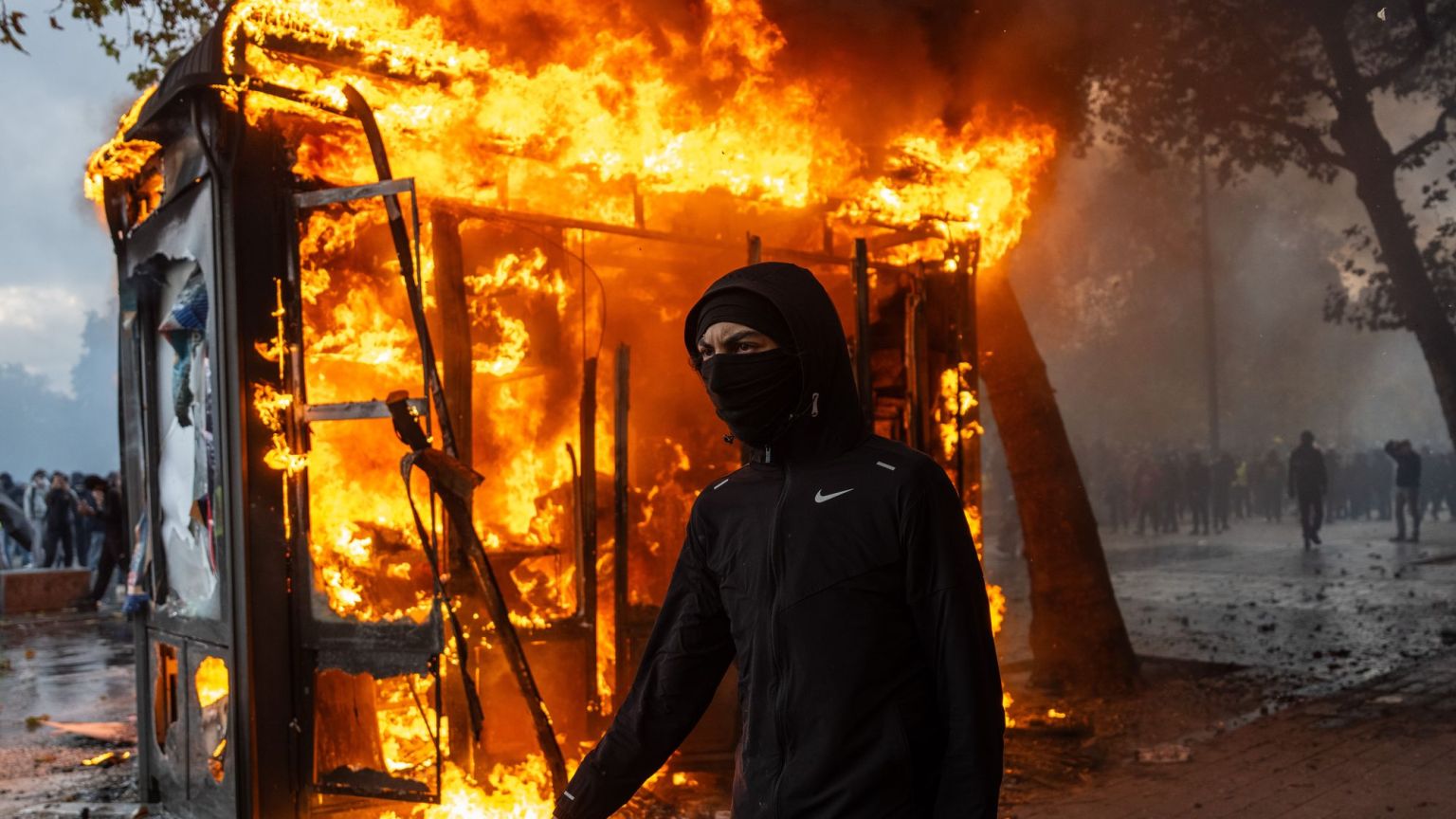
As the so-called Gen Z protests have set European cities on fire, particularly in France, commentary has been awash with comparisons to 1968. But the lazy assumption that this is the spirit of the Sixties in new bottles is as flawed as the complacent shrug that ‘this is just what the French do’ – obscuring both the similarities with past waves of youth protest, and the marked differences.
The 1968 protests across North America and Europe famously marked the emergence of a counterculture, in which youth hitched their energy and idealism to the wagon of a future unconstrained by the stuffy, conservative norms and prejudices of the postwar Fifties. The 2026 version is a backward-looking grievance fest, where kids are burning their heritage and looting stores to express the self-loathing of their fragmented societies. There’s no future orientation on display here, simply an aggressive alienation from their past and present communities.
This is not to let the Sixties off the hook. As Ellie Lee and I discuss in our study of Gen Z and the problems confronting young people growing up in today’s culture wars, bitter conflicts around questions of identity and history have their roots in the battle between conservatism and progressivism decades ago. But as these conflicts have deepened, they have altered both in form and content.
Where there is a genuinely countercultural aspiration among today’s youth, it comes from the socially conservative right, rather than the progressive left. Its radicalism derives not from a desire to tear things down and start again, but from a determination to hold on to the features of modern Western societies that have provided their citizens with a sense of meaning and shaped their way of life. Christianity, biological sex, national borders and history, freedom of speech, and an attachment to family and local community have all come to the fore as countercultural causes. The project is less one of cultural change than of cultural rescue.
Though attempts are continually made to present these concerns as coming from older people nostalgic for a bygone era, they have growing purchase among Gen Z. Most attention has been paid to young men – particularly working-class men – attracted to right-leaning politicians, parties and influencers across North America and Europe. Yet socially conservative ideas are also gaining ground among more moderate and highly educated young men and women in and around universities, who have come to see progressive politics around gender, migration and other issues as a threat to their freedom and security.
Charlie Kirk’s Turning Point USA movement is the most visible example, but European nations are seeing an increasing number of bright young commentators and activists challenge the assumption that young people always lean to the left. Across the spectrum, space is opening up for the kind of debates that need to be had. The ‘political apathy’ brush that tarred Gen X and the Millennials in their younger years could not be used for Gen Z.
That said, conservative counterculture remains a loose and inchoate coalition, riven with contradictions. A shared opposition to trans activism splinters when it comes to broader questions about women’s role in society: should women be acting as independent citizens in the public sphere, or embracing motherhood and homemaking as their destiny? Especially among the Very Online right, the commitment to national borders often morphs into a white identitarian fantasy. A desire to hark back to Christian tradition can sometimes descend into medieval crusader cosplay and outright anti-Semitism. Commitment to freedom of speech tends to falter at the challenge of defending speech for one’s opponents.

Yet the contradictions are no greater than those within progressivism, as encapsulated by the widely derided slogan ‘Queers for Palestine’. Indeed, the culture war of the Sixties spawned any number of peculiar causes, uneasy alliances and fractious squabbles. The point then, as now, is that a counterculture is not a political movement – it is an aspiration for a different vision and value set to that of the mainstream.
So what happens when the mainstream regards itself as radical, and the counterculture expresses a desire to hold on to the values and ways of life associated with its nation’s history? This is the perplexing situation in which we currently find ourselves, and which we can see playing out in the European riots.
The upheaval of the Sixties shook Western societies to their foundations. It reshaped the political landscape, giving rise to the new left and the new right. More fundamentally, it re-shaped relations within the pre-political domain of life: within education and the family, and between the sexes and the generations. The generational conflict associated with the Baby Boomers played an important part in shaping the culture and politics of the late 20th and early 21st centuries, as erstwhile radicals and their ideas became institutionalised within education, politics and the arts.
The mainstreaming of the Sixties’ legacy means that it is easy to overlook the alarm with which many back then viewed the birth of that new world, with its long-haired draft-dodgers, bra-less women, and children socialised according to the self-indulgent outlook that they should be ‘free to be… you and me’. In a similar way, the tendency to view contemporary youth protests through the rose-tinted spectacles of ‘68ism retrospectively downplays the seriousness with which the Sixties youth protesters took themselves.

For all their funny clothes and ideas, the youth protesters of the Sixties were committed to change and they embraced their responsibility for bringing that change about. Their demands for liberalising reforms spoke to an aspiration for autonomy: they were permissive in the sense that they wanted individuals to have the same rights regardless of sex, race or sexuality, and the freedom to live their private lives as they wanted to. They didn’t insist that everyone affirm their chosen identity and express sympathy with their plight, and, unlike the recent French protesters, they didn’t sell looted goods on Vinted.
The violent conflagrations that we see today are fundamentally infantile. From the globalised BLM protests of 2020 to the ‘pro-Palestine’ demonstrations raging since 7 October 2023, to the omnigrievance that characterises the recent European riots, the only point seems to be to express the rage of the self-identified victim. They represent not an optimistic demand for a cultural alternative, but a desire to hasten the process of cultural collapse.
Teenagers and young adults may be on the front lines here, but they are cheered on by an alliance of their elders from the various progressivist camps: Islamist activists, whose hatred of the West is well known; leftists, who blame the evils of their own societies for every ill; and centrists pleading with the kids not to smash things up while assuring them that they support ‘the cause’, with little attempt to articulate what that cause might be.
Meanwhile, the threat to our future is depicted as coming from those who want to hold on to something of its past. The killings of right-wing activists such as Kirk in the US and Quentin Deranque in France were treated as the regrettable consequences of choosing to position oneself on the wrong side of history. In the UK, the bile meted out to young working-class men raising the national flag in protest against mass migration has lost even the pretence of politeness.
The irony of all this is that social conservatives don’t want to be countercultural, and self-proclaimed radicals can’t cope with being seen as the dominant force. To understand this confused state of affairs, we could return to the work of Daniel Bell, one of the most astute commentators on the cultural contradictions revealed by the 1960s. Bell noted, back in 1976, that the shattering of bourgeois culture by events of the earlier 20th century had given rise to an ‘adversary culture’ within the arts, which regarded itself as being under attack even as its ideas became ascendant. As the influence of the adversary culture expanded: ‘Today, each new generation, starting off at the benchmarks attained by the adversary culture of its cultural parents, declares in sweeping fashion that the status quo represents backward conservatism or repression, so that, in a widening gyre, new and fresh assaults on the social structure are mounted.’
Fifty years on, such ‘new and fresh assaults on the social structure’ take place on the streets, unrestrained by an elite that is so in thrall to the romance of ‘68ism that it cannot see itself for what it is: a decadent regime that struggles to own itself. On the other side of the culture war, those who want to preserve something about the societies in which they have grown up find themselves monstered as outsiders.
Jennie Bristow is a reader in sociology at Canterbury Christ Church University. She is author of Stop Mugging Grandma: The ‘Generation Wars’ and Why Boomer Blaming Won’t Solve Anything and co-editor of Studying Generations: Multidisciplinary Perspectives.
You’ve hit your monthly free article limit.
Support spiked and get unlimited access.
Support spiked and get unlimited access
spiked is funded by readers like you. Only 0.1% of regular readers currently support us. If just 1% did, we could grow our team and step up the fight for free speech and democracy.
Become a spiked supporter and enjoy unlimited, ad-free access, bonus content and exclusive events – while helping to keep independent journalism alive.
Monthly support makes the biggest difference. Thank you.




Comments
Want to join the conversation?
Only spiked supporters and patrons, who donate regularly to us, can comment on our articles.