The French school riots are the rage of the entitled
Teenagers rich and poor, white and non-white, are united in their rejection of effort and excellence.
Want unlimited, ad-free access? Become a spiked supporter.
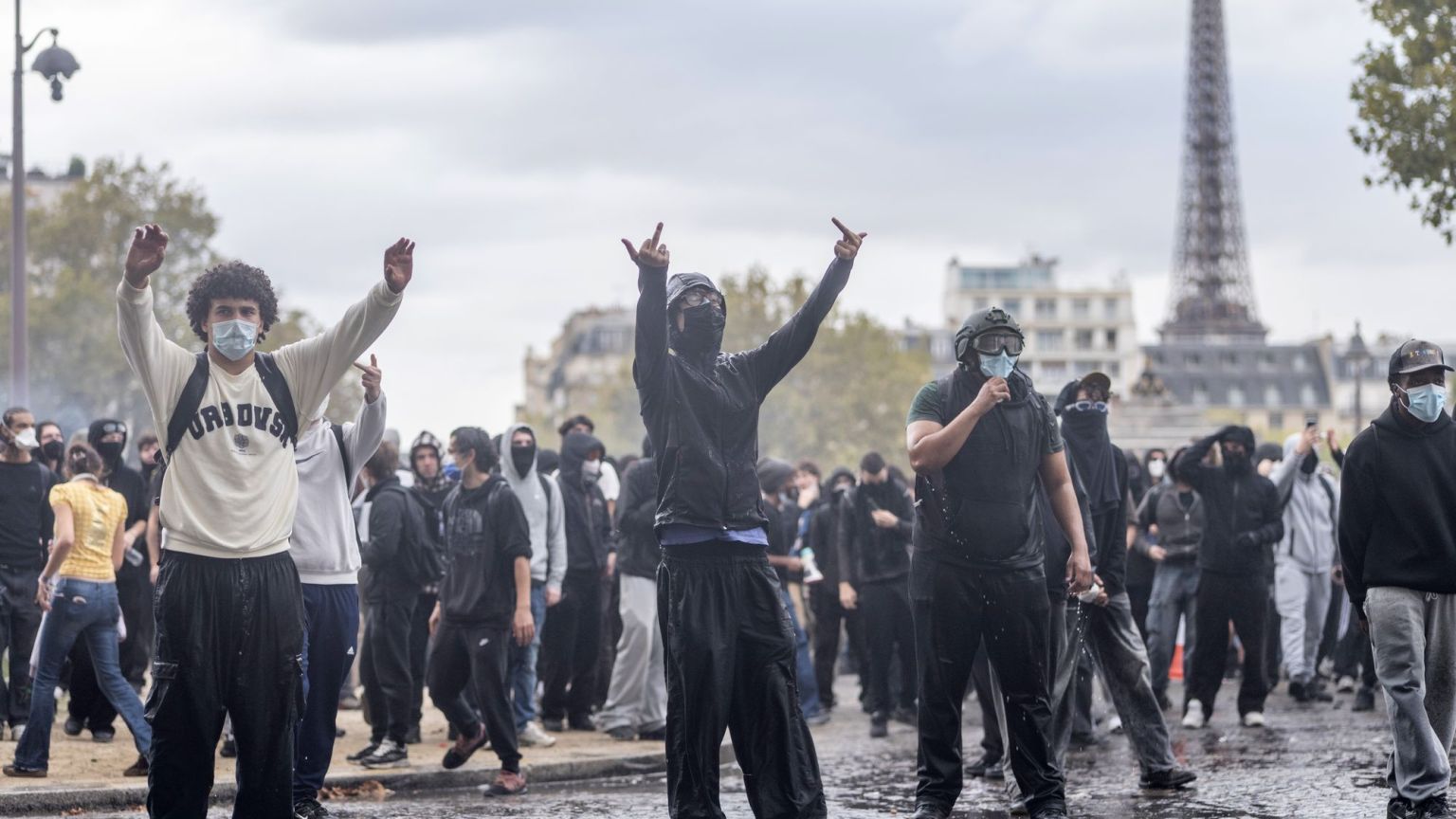
It is wrong to attribute the French protests involving teenagers solely to the ‘New France’ – that is, non-European migrants who hold French identity cards but, in many cases, reject the French way of life. This unrest is not simply a clash between immigrants and France, or between Islam and European civilisation, as Donald Trump has tried to portray it. It is worse than that. Around the barricades and blockades, immigrants and white French teenagers are rising up together – against reality, work and excellence. Two forms of decadence and entitlement are singing in unison.
Of course, no one can deny the obvious over-representation of black and Arab teenagers among the rioters. They parade Algerian and Moroccan flags, as well as Palestinian ones, as if they were engaged in a constant intifada against France – with the French state cast as a ‘foreign’ occupying force. Their struggle is a spasm in a prolonged malady that has been festering for more than 40 years.
The turmoil offers a striking glimpse of France’s changing face: less white and less Christian. Several of the spokespeople in the school-protest movement seem to have origins on the southern shores of the Mediterranean, such as Ryad Rani, Sabrine Kharbach and Lydia Hamadene. Many of these young people attending demos, rather than rioting, are quiet and peaceful – some are brilliant. No doubt some will end up holding prominent positions in the centre-left Socialist Party or in La France Insoumise (LFI) on the far left. The spokespeople are in their late teens and early twenties. They seem ambitious and herald the upcoming renewal of the French elites. Not all sons of migrants are socialists or leftists, but many are certainly ambitious and strive to secure a good spot under the sun. What if one of them becomes the next prime minister in 10 or 20 years?
Many white teenagers have also been interviewed in the media during the protests. Some have become nationally known, such as the young Elwan B, a Parisian from a well-off neighbourhood, who attends a relatively peaceful lycée. Highly articulate, he has made his solidarity with young people from the banlieues clear, has denounced what he calls ‘social segregation’, and has justified violence when it comes from ‘people who have nothing’.
By ‘people who have nothing’, he means the inhabitants of the banlieues, who actually receive substantial support from the French state in the form of free or heavily subsidised housing, welfare benefits and free school books. If Aubervilliers erupts in riots, what would happen in Bab el-Oued in Algiers or Pikine in Dakar? Both are urban outskirts where teenagers receive not a fraction of the support available to their French counterparts.
The overall impression you get from the protesters is one of complete disorientation. The young men wear keffiyehs, like so many white teenagers seen in the media these days. The Palestinian flags and keffiyehs are signs of a complete loss of identity. Who am I? What am I here for? Across vast swathes of white French youth, these two questions seem to have no answer.
Since childhood, they have been told that they are European, not French; that they are citizens of the world; that their ancestors were racists and rapists in the colonies; and that France is – and remains – a rich and prosperous country. This is why they feel empathy with migrant rioters who attack police officers and teachers. It is also why they demand more money. They are ignorant of France’s decline. They are passengers on a plane heading for a crash, yet they feel like first-class travellers entitled to every luxury.

The teenagers in the streets are the sons and grandsons of the generation of May 1968, which replaced duty with pleasure and honour with comfort as the highest callings in life. They act as if life were a party and France were a massive nightclub. So they want to play, sing and dance, whatever tomorrow brings. Some demand free and unrestricted access to whichever university they please, without any selection process. One of the main student organisations, L’Union Étudiante, is calling for the admission of 250,000 extra students to university next year, as if obtaining a degree were a human right and passing exams an offence against human rights. Some give the impression that they feel entitled to a life without effort or hard work – as if everyone had the right to become a footballer at Manchester United, earning thousands of euros a day simply to have fun. Several pupils have said on camera that they are outraged at having to go to school on Saturday mornings or attend classes from 10am to 6pm on weekdays.
These teenagers are delusional. To some extent, they have a right to be: adolescence is a time for illusions. But what about the adults?
Many teachers have joined the movement or given it their moral support. Some lawyers have done so too, advising protesters on how to avoid answering police questions if they are arrested. According to an Elabe poll, 85 per cent of left-wing voters support the movement, as do 73 per cent of young people. Not all of them are black or Arab. The vast majority of the French population is still white and comes from a Christian background.
Part of the country refuses to face reality. France is bankrupt. The deficit is over five per cent of GDP and public debt exceeds €3.5 trillion. France already spends a great deal on education: around €15,000 per secondary-school pupil, well above the OECD average. The education budget has increased by €12 billion under President Macron. Yet educational performance is falling. The latest PISA results have sounded alarm bells over mathematics and reading, with sharp declines in French pupils’ scores.
The very adults who support the student protests are often the same people who eagerly voted for the political leaders who have brought the nation to ruin: Mitterrand, Chirac, Sarkozy, Hollande and Macron. All made disastrous decisions that led to the shutting down of France’s engines of prosperity: meritocracy, excellence and hard work.

France – or at least a part of it – is revolting against reality. Many schools need renovation, not necessarily because the education ministry lacks funding, but because its bureaucrats are incompetent. Wherever the toilets are out of order, there is a bureaucrat hiding behind the camouflage of ‘It’s not my fault’, backed by a pile of regulations whose message is simple: ‘Shut up and comply.’
Many pupils swelter in the summer because environmentalists have imposed fatwas against air conditioning. Many teachers are reluctant to work in the banlieues because parts of them have become no-go zones. And if something happens to them, they are convinced that their superiors will not stand by them.
Nobody helped Samuel Paty when he sent out an SOS a few days before he was murdered by a Chechen extremist near his workplace. The prevailing attitude among school management is pas de vagues – literally, ‘no waves’, or, more idiomatically, ‘don’t rock the boat’. The aim is to keep quiet and preserve the illusion of calm, while a tsunami of fear and hatred engulfs the education system.
Headteachers are afraid. They fear violence from pupils and parents, but also the consequences for their careers should they stand up to this. Many dream of a comfortable retirement at 60 and do not want to jeopardise it by speaking the truth all the way up the chain of command. The issue is not money.
L’Éducation nationale, once the backbone of the French Republic, is dying from within, not because it lacks the means, but because it lacks courage. Or, more precisely, because it has lost its faith. The republic no longer believes in itself. It asks for money like a drug addict asking for another fix of cocaine. Nobody believes in a resolution any more – they just want a little more time before the end.
In short, the mass student protests are the joint product of two sick societies: New France – or, to be fair, its most toxic elements – and a decadent Old France. One has its roots in North Africa and sub-Saharan Africa; the other in May 1968. One often belongs to the lumpenproletariat; the other is frequently bourgeois. Both have played a part in raising the new generation of students.
These are the white teenagers who say wallah and swear on the Koran. And these are the black and Arab teenagers who say the French state can solve all their problems. Each sick society has passed its own bad inheritance on to the other. And nobody saw that coming.
Driss Ghali is a Franco-Moroccan political commentator and the author of A Counter-History of French Colonisation.
You’ve hit your monthly free article limit.
Support spiked and get unlimited access.
Support spiked and get unlimited access
spiked is funded by readers like you. Only 0.1% of regular readers currently support us. If just 1% did, we could grow our team and step up the fight for free speech and democracy.
Become a spiked supporter and enjoy unlimited, ad-free access, bonus content and exclusive events – while helping to keep independent journalism alive.
Monthly support makes the biggest difference. Thank you.


Comments
Want to join the conversation?
Only spiked supporters and patrons, who donate regularly to us, can comment on our articles.