The luminous genius of David Hockney
His work, like his life, was a celebration of the most profound freedom.
Want unlimited, ad-free access? Become a spiked supporter.
David Hockney, who died on Thursday aged 88, changed my life. Until 2012, I maintained the prejudice of a slightly pompous teenager: modern art is rubbish, I thought. But that year, my grandfather took me to see the exhibition, David Hockney: A Bigger Picture, at the Royal Academy of Arts.
In theory, it was an exhibition the teenage me should have despised. It featured a modern artist, immersive video installations, ostensibly gimmicky digital art. Much of the art on display was cast in very unrealistic colours, and had little obvious connection to the classical tradition I adored.
But something incredible happened. The enormous, vivacious installations connected with something, as it were, inside me. This was an artist, I suddenly realised, who loved to be free.
It was this love of freedom that so clearly animated Hockney’s life and art. It sometimes seemed as if this freedom fused both Hockney the man and Hockney the artist into one superhuman entity. It became impossible to separate his life from his art, just as it was with the Renaissance masters. An account of Hockney would almost be at home in Giorgio Vasari’s 16th-century masterwork, Lives of the Most Excellent Painters, Sculptors and Architects.
Born in Bradford in 1937, before studying at the Royal College of Art in London in the 1950s, the young Hockney was very clearly a man of the 1960s counterculture. A rebel in art school, international in outlook and openly gay at a time when it was still illegal. He worked across media, eager to experiment with whatever seemed new. Yet he was never seduced by technology for its own sake – he famously complained of the fundamental limitations of film compared with painting. Certain concerns would become lifelong obsessions, especially landscape and the luminous use of colour.
Yet while much of the post-1960s artworld very quickly embraced kitsch, parody and irony, Hockney didn’t. He retained his grounding in the real world and never sought to disdain or deconstruct it. His art was modern but not postmodern.
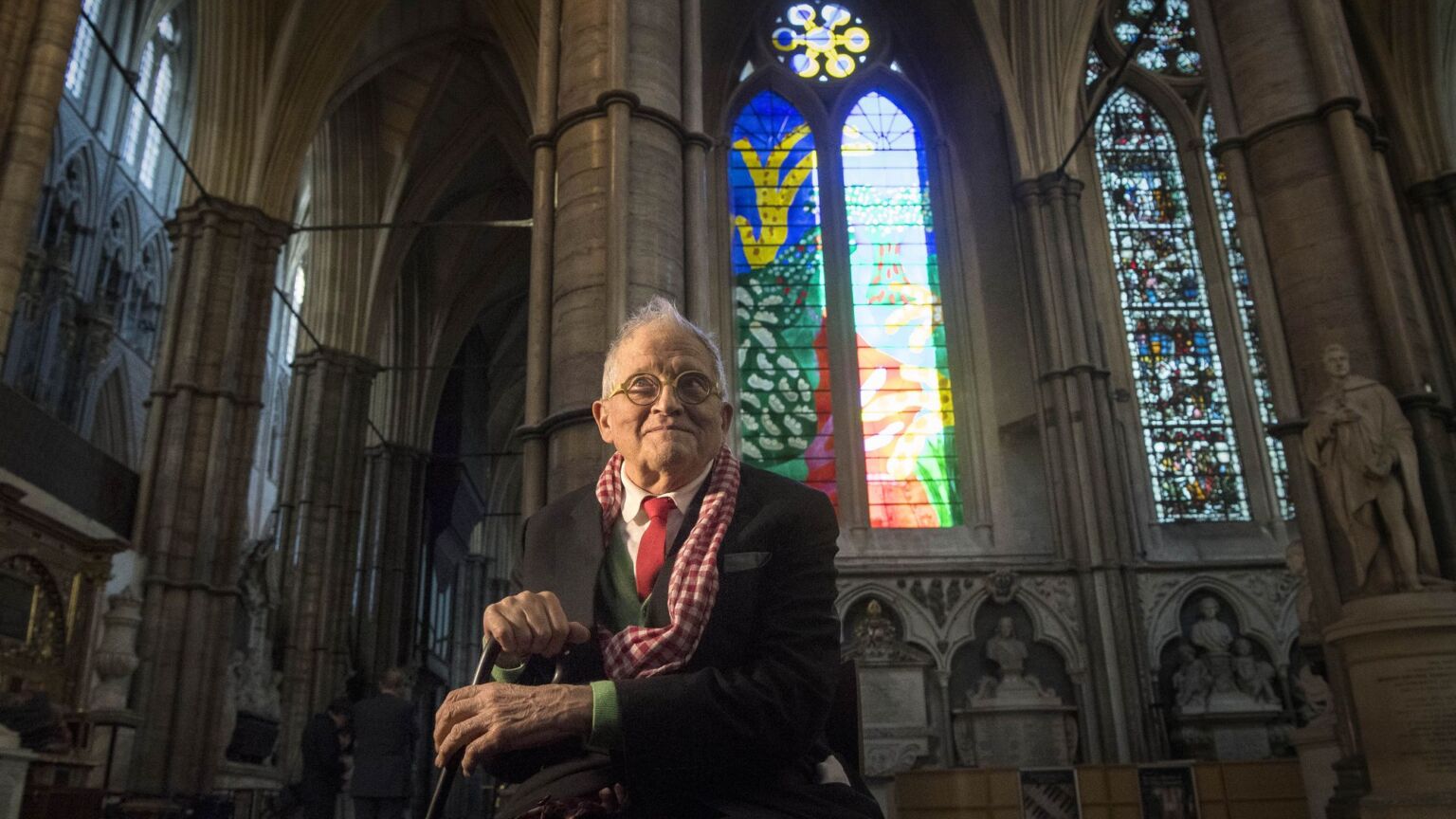
Perhaps also for this reason, Hockney was able to gain the always dangerous designation of ‘national treasure’. He guest-edited the BBC Radio 4’s Today programme in 2009 and was invited to design a stained glass window in Westminster Abbey in 2016, to commemorate the reign of Queen Elizabeth II.
But his status as national treasure was not, as it often is, a celebration of dull and unchallenging British twee. It reflected the fact that he always remained a man from Bradford and that his art was genuinely popular among the British public.
Perhaps what saved him above all from becoming twee was his increasingly combative relationship with Britain’s nanny state. As the nation’s most famous smoker, he was fond of public interventions calling out the increasingly hostile environment the government was constructing around life’s simple pleasures. All his criticisms boiled down to a simple and compelling formula: he loved smoking because he loved life, and loving life meant not pretending you could cheat death.
Eventually, this displeasure with the stifling atmosphere of the nanny state, alongside his increasing fascination with the Normandy countryside, led him to leave Britain in the late 2010s. This should have been a source of national shame – our greatest living artist forced to live abroad.
In Normandy, Hockney began to paint what are, to my mind, the best works of his life. Here, Hockney, through his mastery of colour, elevated his work to what felt like a higher plane.
Hockney made two vitally important contributions to art and society during this late period. The first was the mastery of the iPad as an artistic device. No artist has, to my knowledge, managed to make such a contribution to art in a purely digital medium. It was as if his irresistible creativity simply overflowed the limitations of the computer, shoved aside the lifelessness of the digital and breathed the warm human spark into the cold machine. The speed at which he was able to create allowed him to track the seasons almost minute-by-minute, as if he suddenly had a device capable of keeping up with the ceaseless change of the life of nature.
The second was more subtle. At the height of the Covid lockdowns, Hockney began painting springtime. His thoughts and some works of this period were published in the book Spring Cannot Be Cancelled. It was hard not to see the title as a masterful middle finger to lockdown hysteria. But it was also a demonstration of an almost spiritual faith: that life cannot be simply put on hold, that spring is the inevitable, but always shocking, rebirth of the world. At this peculiarly dark time, Hockney reminded us of the inexhaustible roots of freedom and the irrepressible beauty of the world.
For all Hockney’s outstanding genius, I was always struck by how he managed to remain almost unremarkably, avuncularly British. In a letter to the Guardian, he once complained that the voices of ordinary smokers never seemed to feature in the debate about tobacco. He wished they would interview ‘someone who knows we are all a bit different and who is fed up by the growing regimentation of people’. This was, both as a turn of phrase and in spirit, the complaint not of an iconoclast but of the average Brit.
As my grandfather used to say, in a very British sort of way, it takes all sorts to make a world. Our world is poorer now that Hockney’s sort is no longer with us.
Jacob Reynolds is convening The Academy 2026: Hollow Leviathan: The State Against the Demos, which asks why the state became so disconnected from ordinary people, so incompetent, but at the same time so dangerously authoritarian. Find out more and book your tickets here.
spiked summit 2026 – SOLD OUT
Saturday 27 June 2026
10am-6pm, Saturday 27 June
Emmanuel Centre, London, SW1P 3DW
With Lionel Shriver, Brendan O’Neill, Katharine Birbalsingh, Toby Young, Allison Pearson, Paul Embery, Tom Slater, Andrew Doyle, Fiyaz Mughal and more
The spiked summit has now SOLD OUT. To join the waitlist, email:
[email protected]
£80 or £50 for supporters
You’ve hit your monthly free article limit.
Support spiked and get unlimited access.
Support spiked and get unlimited access
spiked is funded by readers like you. Only 0.1% of regular readers currently support us. If just 1% did, we could grow our team and step up the fight for free speech and democracy.
Become a spiked supporter and enjoy unlimited, ad-free access, bonus content and exclusive events – while helping to keep independent journalism alive.
Monthly support makes the biggest difference. Thank you.
Comments
Want to join the conversation?
Only spiked supporters and patrons, who donate regularly to us, can comment on our articles.