‘Manchesterism’ is a mirage
Andy Burnham's political brand is built on hype, misdirection and stolen valour.

Want unlimited, ad-free access? Become a spiked supporter.
‘There’s no such thing as Starmerism and there never will be’, declared Keir Starmer in 2020, shortly after assuming the leadership of the Labour Party. ‘I have no ideology at all.’
With that statement, Starmer had tried to paint himself as a pragmatic, commonsensical leader. ‘Unburdened by doctrine’ is how he would convey the same message on the day he entered Downing Street in July 2024. Yet less than two years later, his lack of convictions and principles has proven to be his downfall. His time in government has been defined by indecision, drift and u-turns. Just about everyone now agrees, there is no substance beneath the spin, no programme to improve the country and no strategy to keep his party afloat.
Enter Andy Burnham, the mayor of Greater Manchester and Labour’s prince over the water. Burnham, like Starmer, also stands accused of being a serial flip-flopper. Over the years, he has presented himself as a Blairite, a Brownite, a Corbynite and a Starmerite, appealing to whichever tendency in Labour that seems in the ascendancy. Now, in the run-up to June’s Makerfield by-election, Burnham has performed at least six u-turns in just the past few days alone: on Brexit, on women’s spaces, on the government’s fiscal rules, and more – shedding policies that might go down poorly in this Leave-voting, Reform-curious constituency.
Nevertheless, Burnham insists that he does indeed have a guiding political philosophy that he has developed in his nine years as Greater Manchester mayor that he plans to bring to Downing Street. ‘Manchesterism’ has been defined by Burnham as ‘business-friendly socialism’. In his campaign for the Makerfield seat, he has declared that Manchesterism means ‘the end of neoliberalism’ and that Britain has been on the ‘wrong path’ for 40 years. In other words, Burnham is selling Manchesterism as nothing short of transformational, as a near-total overturning of the economic status quo. Yet there is nothing in Burnham’s tenure as Greater Manchester mayor to make such lofty claims stack up.
Burnham is fond of repeating that Greater Manchester has grown at a rate more than twice the national average, making it the fastest-growing region in the UK. The transformation is visible in the new tower blocks filling the city’s skyline, the thriving hospitality industry and its rapidly expanding population. In 1990, as few as 500 people lived in Manchester’s city centre, compared with an estimated 100,000 now, with some property developers expecting this to reach 250,000 by 2035.
Yet the seeds of this change long predate Burnham’s arrival in office in 2017. Indeed, most credit Manchester’s construction boom to Sir Richard Leese, Labour leader of the city council from 1996 to 2021, then Burnham’s deputy mayor until 2021, and the late Sir Howard Bernstein, former chief executive of the city council from 1998 to 2017. The pair successfully courted foreign investment, lobbied for more money and powers from Westminster, and took an unashamedly pro-growth approach to private development. They also expanded public transport and cleaned up the city’s image.
Some critics have argued that Manchester’s growth is largely illusory, buttressed by questionable statistics and the right ‘vibes’. Paul Swinney, economist at the Data City, has asked why Greater Manchester’s supposed productivity boom hasn’t translated into rising wages, as would usually be expected. Mancunians’ disposable income rose by just 0.2 per cent per year between 2013 and 2023, far less than comparable cities. In the same period, Manchester was beaten in jobs growth not only by London, but also by far less celebrated urban centres, including Luton, Basildon and Warrington. As Alistair Heath notes in the Telegraph, Liverpool – a city whose mayor was recently charged on suspicion of bribery and misconduct – has enjoyed similar job-growth rates to the much-hailed Manchester.
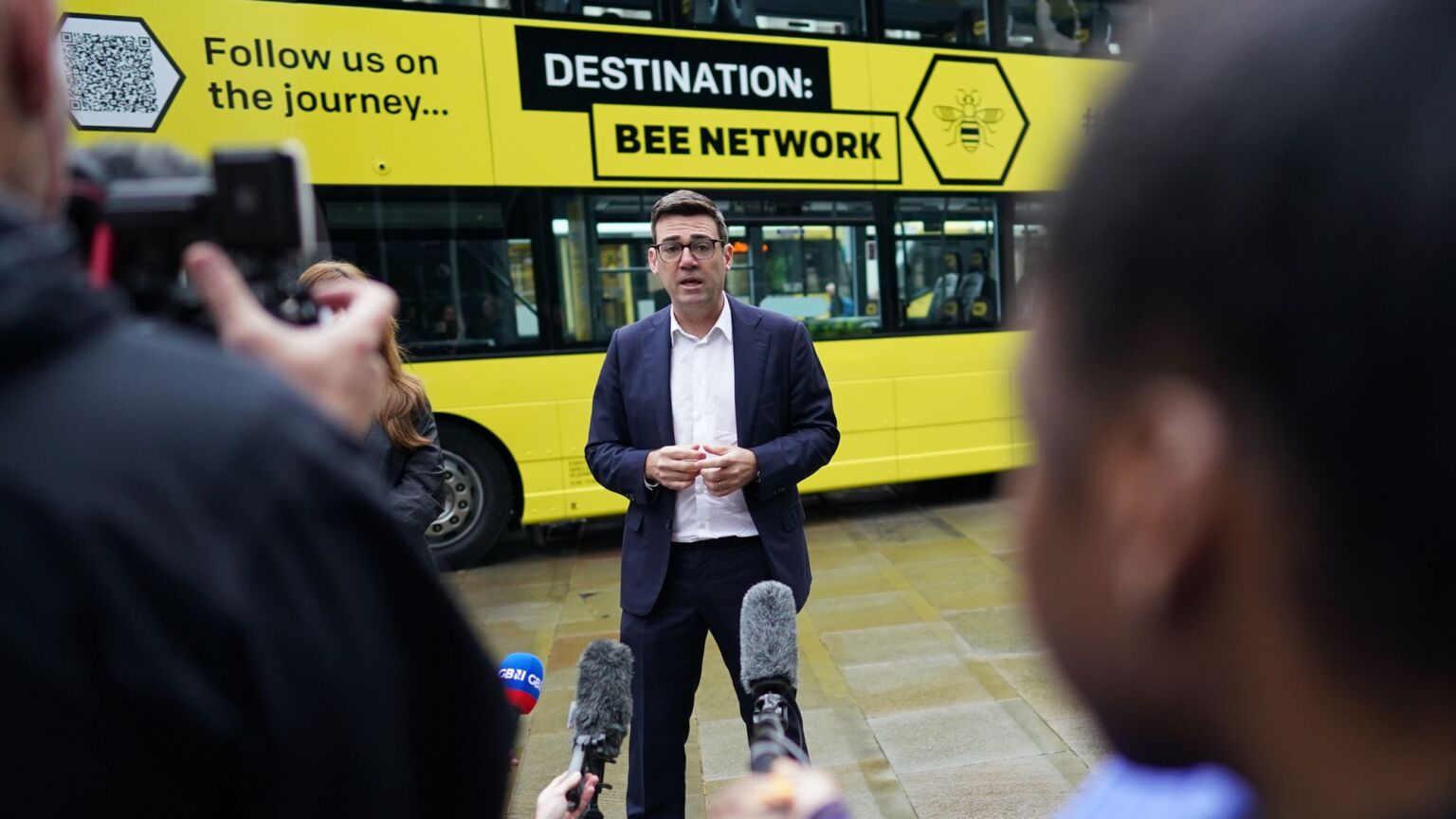
So if Manchester isn’t the economic powerhouse its boosters claim it is, is it a ‘socialist’ city as Burnham likes to paint it? Again, the rhetoric fails to do justice to reality. Burnham’s favoured example of Greater Manchester’s municipal socialism is the Bee network of buses, which brought the region’s hodgepodge of bus services under one umbrella, with the mayor setting fares, routes, timetables and more. Here, the mayor is careful to speak of the buses being under ‘public control’ and not ‘public ownership’. Burnham may claim that his Manchester likes to ‘do things differently’ to down south, yet his buses are franchised out to private companies, just as they are in London. Whatever the merits of the integrated transport system, it is surely a stretch to describe this as anything approaching ‘socialism’. It is hard to imagine any self-respecting socialist manning the barricades for a northern equivalent of Transport for London.

What’s more, like most of the projects that are said to define Manchesterism, bus reform predates Burnham’s arrival. Indeed, it was a key plank of the devolution deal struck by Leese and Bernstein with then Conservative chancellor George Osborne in 2015.
As for Manchester’s development agenda, this has succeeded largely by ignoring the demands of the left, especially when it comes to providing affordable housing. As Leese explained in 2021: ‘If we’d done what our critics wanted us to do, it wouldn’t have delivered affordable housing, it would have delivered no housing at all, zero. If we’d tried to impose 20 per cent affordability on it, it wouldn’t have happened. We wouldn’t have got 20 per cent affordable housing, we would have got nothing.’ Would Burnham bring such a ruthless and clear-eyed pro-development approach to Westminster? I wouldn’t hold my breath.
The great irony here is that the Labour Party is going through great convulsions to replace its ideas-lite, ideology-free prime minister with a man who is just as lacking in convictions and principles. Whatever Andy Burnham says, ‘Manchesterism’ is more of a brand than an ideology. It offers no coherent programme for government and certainly poses no challenge to conventional economic thinking. Burnham’s nine years as mayor show that Labour’s emperor of the north has no clothes, but will party members notice before it is too late?
Fraser Myers is deputy editor at spiked and host of the spiked podcast. Follow him on X: @FraserMyers
spiked summit 2026 – SOLD OUT
Saturday 27 June 2026
10am-6pm, Saturday 27 June
Emmanuel Centre, London, SW1P 3DW
With Lionel Shriver, Brendan O’Neill, Katharine Birbalsingh, Toby Young, Allison Pearson, Paul Embery, Tom Slater, Andrew Doyle, Fiyaz Mughal and more
The spiked summit has now SOLD OUT. To join the waitlist, email:
[email protected]
£80 or £50 for supporters
You’ve hit your monthly free article limit.
Support spiked and get unlimited access.
Support spiked and get unlimited access
spiked is funded by readers like you. Only 0.1% of regular readers currently support us. If just 1% did, we could grow our team and step up the fight for free speech and democracy.
Become a spiked supporter and enjoy unlimited, ad-free access, bonus content and exclusive events – while helping to keep independent journalism alive.
Monthly support makes the biggest difference. Thank you.


Comments
Want to join the conversation?
Only spiked supporters and patrons, who donate regularly to us, can comment on our articles.