Why Friedrich Merz has been such a flop
Merkel’s rival has failed spectacularly to reverse her disastrous legacy.
Want unlimited, ad-free access? Become a spiked supporter.
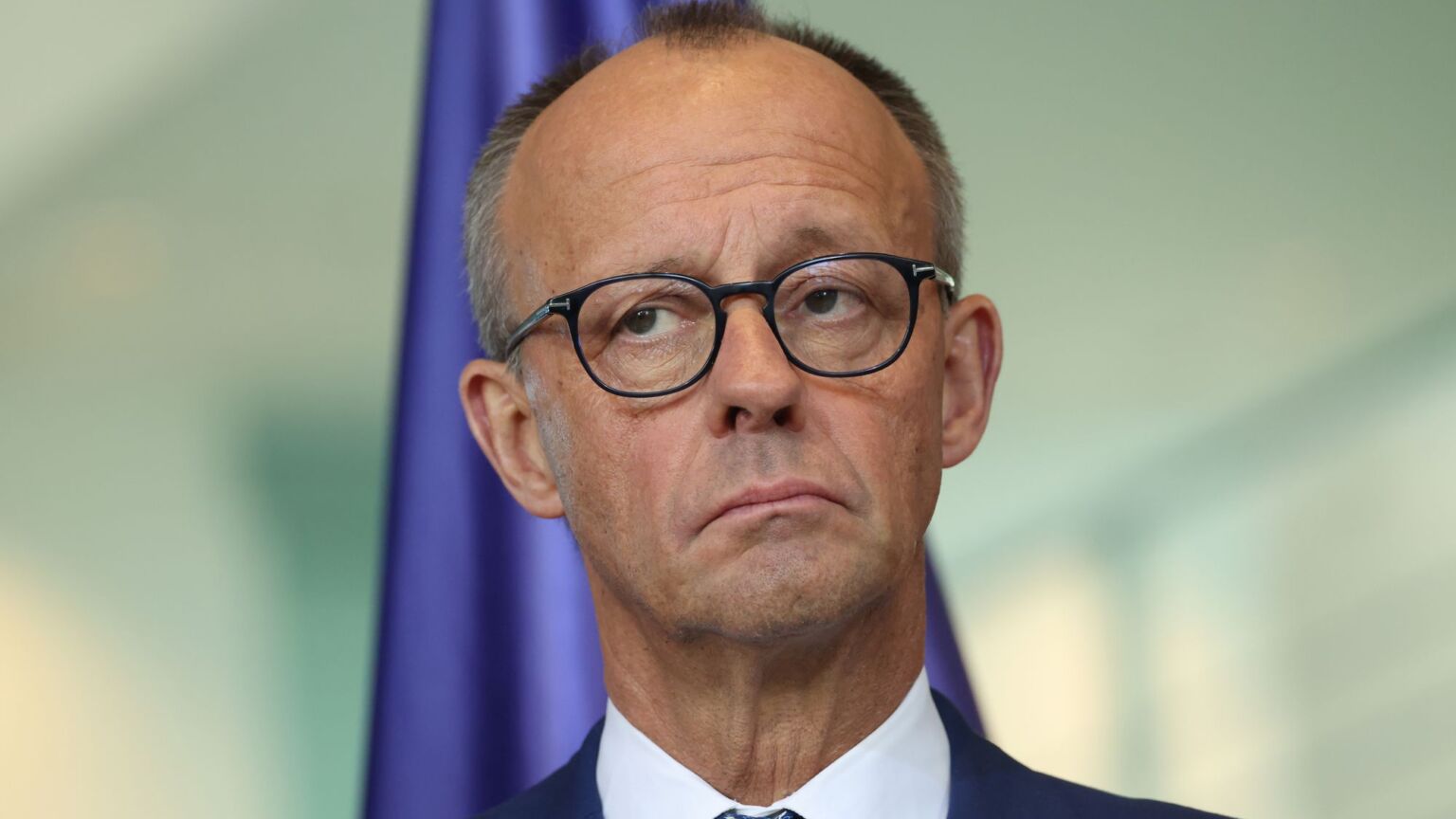
Germany’s chancellor, Friedrich Merz, is already a record holder: after just one year in office, he has become the most unpopular chancellor in postwar German history. Only 16 per cent of Germans say they are satisfied with the man who entered office in May 2025 promising renewal and reform. This is underscored by another finding: the right-populist Alternative for Germany (AfD) now leads the polls by six points, while a quarter of Germans say they would support an AfD chancellor. So where did it all go wrong?
In some ways, Merz’s chancellorship was doomed from the start. His result in the 2025 election was weak by historical standards: his Christian Democratic Union (CDU) party won less than 29 per cent of the vote. Unable to secure a majority, he entered into a coalition with the Social Democrats (SPD) – the very party voters had just tried to vote out of office, whose support had fallen to only 16 per cent.
Rather than symbolising a new beginning, the coalition was a continuation of the same exhausted political formula Germans had endured for two decades. It was an alliance of the old establishment parties, whose authority and voter trust have steadily eroded.
Even before taking office, scepticism toward Merz ran so deep that he required two rounds of parliamentary voting to secure the chancellorship. His failure in the first round suggested that even sections of his own party refused to back him wholeheartedly.
The deeper reason for Merz’s rapid decline, however, is that many conservatives had projected abilities on to him that he never possessed. The Friedrich Merz Germans voted for was invented by commentators and political pundits – an outsider, a disruptive conservative willing to shake up Germany’s stagnant political system. It was wishful thinking.
The conservative wing of the CDU, long frustrated by the liberal faction that had dominated under former chancellor Angela Merkel, convinced itself that Merz would reverse Germany’s decline. He would, they hoped, break the sclerosis of the Merkel twilight years, characterised by weak growth, suffocating bureaucracy, political timidity, and economic stagnation.
Ironically, the German left helped build this illusion as well – albeit in opposition. Because Merz was not Merkel, whose policies leftists had largely welcomed, from open borders to the nuclear phaseout and the weakening of the armed forces, they cast him as a hidden populist, even a covert ally of the AfD.

The hysteria surrounding Merz reached its peak during the loud anti-far-right demonstrations of January 2025, only weeks before the elections. The protests erupted after Merz proposed a largely symbolic tightening of migration policy that also received AfD support. One progressive NGO involved in organising the demonstrations later praised the 1.5million Germans who had supposedly ‘stood up to Merz and the AfD’.
One year later, this panic looks even more absurd than it did at the time. Those protesting against Merz were, at best, tilting at windmills. Merz is as hostile to populism as his critics are. Far from representing a concession to populist voters, he was the CDU establishment’s final attempt to stop the rise of the AfD.
As early as 2018, during his first campaign for the CDU leadership, Merz famously declared that he would halve the AfD’s support. That promise shaped his entire 2025 election campaign. Merz attempted a balancing act: using occasional hard rhetoric on migration to attract AfD voters, while simultaneously reassuring liberals and moderates that there would be no cooperation whatsoever with the right-populist party.
The strategy failed spectacularly. The AfD nearly doubled its vote share to 20.8 per cent in last year’s elections, and has been closing in on the CDU ever since (even overtaking it, as the polls suggest).

For the CDU, the real problem is not merely that Merz failed in his central political mission. It is that he has been exposed as a weak technocrat: a politician unable to connect with voters, driven by managerial instincts rather than conviction, and increasingly known for saying one thing before doing another.
It did not take long for his pattern of broken promises to emerge. Almost immediately after the election, Merz executed a spectacular u-turn on government debt. Having campaigned as a defender of Germany’s constitutional debt brake, which places strict limits on government borrowing, his first major act was to approve a massive debt package worth hundreds of billions – pushed through with the outgoing parliament before the newly elected Bundestag, strengthened by AfD gains, could convene.
On energy, Merz abandoned plans to reconsider Germany’s ban on nuclear power and scrapped a planned reduction in electricity taxes. On foreign policy, Merz pledged to stand with Israel, but then halted arms deliveries to the Jewish State in the summer 2025. At the time, Hamas continued to hold hostages, including German citizens. Similarly, Merz’s promised ‘Autumn of Reforms’, aimed at cutting Germany’s bloated social-security system, have yet to materialise.
Some broken promises can, of course, be blamed on the coalition with the SPD – a party battling for its own survival and deeply resistant to welfare reform. At best, the coalition leaves room only for lowest-common-denominator compromises. Complaining about coalition constraints has become the default excuse of the current government, with each side blaming the other for its weakness. But for voters who demanded genuine change, these excuses ring hollow. Indeed, they only make sense as long as Germany’s political establishment upholds its self-imposed ‘firewall’ against the AfD. This not only rules out formal coalitions with the AfD, but also prevents cooperation on an issue-by-issue basis.
Merz has not, as many commentators claim, squandered the trust of the German people. The harsher truth is that he never truly possessed it. Much of his image as a reformer rested on a single fact: his long-running rivalry with Angela Merkel. In 2002, he famously lost the battle for CDU parliamentary leadership to Merkel, and later withdrew from politics during her chancellorship. But his opposition to Merkel was never rooted in deep ideological conviction. It was driven largely by personal ambition.
Now that he has finally reached the summit of German politics, he appears unwilling to risk losing power again. That, too, explains his insistence that the current CDU-SPD coalition is unavoidable. Unable to defeat the AfD politically, he now seems focussed primarily on preserving the existing system – and his place within it.
Asked recently what conclusions he drew from his disastrous poll numbers, Merz responded defensively: ‘Please, let no one dream of a snap election. What on earth would come of it?’ For Merz and his government, resistance to populism has become their sole remaining raison d’être.
But democratic discontent cannot be postponed or ignored. The government is expected to suffer heavy losses in the upcoming regional elections in September. German voters have grown tired and frustrated with Friedrich Merz. Soon they will have a chance to express this.
Sabine Beppler-Spahl is spiked’s Germany correspondent.
spiked summit 2026 – SOLD OUT
Saturday 27 June 2026
10am-6pm, Saturday 27 June
Emmanuel Centre, London, SW1P 3DW
With Lionel Shriver, Brendan O’Neill, Katharine Birbalsingh, Toby Young, Allison Pearson, Paul Embery, Tom Slater, Andrew Doyle, Fiyaz Mughal and more
The spiked summit has now SOLD OUT. To join the waitlist, email:
[email protected]
£80 or £50 for supporters
You’ve hit your monthly free article limit.
Support spiked and get unlimited access.
Support spiked and get unlimited access
spiked is funded by readers like you. Only 0.1% of regular readers currently support us. If just 1% did, we could grow our team and step up the fight for free speech and democracy.
Become a spiked supporter and enjoy unlimited, ad-free access, bonus content and exclusive events – while helping to keep independent journalism alive.
Monthly support makes the biggest difference. Thank you.




Comments
Want to join the conversation?
Only spiked supporters and patrons, who donate regularly to us, can comment on our articles.