Why Australians are booing the ‘Welcome to Country’ ritual
Aussies are sick of being told they are second-class citizens who don’t belong in their own country.
Want unlimited, ad-free access? Become a spiked supporter.
As I flew back to Australia last week, a Qantas cabin announcement informed us that we’d arrived in Gadigal Country. Which was odd, since the sign at the gate in Singapore stated clearly that flight QF2 was bound for Sydney.
Replacing the names of Australian cities with their pre-colonial appellations has become an irritating feature of Australian daily life. So too has the pious ritual of ‘Welcome to Country’, which is now performed at everything from sporting events to writers’ festivals, and even Zoom meetings. It flourishes in the most absurd places. It has even been incorporated into the sacred liturgy in social-justice-attuned Anglican congregations.
Australians have become heartily sick of being welcomed to their own country, the land where most of them were born, where many raised children and where countless ancestors are buried. For years, they endured this performative handwringing with forbearance. On 25 April, however, the simmering resentment exploded in the dim early morning light at the Shrine of Remembrance in Naarm, a city once known as Melbourne.
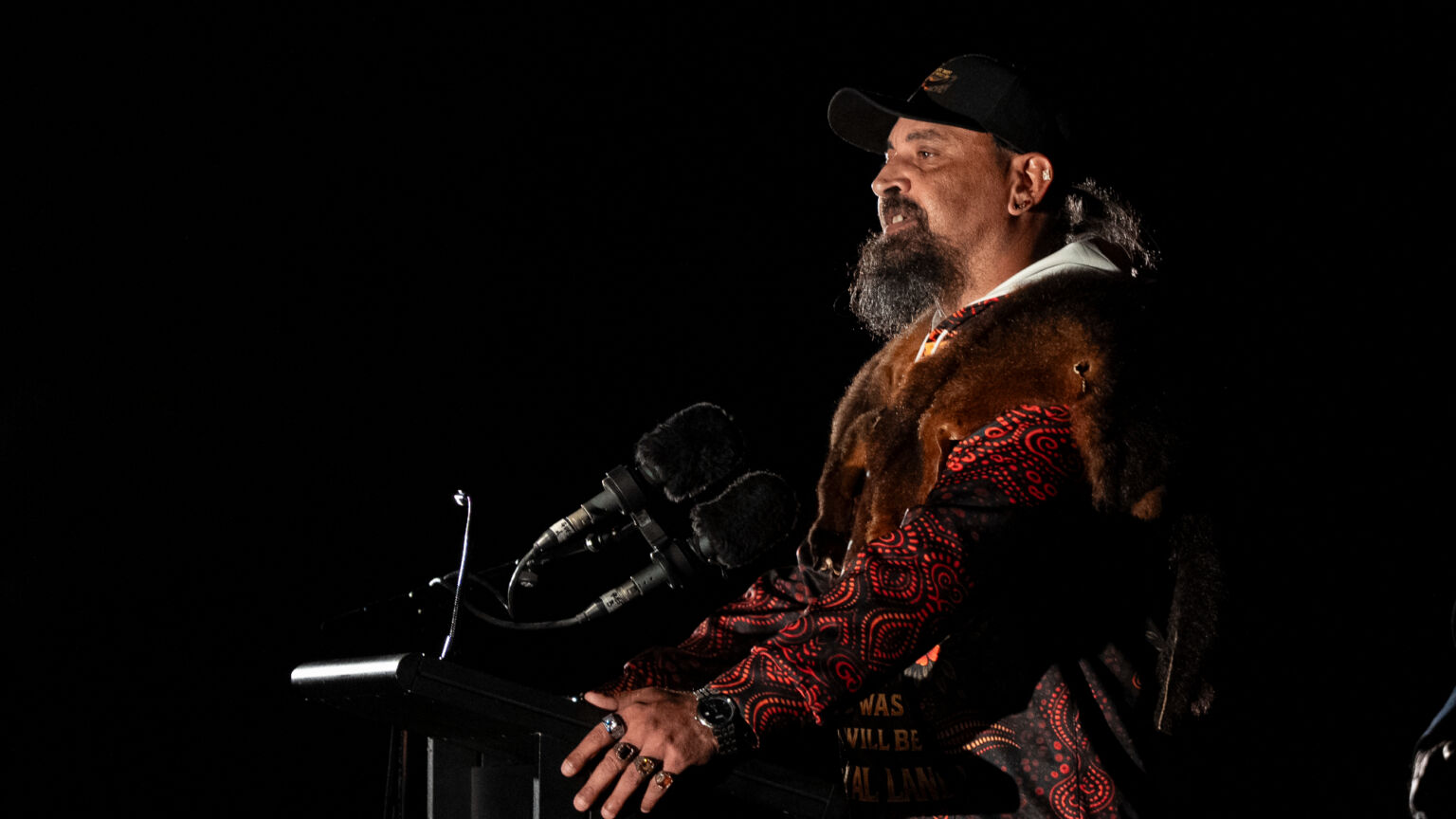
At the annual dawn Anzac Day service, a commemoration of Australian war veterans, a Welcome to Country speech was drowned out by loud and persistent boos. ‘I’m here to welcome everybody to my father’s country’, self-styled Aboriginal elder Uncle Mark Brown began, against a rising chorus of jeers. The crowd was then encouraged to ‘pay respect’ to all of Brown’s ancestors, ‘past, present and emerging’. The ‘Welcome to Country’ ceremonies at Anzac Day services in Sydney and Perth were also met with loud booing.
Brown, or ‘Moonblood’ as he styles himself, has no record of military service. Unlike many at Anzac ceremonies, he has never been obliged to put his life on the line in defence of his country. Yet he nonetheless used this solemn occasion to demand ‘respect’. This seemed all the more inappropriate given that he almost certainly profited from his appearance.
If Brown’s website is anything to go by, his status as an ‘elder’ is a lucrative one. He charges AUD $770 (£408) for an average Welcome to Country ceremony. His fee rises to AUD $1,540 with the inclusion of a ‘smoking ceremony’, and reaches $2,310 for a ‘cultural walk and talk’. Substantial numbers of Aboriginal people in Australia live in genuine and shameful poverty. Brown, we suspect, is not one of them. His enterprises include the sale of Aboriginal-themed Anzac Day merchandise, in contravention of laws that prevent the commercial exploitation of the Anzac brand.
Respect, in the minds of the Aboriginal activist class, is a one-way street. We are constantly reminded to respect Aboriginal sovereignty and to accept that it has ‘never been ceded’. We are told that Australia was founded on the genocide of Aboriginal people and urged to acknowledge that colonial structures remain in place today. Both claims are utter rubbish, yet they are force-fed to most Australian children daily.
Uniquely in the history of colonialism, the foundations of modern Australia and New Zealand lie in the classical liberal philosophy of the English and Scottish Enlightenments. Australia was founded as a land with freedom and equality before the law – the first attempts to prosecute European settlers for the murder of Aborigines began in 1799, 11 years after the colony’s foundation. The classical liberal principle that every human being is equally worthy of respect has formed the basis for a cohesive society.
Not anymore. In the brave new world of identity politics, it turns out that one racially defined cohort of citizens is more equal than others. The issue came to a head in October 2023, when Australians were asked to approve a constitutional amendment establishing an Aboriginal representative body in federal parliament, effectively a third chamber, to be known as the Voice. The referendum proposal was comprehensively defeated.
Many of those who voted ‘no’ were passing judgment not just on a narrow constitutional amendment, but on the acceptability of identity politics in any form. The decisive referendum verdict gave them confidence to express views that had previously been suppressed for fear of being declared apostate. A watershed had been crossed. Anti-establishment views could be openly expressed.
Anzac Day is a highly significant date for Australians. Initially a remembrance of the ill-fated role Australian and New Zealand soldiers played in the disastrous Dardanelles campaign of 1915, it is now a celebration of all wars involving Australian military personnel. The values of resilience, ‘mateship’ and egalitarianism are woven into the attempt Australian ‘diggers’ made to establish a foothold on an inhospitable Turkish peninsula. Like many national legends, it was a tale of bravery and patriotism.

Australia’s new elite – Aboriginal and non-Aboriginal alike – are poisoning this unifying tradition with identity politics. Effectively, they are saying that the country so many Australians fought and died for doesn’t really belong to them.
Unsurprisingly, Australians have had a gutful of their arrogance and ingratitude. They see the idea of Australia being steadily eroded. They are exasperated with the hypocrisy that condemns them as racist by a class for whom race has become a defining trait. Pushed to their limits, they have discovered the courage to call it out, as they did on 25 April.
Nick Cater is a columnist with the Australian. He publishes Reality Bites on Substack.
spiked summit 2026 – SOLD OUT
Saturday 27 June 2026
10am-6pm, Saturday 27 June
Emmanuel Centre, London, SW1P 3DW
With Lionel Shriver, Brendan O’Neill, Katharine Birbalsingh, Toby Young, Allison Pearson, Paul Embery, Tom Slater, Andrew Doyle, Fiyaz Mughal and more
The spiked summit has now SOLD OUT. To join the waitlist, email:
[email protected]
£80 or £50 for supporters
You’ve hit your monthly free article limit.
Support spiked and get unlimited access.
Support spiked and get unlimited access
spiked is funded by readers like you. Only 0.1% of regular readers currently support us. If just 1% did, we could grow our team and step up the fight for free speech and democracy.
Become a spiked supporter and enjoy unlimited, ad-free access, bonus content and exclusive events – while helping to keep independent journalism alive.
Monthly support makes the biggest difference. Thank you.



Comments
Want to join the conversation?
Only spiked supporters and patrons, who donate regularly to us, can comment on our articles.