Banksy’s art for the lanyard classes
His trite new sculpture has the moral complexity of a Catchphrase clue.
Want unlimited, ad-free access? Become a spiked supporter.
At times such as these, of extreme social disorientation and moral fragmentation, the public cries out for meaning, commonality, a light in the dark. Well bad luck, public, because what you get is another Banksy.
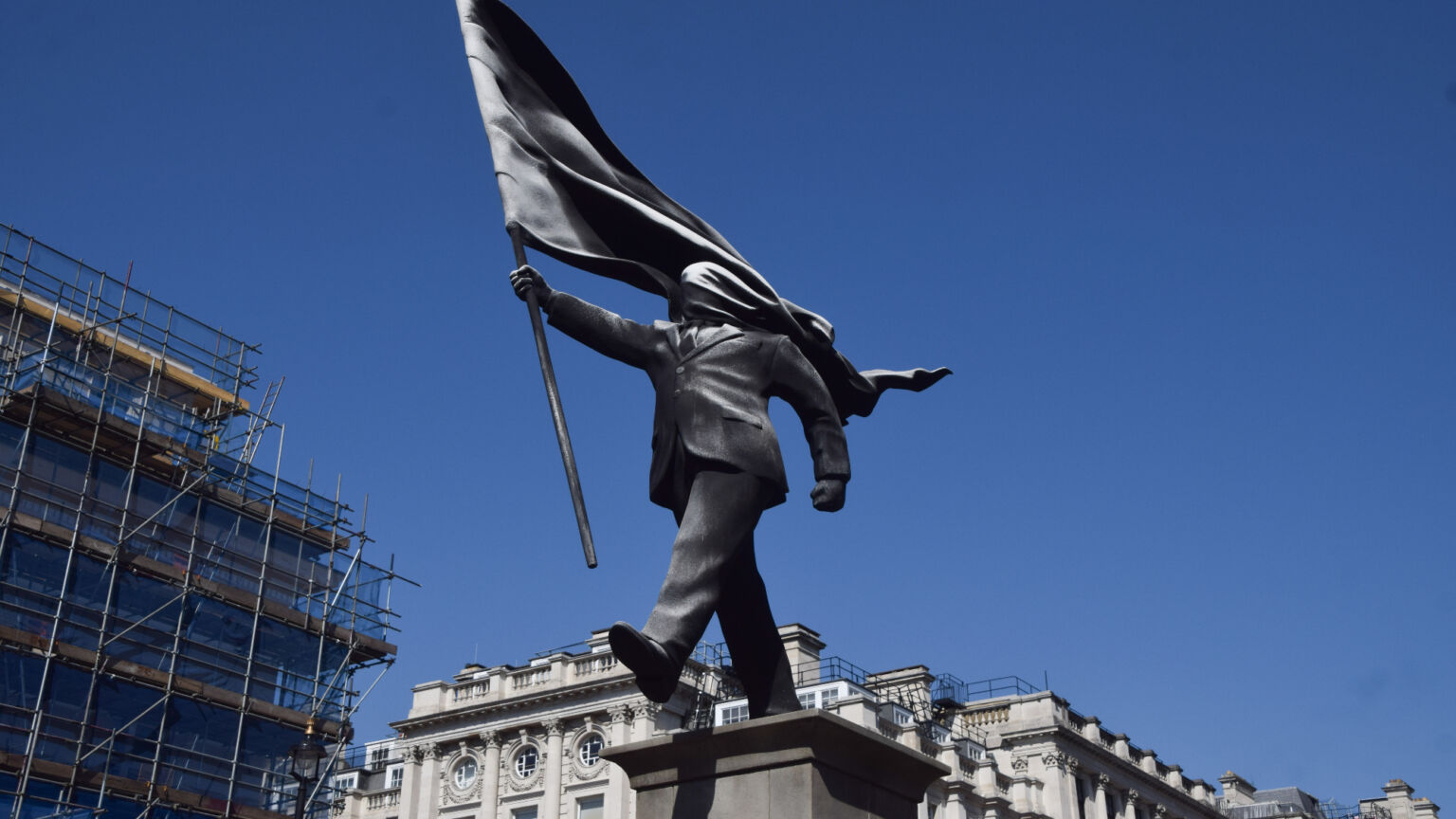
Banksy, the world’s best-known anonymous artist, has seen fit to gift the world another piece of art, in this case a sculpture. It depicts a suited man carrying an oversized flag, the flag obscuring the man’s vision as he is about to march, blinded, off the statue’s supporting plinth.
The statue appeared overnight on Wednesday in Waterloo Place in the St James’s district of Westminster – a street, as the BBC helpfully explains, ‘designed to celebrate imperialism and military dominance in the 1800s’.
What could it all mean? Well, if Banksy has a skill at all, it is in being sledgehammer-obvious.
Being obvious – making things people understand – is surprisingly difficult. But where being obvious takes real talent is in making difficult ideas accessible. Banksy does not do this. Banksy takes easy ideas and reveals, through heavy-handed metaphors, just how breathtakingly obvious they are.
The badness of Banksy’s art is not a bug but a feature. It is designed to go down nice and easy, to be as inclusive and non-threatening as humanly possible. Its trick is to unite people around a lowest-common-denominator premise while convincing them that they are razor-sharp semiologists who can deconstruct the floating chain of signs and signifiers. Banksy flatters mediocre thinkers that they are the in crowd, and smarter than the next guy.
As a sculptor, Banksy wears his artistic heritage lightly. Not for Banksy the subtle homoerotic contrapposto of a Michelangelo, nor the witty repurposing of objects à la Picasso, nor even the brute scale and tension of a Richard Serra. Rather, Banksy takes the aesthetics of mass-produced garden-centre ornaments and fills them with the moral complexity of a Catchphrase clue. Roy Walker’s gentle encouragement to nervous game-show contestants, ‘Say what you see!’, is also the best way of unlocking the meaning of a Banksy.
Let’s say what we see in Banksy’s latest. We are so blinded by nationalism that we risk putting ourselves in danger. Jackpot! An idea so facile it barely merits the resin it took to cast the statue.
Nevertheless, Banksy’s art fulfils an important social function, which is to reassure worried, like-minded people that they are not alone. In this case, people who feel that strong national sentiment is misguided and dangerous – and there are plenty of them – can take comfort that this is a legitimate feeling. Banksy’s gift to them is to remove any iota of thought that might cloud the issue, any possibility of uncomfortable doubt.
Banksy skillfully avoids any chance of misunderstanding through the location of the statue and the timing of its deployment. St James’s – establishment, militarism, yeah? – in the run-up to the local elections, because politics, yeah? There is on the nose, and there is Banksy.
And if you are worried that a hefty, spontaneous and unauthorised statue could be a form of vandalism, don’t be. There is certainly no risk of the authorities seeing it that way. Westminster City Council has already given the statue its unofficial blessing, with a spokesperson telling the BBC: ‘We’re excited to see Banksy’s latest sculpture in Westminster, making a striking addition to the city’s vibrant public art scene.’ Truly, as an act of subversion, the stakes could not be lower.
Banksy’s art is dissent for the lanyard classes. It is a way of turning their own contempt for the working classes, and working-class values such as patriotism, into something less obviously judgemental, ugly and upsetting to their own psychic health. Disdain becomes sophistication, and snobbery a self-contained culture. In an age of virtue-signalling, Banksy’s success lies in making both the virtue and the signal gobsmackingly explicit.

Alex Dale is a designer based in London.
You’ve hit your monthly free article limit.
Support spiked and get unlimited access.
Support spiked and get unlimited access
spiked is funded by readers like you. Only 0.1% of regular readers currently support us. If just 1% did, we could grow our team and step up the fight for free speech and democracy.
Become a spiked supporter and enjoy unlimited, ad-free access, bonus content and exclusive events – while helping to keep independent journalism alive.
Monthly support makes the biggest difference. Thank you.





Comments
Want to join the conversation?
Only spiked supporters and patrons, who donate regularly to us, can comment on our articles.