Gay marriage: the fastest-formed orthodoxy ever?
It is scary how quickly gay marriage became dogma.
Want unlimited, ad-free access? Become a spiked supporter.
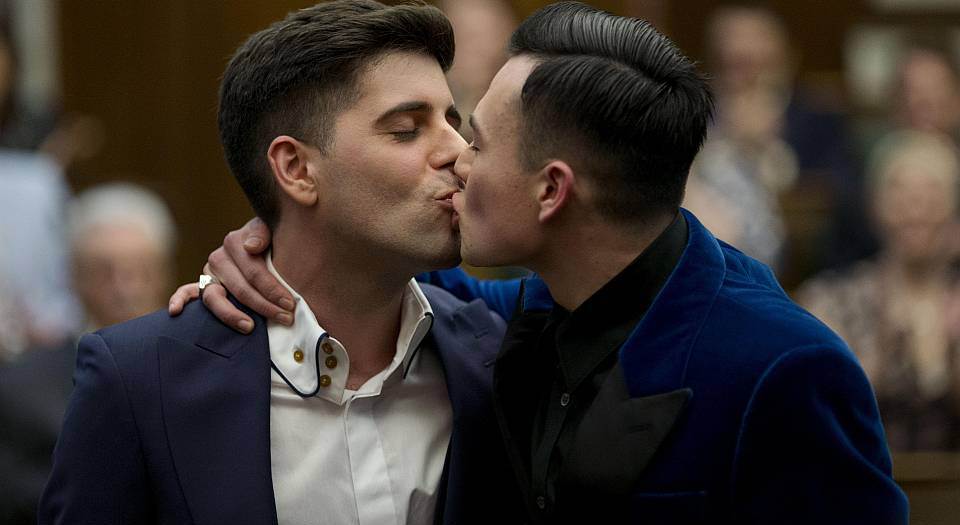
No one likes to be a party pooper. But as the champagne corks rocket through the air and politicians slog it out to see who can be the most effusive in their celebration of the legalisation of gay marriage in Britain, there remains one awkward question about the whole thing, an elephant in the fabulously decorated room. And it’s this: how did this all happen so quickly? How did we go at such speed from a situation where gay marriage was a rather eccentric concern of small numbers of professional activists and lawyers to a situation where to oppose gay marriage is treated as an eccentricity, and a wicked one at that? How did saying ‘Let gays get hitched’ go from being fairly outré to utterly orthodox in about the same amount of time – I’m saying around five years – that it takes most modern campaign groups to design their headed paper?
It isn’t surprising people are reluctant to ask this question. For to do so, to give this conundrum some serious consideration, might just reveal that our society is not quite as tolerant, or as free, as the gay-marriage campaigners and their influential backers would have us believe. It might just show that the true driver of gay marriage up the political agenda, at a pace unprecedented in the modern social-issues arena, has been less a new civil-rights vibe and more a kind of soft authoritarianism – a largely media-driven momentum that has turned gay marriage into social demarcator par excellence, where those who accept it are Good, and those who oppose it are Bad, bigoted, ripe for being mauled and ideally silenced by the strangely intolerant promoters of tolerance for same-sex unions.
The coming into force of the Marriage (Same Sex Couples) Act at the weekend has been talked up as the latest stage in the civil-rights revolutions of the 1960s and 70s. Politicians, when they’re done with patting themselves on the back (‘I’m incredibly proud to have been the first party leader to have supported equal marriage’, said deputy prime minister Nick Clegg), talk about gay marriage as an issue of liberty and tolerance. According to PM David Cameron, the legalisation of gay marriage shows that Britain’s ‘proud traditions of respect, tolerance and equal worth’ are alive and kicking. But this doesn’t feel true; it doesn’t gel with the tenor of the advocacy for gay marriage in recent years, which has frequently been ugly and censorious, and, in the words of one American observer who supports gay marriage, has displayed a ‘stunning lack of charity, magnanimity and tolerance’.
Easily the most noteworthy thing about the gay-marriage issue has been the speed with which media, political and public opinion has fallen in line behind it. So in Britain, an ICM poll in March 2012 found that 45 per cent of Brits supported the legalisation of gay marriage; nine months later, another ICM poll, asking the same question, found that 62 per cent supported it; in 2013 it rose to 68 per cent. That’s a leap of nearly 25 percentage points in the space of a year, which, to say the least, is unusual. It’s a similar story in America, where in the space of a few years public support for gay marriage has risen from 37 per cent to 60 per cent. Since 2009, there has been a four-point rise in support for gay marriage every year in America, which just doesn’t happen on major social issues that touch upon tradition, faith, family and culture. The conservative commentator Christopher Caldwell has a point when he says: ‘Public opinion does not change this fast in free societies. Either opinion is not changing as fast as it appears to be, or society is not as free.’
To put the speedy shift from opposition to support for gay marriage into historical perspective, consider this: In the UK, the Wolfenden Report suggesting that some homosexual acts should be decriminalised was published in 1957; it wasn’t until 1967 that consensual sex between two men in private was actually decriminalised; and it wasn’t until 2000 that the age of consent for gay men was made equal to that for heterosexuals. So it took 40 years to secure the right of all gay men over the age of 16 simply to sleep with each other. Yet somehow, the idea of gay marriage – which touches upon far more than what happens in private, pertaining to the institutions of marriage, the family and traditional forms of commitment – has turned from a lightbulb moment over a few activists’ heads into actual law in less than a decade. What’s going on?
Many, among both supporters and opponents of gay marriage, have noted the swiftness with which this idea has come to be institutionalised. Gay marriage has gone from ‘joke to dogma’ in less than a decade, says Caldwell. The ‘pace and scale’ of this campaign have been ‘breathtaking’, admits one gay-marriage proponent. A writer for The Week, who supports gay marriage, has marvelled at how in a ‘figurative blink of an eye in cultural terms… gay marriage has gone from being an oxymoron to a lived reality’. Jonah Goldberg of the National Review says ‘future historians will likely be flummoxed by the moment we’re living in’ and by the ‘blink of an eye’ in which gay marriage was established as an almost unquestionable orthodoxy.
How has this happened? I think both sides get it wrong. The pro side’s claim that the speedy shift is a consequence of the brave agitation of liberal campaigners and politicians fails to explain the curious absence of any marches or demos for this apparent addition to the civil-rights pantheon, and also how this outburst of alleged liberalism came about at a time when true liberalism is in short supply. As for the anti side’s claim that a sharp-elbowed gay lobby is demolishing marriage as we knew it, and probably laughing as they go – that veers towards conspiracy-theory territory, echoing the old right’s nonsense about Western culture being under threat from pinkos ‘marching through the institutions’. My view is that the spreading conformism on gay marriage is neither a result of a public liberal struggle nor of sinister machinations by gay groups, but rather speaks to the weakness of modern society’s attachment to traditional institutions and long-term commitment, and to the ability of small elites in our post-political age to shape the public agenda in a scarily thoroughgoing fashion.
There has been extraordinary cultural pressure on people to conform to the notion that gay marriage is not only a good idea but the good idea of our era. This pressure has taken the form of demonising dissent, where those who criticise gay marriage are instantly written off as homophobes and bigots. As Damon Linker at The Week says, those who don’t bend the knee at the altar of gay unions risk ‘ostracism from public life’. Gay-marriage advocates seem determined to ‘stamp out rival visions’, he says, ‘hurl[ing] insults as a means of bullying [opponents] into submission’. As a result, many who feel morally uncomfortable with gay marriage are likely to hide their true views, for fear of being cast out or publicly branded with the ‘phobe’ tag.
The pressure to conform is increasingly taking a legal form, too, particularly in America. As Jonah Goldberg points out in his piece ‘Celebrate gay marriage – or else’, there are more and more cases where private businesses that refuse to work on gay weddings, notably florists and photographers, run the risk of being had up for committing a kind of ‘hate speech’. There is almost a ‘mandatory celebration’ of gay marriage, says Goldberg, which is ‘so intense’ that ‘refusal is now considered tantamount to a crime’. Meanwhile, actual scientific journals advise readers on how to use social-networking sites to send out the message that supporting gay marriage is ‘acceptable, appropriate [and] normal’, reminding us that everyone is ‘susceptible to the powers of peer pressure’. Whether it’s through cultural pressure, legal pressure or peer pressure, you will celebrate gay marriage.
This intolerant, confrontational style of the gay-marriage lobby, its virtual trawling for the remaining few people who oppose gay marriage so that they, too, might be pressured into mandatory celebration, reveals something about the true nature of this issue – which is that it has become a barometer of social decency, one of the few things which otherwise at-sea politicians and campaigners can use to define themselves as purposeful in these morally amorphous times. This leads, inevitably, to ostentatious showdowns with the other side, the bad side, making gay marriage into a ‘zero sum game’, in Damon Linker’s words, where campaigners demand not just tolerance of their views but ‘psychological acceptance and positive affirmation’ of them. The more the political and media classes define their moral worldview through gay marriage, the more they need to hunt down and point a finger at the lingering opponents of it in increasingly intolerant exercises in moral juxtaposition. This leads, not to a genuine acceptance of gay marriage, but to a kind of acquiescence to it, a compliance with it, as individuals sign up under duress, certainly under pressure.
So in a stunningly short period of time, not only has gay marriage been normalised, but opposition to it, traditionalism itself, has been denormalised. This reveals the extent of the corrosion of the old conservative values of long-term commitment and family life, whose one-time proponents in the church and elsewhere have effectively vacated the moral battlefield and stood back as marriage has been redefined. (‘The terms of our surrender’ was the fitting headline to a recent sad article by one such conservative.) And it also reveals the ability of newer cultural elites, especially the media classes, to impose new narratives on public life and to set political and social agendas. The media have been key to the gay-marriage crusade, playing a leading role in promoting it, defining it, and demonising those who question it. As a consequence of an historic emptying-out of political life in recent years, of the decline and fall of the classes and interests whose tussles were once the lifeblood of politics, the media have come to be an increasingly important political actor, their concerns and prejudices often taking centre stage in public life. The unstoppable rise of gay marriage really speaks to the replacement of older, conservative elites with a new elite, one that is, remarkably, less tolerant of dissent and more demanding of psychological affirmation of its every idea, whim and campaign than its predecessors were.
So perhaps we should put all that champagne on ice. For the transformation of gay marriage from just an idea to a juggernaut in the blink of an eye actually has little to do with the expansion of tolerance, but rather speaks to the very opposite phenomenon: the emergence of new forms of intolerance that demand nothing less than moral obedience and mandatory celebration from everyone – or else.
Brendan O’Neill is editor of spiked.
You’ve hit your monthly free article limit.
Support spiked and get unlimited access.
Support spiked and get unlimited access
spiked is funded by readers like you. Only 0.1% of regular readers currently support us. If just 1% did, we could grow our team and step up the fight for free speech and democracy.
Become a spiked supporter and enjoy unlimited, ad-free access, bonus content and exclusive events – while helping to keep independent journalism alive.
Monthly support makes the biggest difference. Thank you.

Comments
Want to join the conversation?
Only spiked supporters and patrons, who donate regularly to us, can comment on our articles.