Marco Rubio’s West First foreign policy
The US secretary of state called on allies to rediscover their civilisational yearning for discovery, adventure and glory.
Want unlimited, ad-free access? Become a spiked supporter.
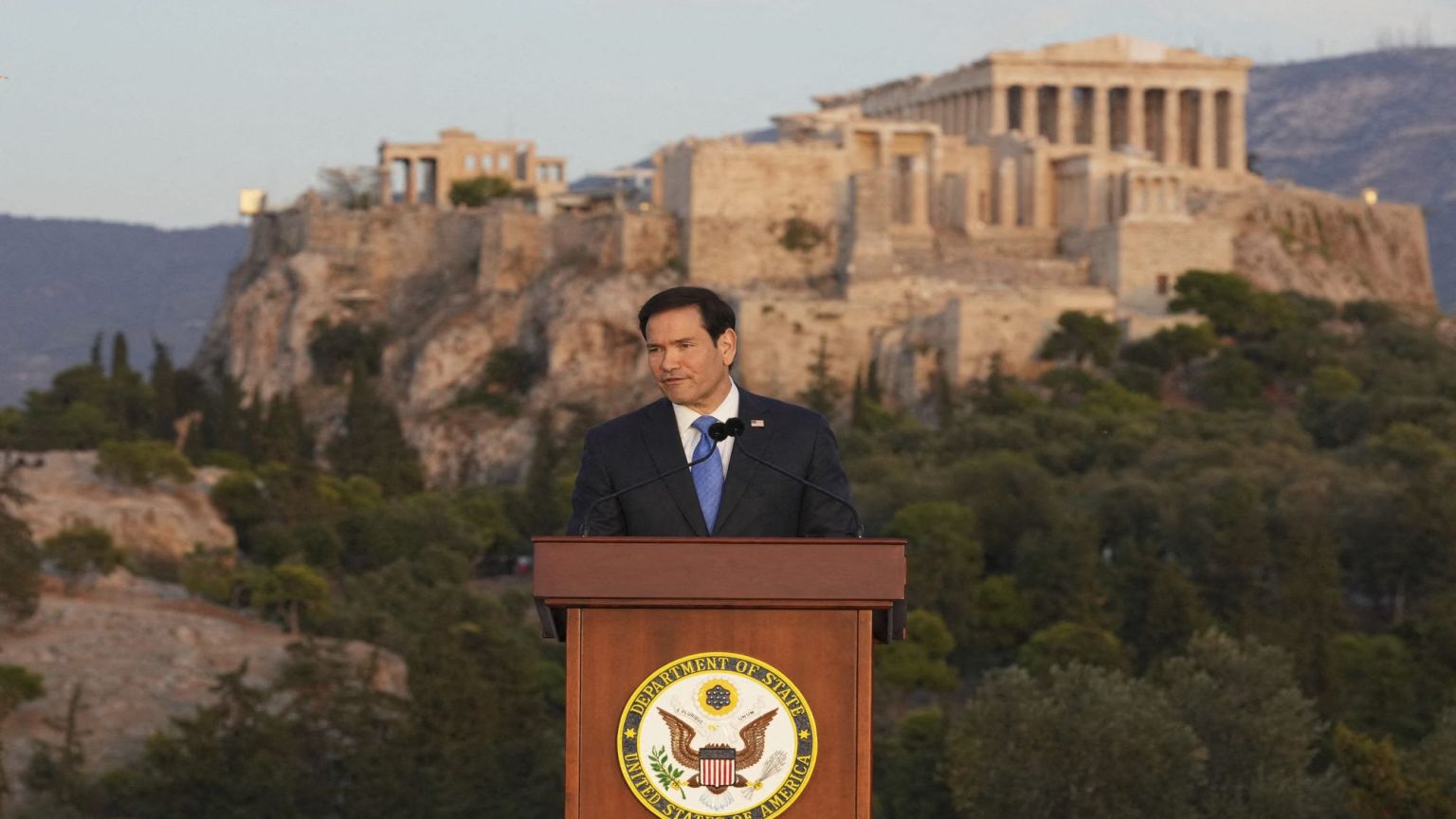
It was certainly set up to look and feel like a historic speech. With the Acropolis acting as the backdrop, US secretary of state Marco Rubio laid out his new vision for American power. And he did so by appealing to the legacy of Ancient Greece.
For those concerned about the crisis of Western self-confidence, there was much in the speech to stir the soul. Rubio cast the West not as a place of equal rights or even material wellbeing, but as a place of ‘fierce individuality and relentless ambition; daring exploration and invention; a yearning for discovery, for adventure, risk and glory’.
Rubio developed ideas he had first expounded in Munich this February, when he attacked the West’s culture of fear. He warned that we will be ‘paralysed into inaction by fear – fear of climate change, fear of war, fear of technology’. In Athens, though, he went further, arguing that the root of this fearful culture was the dominance of safetyism, which has become ‘the ideal of many ideologies in our time’. He attacked ‘a world of perfect safety, devoid of risk or failure, with neither the glory of victory nor the shame of defeat’.
On the face of it, then, Rubio’s speech in Athens was, as most commentators have noted, an exhortation to recover the Western thumos – ‘the fire of passion, strength, courage, pride’, which, as Rubio put it, is at ‘the heart of great civilisation’. European elites, he argued, have become little more than ‘polite and orderly caretakers of the West’s managed decline’.
It is a resonant message. Among the many challenges we in the West face today, from economic sclerosis to political inaction, a profound sense of timidity is surely among the most significant. Even today’s billionaire industrialists, like Elon Musk or Dario Amodei, may well talk of colonising the stars, but they are more often found begging for protection from their own AI technologies.
Yet lurking within Rubio’s call for the West to discover its mojo was a more complicated proposition. After all, it’s unusual for an American politician to invoke Ancient Greece as a model for the US. Going back to the founding fathers, America’s leaders have normally appealed to Ancient Rome. One of the two Latin mottos on the reverse side of the Great Seal of the United States is novus ordo seclorum (the ‘new order of the ages’), a conscious adaptation of Roman poet Virgil’s magnus ab integro saeclorum nascitur ordo (‘the great order of the ages is born anew’).
Why, then, has Rubio turned to Greece? The answer lies in his attempt to overturn liberal universalism, the main ideological ambition of the new American right. Hence Rubio argued that the Greek spirit of daring and contest was not ‘just the formulas or precepts of a particular school of philosophy – they were the characteristic of a people’. And later in the speech, he argued that we take the legacy of the West for granted, and assume Western ideals ‘somehow are universal to all people in all times and in all places. They are not – they are the product of a distinct character.’

Rubio’s target, repeatedly identified in plainer terms by US vice-president JD Vance, is the idea of America as a merely ‘creedal’ nation – a nation defined, that is, by a common set of universal values and principles. Rubio, like Vance, is arguing that these principles and values are in fact the inheritance of a particular people, capable of developing a certain kind of character.
There is a rationale for this. The old geopolitical mission of America – the bearer of the universal civilisation, the global policeman of the global moral order – is by now thoroughly discredited. American military dominance of the globe is no longer plausible, and the claim of a universal, America-led moral order lies shattered, caught in its own contradictions internationally and disparaged at home as little more than a globalist fetish.
Instead, America has in recent years sought to cement a more modest position for itself. As the 2025 National Security Strategy argues, the post-Cold War ambition of ‘permanent American domination of the entire world’ was a mistake, and America should no longer impose on other nations ‘democratic or other social change that differs widely from their traditions and histories’.
America is therefore in need of not a universal ideology but a merely ‘civilisational’ one. America is no longer the supreme embodiment of the universal civilisation; it is merely the leader of the particular Western civilisation. While both Rubio and the 2025 National Security Strategy insist America can still be the most powerful nation on Earth, that the West can be the most powerful of the civilisations, this does look, as many have noted, suspiciously close to an accommodation with Russia and China, seen as the heads of their own ‘civilisation-states’.

Attacking the claims of liberal universalism has therefore become not just a domestic issue, but also a geopolitical one. Why, then, is Rubio drawn to Greece instead of Rome as the historical ally for this ideological mission of overturning liberal universalism?
One answer suggests itself – that Rome is too bound up with the idea of universalism. Universalism might not be a Roman idea – you can trace its antecedents back to the Hebrew idea of man being made in the image of God, or to the idea of Diogenes the Cynic that he was kosmopolitēs, citizen of the cosmos. But universalism does develop its fullest expression through Roman law, Roman imperial development, and the fusion of Christianity with Rome. This is owing in part to the Roman practice of demanding a legal settlement from those they conquered, as if their ambition was, in Hannah Arendt’s words, to ‘throw the Roman system of alliances over all countries of the Earth’. This was embodied in the ius gentium, the ‘law of peoples’, which initially dealt with conduct among the non-Romans before being theorised as a universal law that could prevail among all peoples. Little wonder Rome was such fertile ground for Christianity, the universal church of all men made in the image of one God.
Trumpists’ dislike of international law makes Rome and Roman universalism especially problematic. After all, whatever bastard form contemporary international law takes, it very much does trace its intellectual history back to Rome, most importantly to the fusion of Christianity and Rome in the works of Thomas Aquinas. To enforce the claims of naked national interest over international law may not require an attack on the legacy of Rome, but it does make it rather tempting.
Rubio is, however, too Catholic to expressly renounce the legacy of Rome. Instead, he quietly hands Rome’s inheritance to Greece. ‘Our ideas of law, of virtue, of citizenship and republican government’, he says, ‘were shaped in the Greek city-states’, and the Greek confidence in a rational cosmos became the foundation of ‘Augustine and Aquinas and of the whole tradition of natural law’. Law, citizenship and Aquinas – the very Roman inheritance at stake in any argument about universalism – are not renounced but relabelled as Greek.
Of course, Rubio is keen to superficially preserve the standard account of the Western tradition – ‘born in Athens, formed by Rome, baptised in Christendom, hardened in the furnace of medieval Europe endowed with the English genius for liberty, and then carried across the Atlantic’. But there is no mistaking the tenor of the speech: it is very clearly a paean to Athens.
Ancient Greece provides an important counterpoint to Ancient Rome when it comes to shoring up the new American ideology. If Rome provides a model of an empire that, to a fault, imagined itself universal, the tradition of the Greek city-state is much more hospitable to the uncertain, freewheeling international era we find ourselves in now. If the Romans were usually careful to couch their interest in terms of the requests of their allies, the Greek states were less apologetic about the exercise of their interest. As Rubio says of the new America, ‘we choose the unapologetic pursuit of national power’. Even if this line does not go as far as Thucydides’ famous phrase from ‘the Melian Dialogue’, in his History of the Peloponnesian War – ‘the strong do what they can and the weak suffer what they must’ – it is an ambition clearly bolstered by Rubio’s reclamation of the Greek pursuit of glory at all costs. Ancient Greece thus becomes the theoretical and historical foundation for the new era of unapologetically assertive American self-interest, at the head of Western civilisation.
Indeed, Rubio harnesses the Ancient Greeks for his vision of American renewal, in particular their striving for excellence writ large in the Homeric injunction ‘to be ever the best and to excel all other men’. As Rubio, almost quoting Homer, puts it: ‘The men who made the Parthenon… held that the highest and most noble aspiration in life was to surpass all others, to strive to be the best in all things.’ For Rubio, Ancient Greece provides an appropriate model for modern America, not least, as he notes, because of the similarities between the Ancient Greek striving for immortal glory and the American frontier spirit.
There are other good reasons for Rubio’s Athenian turn. Rubio, we should not forget, has always been uneasy with the isolationist instincts of MAGA. With this speech, he is trying to stake out a possible ideological basis to America’s geopolitical ambitions. These ambitions may well be much reduced compared to the recent past, but the vision of America striving for glory at the head of a refreshed ‘West’ is still globally significant.
Whether the contradictions of this worldview can be worked out is uncertain. Can a Christian country turn away from Rome? Can a ‘government of laws not men’ live by Homeric standards? And, above all, can the West, which is but a collection of states, become a civilisation-state?
But there is a further difficulty, which the recovery of Greek greatness alone cannot resolve. The Greeks understood better than anyone that freedom finds its highest expression in the striving for distinction. But they were unable to preserve the political conditions of their excellence. The reason for ‘the incredible development of gift and genius in Athens’, Arendt observed in The Human Condition, was also a reason for ‘the hardly less surprising swift decline of the city-state’. The endless pursuit of glory is untameable – it tears at the seams of the society that birthed it.
Permanence was the achievement of Rome, whose politics rested, Arendt argued, on ‘the conviction of the sacredness of foundation, in the sense that once something has been founded it remains binding for all future generations’.
Marco Rubio has called on the West to recover the Greek love of greatness. The harder task is to give it the Roman gift of permanence, without the universal empire that came with it.
Jacob Reynolds is policy director for Freedom and Sovereignty Initiative Europe.
You’ve hit your monthly free article limit.
Support spiked and get unlimited access.
Support spiked and get unlimited access
spiked is funded by readers like you. Only 0.1% of regular readers currently support us. If just 1% did, we could grow our team and step up the fight for free speech and democracy.
Become a spiked supporter and enjoy unlimited, ad-free access, bonus content and exclusive events – while helping to keep independent journalism alive.
Monthly support makes the biggest difference. Thank you.




Comments
Want to join the conversation?
Only spiked supporters and patrons, who donate regularly to us, can comment on our articles.