Britain is erasing the Islamic Republic’s victims
A London memorial to those slain by this brutal regime has been torn down by the Met Police.
Want unlimited, ad-free access? Become a spiked supporter.
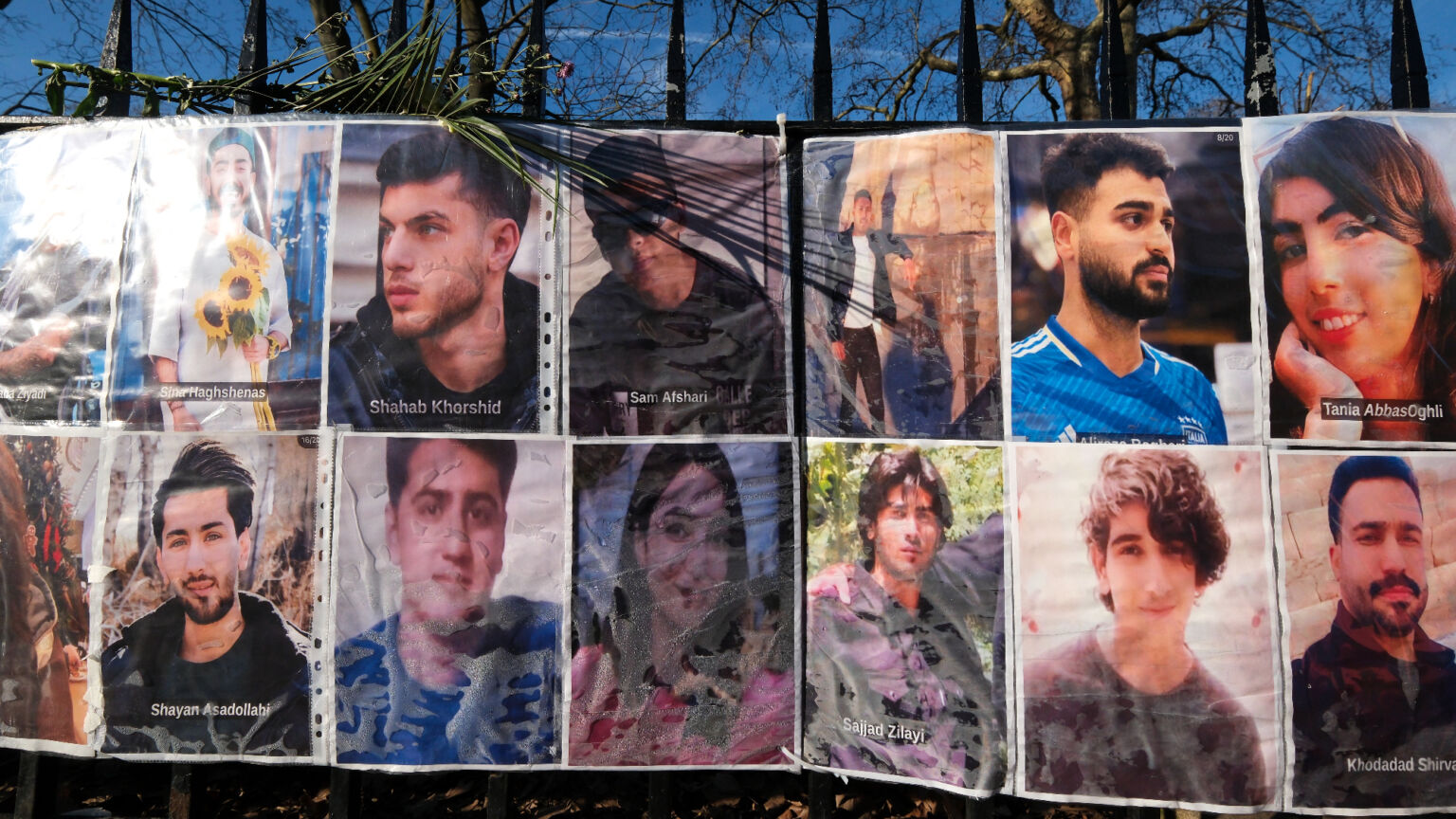
There is something slightly otherworldly about watching 30 police officers prepare to dismantle temporary plywood walls covered with the faces of young Iranian men and women protesters massacred by their own government just a few months ago.
I arrived at the memorial outside the Islamic Republic’s embassy in Knightsbridge late afternoon on Friday to find five or six large police vans emptying themselves on to the pavement opposite. A senior officer approached the 10 or so Iranian protesters to deliver the news: the memorial wall – featuring handwritten messages, posters and the carefully arranged photographs of some of the tens of thousands of people murdered by the regime whose embassy stands just yards away – was to be removed. All of it. Right now. They had had their orders.
The protesters had maintained this memorial with extraordinary care. Mahan, its principal organiser, had been at the site virtually around the clock since January – four months of continuous vigil, sleeping there, guarding it against attacks, refusing to abandon the faces of his countrymen to our country’s indifference.
One of the protesters, Mary, was already making her case to the officer in charge. She had been in ongoing discussion with someone at the council and had not yet received a formal written response. I decided to interject, for whatever it was worth – probably not much. I pointed out that whatever authority the police were acting under, the obvious question was whether there was any meaningful obstruction to the highway, and clearly there wasn’t. The combined effect of these remonstrations was eventually sufficient. After a lot of back-and-forth and a call to the superintendent who had apparently ordered the removals, the officer overseeing the operation granted the Iranians a temporary reprieve, and the police, one by one, looking rather more indifferent now, filed back into their vans.
But the following morning, the police were back. The wooden hoardings were forcibly removed. And Mahan was arrested.
This did not come from nowhere. In the brief few months the protesters have been opposite the embassy, they have come under sustained pressure – permitted hours curtailed, the structure of the protest repeatedly scrutinised, even the playing of music challenged. It is worth setting those few months against what the Metropolitan Police have tolerated for over two years on the streets of London with the pro-Palestine protests: crowds chanting ‘Globalise the Intifada’, ‘From the River to the Sea’ and ‘Khaybar, Khaybar ya Yahud’ (an Arabic battle cry calling for the massacre of Jews) have been allowed to march unimpeded through the capital week after week. Not to mention countless violent incidents against other members of the public and the police, too.
Counter-protesters peacefully holding signs reading ‘Hamas are terrorists’ have been repeatedly arrested and even prosecuted for breaching the peace. And in one incident, Gideon Falter, chief executive of the Campaign Against Antisemitism, was stopped by a Met police officer from crossing a public road, and told that his presence, described by an officer as being ‘quite openly Jewish’, risked being inflammatory.
That two-year tolerance has undoubtedly contributed to a very different climate in the UK, felt most acutely by Jewish and Iranian communities. Less than a week ago, an arsonist attacked the Iranian memorial wall on Limes Avenue in Golders Green – part of a wave of violence targeting Jewish and Iranian dissident sites across north London. The wall itself survived, but a wooden display case was burned and photographs were charred. Community members have since been sleeping in their cars beside it at night because, as one of them put it, they do not feel the memorial site is safe.
Two days after that, two Jewish men were subjected to a frenzied knife attack on Golders Green Road. They were stabbed repeatedly in the street, and were lucky to escape with their lives, in what was declared a terrorist incident and suspected attempted murder. The government has since raised the national terrorism threat level to critical. On Thursday, prime minister Keir Starmer stood up and promised more muscular action against the pro-Palestine protests.
On Friday evening, one day after Starmer’s announcement, that muscularity found its first expression outside the Iranian embassy – not against those chanting for the killing of Jews, but against Iranians protesting the horrors of the Islamic Republic, the very regime that funds, arms and promulgates the extremism Starmer had just pledged to face down. The Met cleared away a memorial maintained by a handful of grieving diaspora Iranians, while the embassy of the regime that killed their relatives continues to operate freely on British soil. That embassy represents a government that funds proxy militias across the Middle East, that supplies the drones used to kill Ukrainians, that rapes female prisoners before executing them, and that British counter-terrorism investigators strongly suspect of orchestrating the very arson campaign currently terrorising north London.
This is what muscular action looks like in practice. This is what the police consider their most pressing priority in the wake of Golders Green and the prime minister’s words.
The Iranian diaspora occupies a stunningly awkward position in the official British imagination. For a constellation of reasons, they are just not the right kind of oppressed and their oppressors still aren’t quite the right kind of oppressors. We seem to have far more to say about Trump than about a regime that massacres thousands of its own citizens and hangs children from cranes. When Iranians march through central London carrying pictures of blinded and executed girls, they receive a fraction of the media coverage granted to other causes. When their memorials are attacked, the news cycle barely registers it. And when police arrive to enforce what arsonists had attempted in Golders Green just days before, there is no outcry from the organisations that have spent years insisting the right to protest is non-negotiable.
And look what was torn down. Pictures of victims of the Iranian regime. Of Mahsa Amini, 22 years old, killed for not covering her hair. Of Sarina Esmailzadeh, 16, beaten to death at a protest. Of the thousands imprisoned in 2019, hundreds of whom were subsequently executed. The wall was a very dignified act of witness – the kind of thing a civilised society ought to protect.
Since the Islamic Republic began massacring its own people, the Iranian community here has been asking a simple question: whose side are you on? The answer from the British state was writ large in the hoardings taken down on Saturday and the young man led away in handcuffs.
Max Sadie is a photographer who has been documenting the Iranian diaspora and its protest movement in London.
spiked summit 2026 – SOLD OUT
Saturday 27 June 2026
10am-6pm, Saturday 27 June
Emmanuel Centre, London, SW1P 3DW
With Lionel Shriver, Brendan O’Neill, Katharine Birbalsingh, Toby Young, Allison Pearson, Paul Embery, Tom Slater, Andrew Doyle, Fiyaz Mughal and more
The spiked summit has now SOLD OUT. To join the waitlist, email:
[email protected]
£80 or £50 for supporters
You’ve hit your monthly free article limit.
Support spiked and get unlimited access.
Support spiked and get unlimited access
spiked is funded by readers like you. Only 0.1% of regular readers currently support us. If just 1% did, we could grow our team and step up the fight for free speech and democracy.
Become a spiked supporter and enjoy unlimited, ad-free access, bonus content and exclusive events – while helping to keep independent journalism alive.
Monthly support makes the biggest difference. Thank you.
Comments
Want to join the conversation?
Only spiked supporters and patrons, who donate regularly to us, can comment on our articles.