Why is the RAF suspending cadets for criticising Islam?
The refusal to confront Islamic extremism is putting Britain’s national security at risk.
Want unlimited, ad-free access? Become a spiked supporter.
It has been clear to most of the British population for some time that criticising Islam is a dangerous game. But one would still hope that the military would be allowed to talk more freely about the threats to our national security.
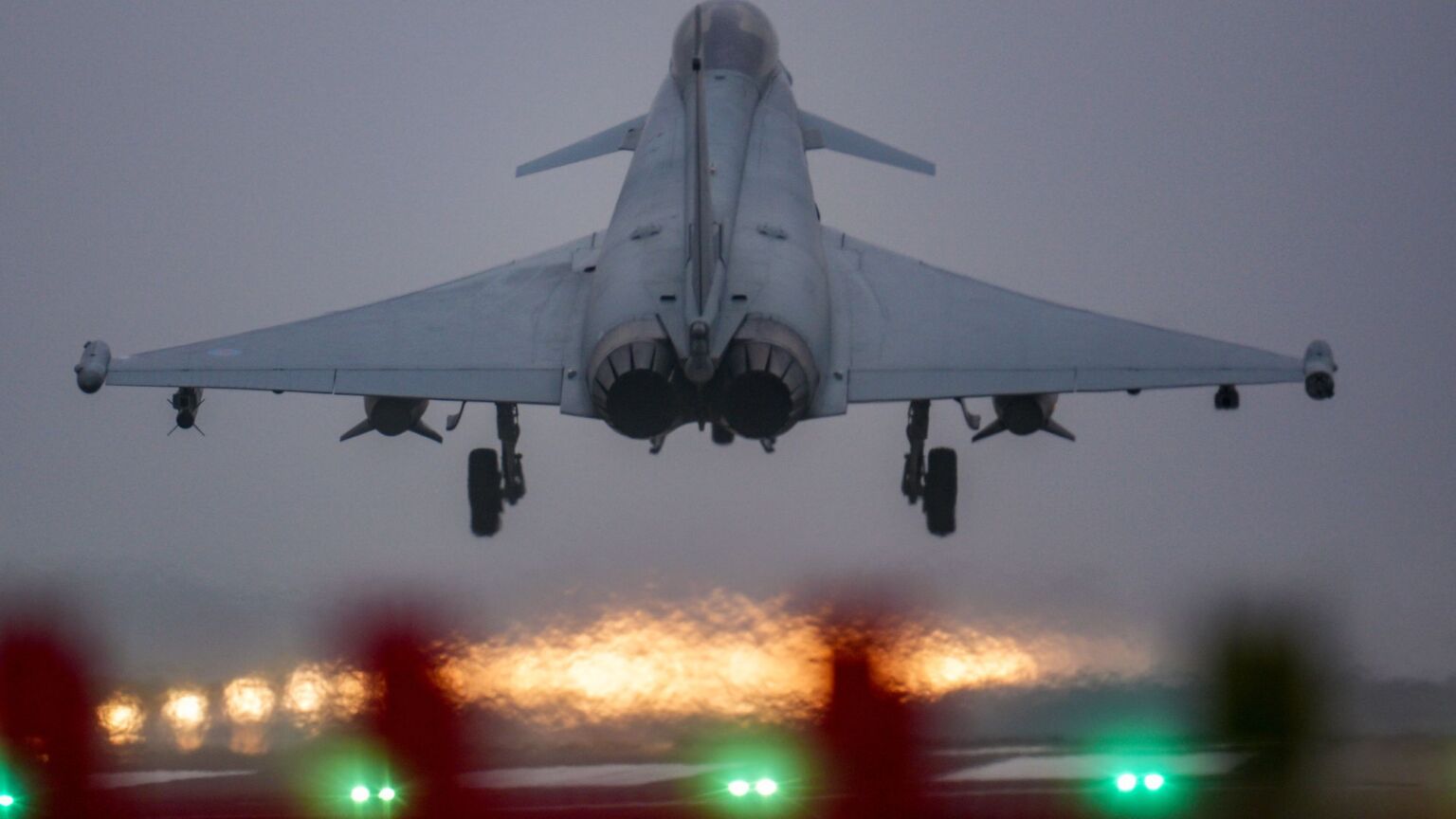
But apparently not. According to the Daily Mail, a Royal Air Force cadet has been suspended for describing Islam as ‘the greatest threat to the UK’ during a presentation at RAF Cranwell, shortly before Easter. An RAF spokesperson confirmed it was investigating an ‘alleged incident of inappropriate behaviour’, without providing any further information.
The cadet will no doubt be accused of failing to distinguish between Islam and Islamist terrorism. He failed, that is, to abide by the unwritten law of our age – to ‘respect’ the former, and at the same time insist that the latter has no connection whatsoever with the ‘religion of peace’. Either for failing to make this distinction, or for simply mentioning Islam at all, this young cadet will be hauled over the coals much the same way that Conservative MP Nick Timothy was last month, when he (correctly) characterised a mass Islamic prayer in Trafalgar Square as an act of ‘domination’.
The response to Timothy’s comments was ominous, not least as a demonstration of just how perilous it has become to criticise Islam in the UK. But it was also predictable – Labour, desperate to recapture Muslim voters after its loss at the Gorton and Denton by-election in February, was always going to leap at the opportunity to label a political opponent as ‘Islamophobic’.
The treatment of the RAF cadet is in some ways a cause for greater concern. It is increasingly difficult to see where the ‘mainstream’ Islam ends and radical Islam begins in the UK (more than half of Britain’s mosques are run by the fundamentalist Deobandi movement). And radical Islam is by far the greatest security threat the country faces. If this fact can’t be acknowledged in the armed forces, then they are not doing their job.
The statistics support the cadet, not his inquisitors. In the past 20 years, Islamic extremists have killed 95 people in the UK. The ‘far right’ that we endlessly hear of has killed three. In 2020, it was reported that of the 43,000 extremists monitored by MI5, more than 90 per cent were Islamists.
Recent events bear this out. Who attacked the Heaton Park synagogue in October? Who allegedly set fire to four Hatzola ambulances in Golders Green last month? Who was recently convicted for planning to gun down as many Jews as their ammunition allowed at a march against anti-Semitism in Manchester in 2024? It wasn’t the far right. It wasn’t someone who had been ‘radicalised’ by watching Tommy Robinson videos. It was Islamists or suspected Islamists in every case.
The inability to criticise Islam has had a chilling effect on freedom of speech in the UK and across the West. We can hardly be reminded enough that a British schoolteacher remains in hiding, under a new name, for showing pupils a drawing of Muhammad during a religious-studies class at Batley Grammar in 2021. Labour has even introduced a non-statutory definition of Islamophobia (rebranded as ‘anti-Muslim hostility’), which is effectively an Islamic blasphemy law in all but name.
Clearly, this timidity towards Islamism has now seeped deep into the nation’s institutions. The treatment of the RAF cadet is mirrored by the warped priorities of Prevent, the government body that is supposed to stop people becoming terrorists or supporting terrorism. In 2022, it was reported that just 16 per cent of referrals concerned Islamic extremism. Right-wing extremism, on the other hand, accounted for 20 per cent of its caseload.
The evasiveness around Islam must end. Every other country, it seems, is able to see that the UK has a problem with the nature of the Islam practised here. The United Arab Emirates now discourages students from studying in Britain because of the pervasive influence of the Muslim Brotherhood. That a Muslim country can identify a threat that the British authorities can’t, or won’t, hardly inspires optimism.
The Iran war may have exposed the decrepit state of the UK’s armed forces. But the treatment of the young cadet by the RAF suggests that the problem with the British Armed Forces runs deeper than a shortage of materiel. What is the good of having more warships or more troops, if a threat cannot be named?
The treatment of the Royal Air Force cadet is a scandal. The public has come to expect this kind of thought-policing in government bureaucracies, but it appears it’s now worked its way into the military, too. The price we might have to pay for this right-on censorship will be very high indeed.
Hugo Timms is a staff writer at spiked.
spiked summit 2026 – SOLD OUT
Saturday 27 June 2026
10am-6pm, Saturday 27 June
Emmanuel Centre, London, SW1P 3DW
With Lionel Shriver, Brendan O’Neill, Katharine Birbalsingh, Toby Young, Allison Pearson, Paul Embery, Tom Slater, Andrew Doyle, Fiyaz Mughal and more
The spiked summit has now SOLD OUT. To join the waitlist, email:
[email protected]
£80 or £50 for supporters
You’ve hit your monthly free article limit.
Support spiked and get unlimited access.
Support spiked and get unlimited access
spiked is funded by readers like you. Only 0.1% of regular readers currently support us. If just 1% did, we could grow our team and step up the fight for free speech and democracy.
Become a spiked supporter and enjoy unlimited, ad-free access, bonus content and exclusive events – while helping to keep independent journalism alive.
Monthly support makes the biggest difference. Thank you.
Comments
Want to join the conversation?
Only spiked supporters and patrons, who donate regularly to us, can comment on our articles.