Israel is not at war with Lebanon
Hezbollah’s murderous campaign against the Jewish State has been routinely ignored and downplayed.
Want unlimited, ad-free access? Become a spiked supporter.
The joint statement released by Israel and Lebanon on Thursday could not have been clearer. ‘Israel and Lebanon affirm that the two countries are not at war and commit to engaging in good-faith direct negotiations’, it said.
Wait, what? Israel and Lebanon were not at war? What about the endless hours of media coverage showing us the devastation of Lebanon’s southern villages? What about all the Gaza comparisons? What about all the outrage?
Well, their joint statement held further clues. ‘Both countries recognise the significant challenges faced by the Lebanese state from non-state armed groups’, it said. ‘Those groups’ activities must be curtailed.’
To anybody who knows anything about the region, so much was already obvious. Israel’s campaign in Lebanon is targeted at Hezbollah, not the population at large. Even if every single Shia in the country was supportive of the terror group – which is far from the case – that would mean that two-thirds of Lebanese people opposed it.
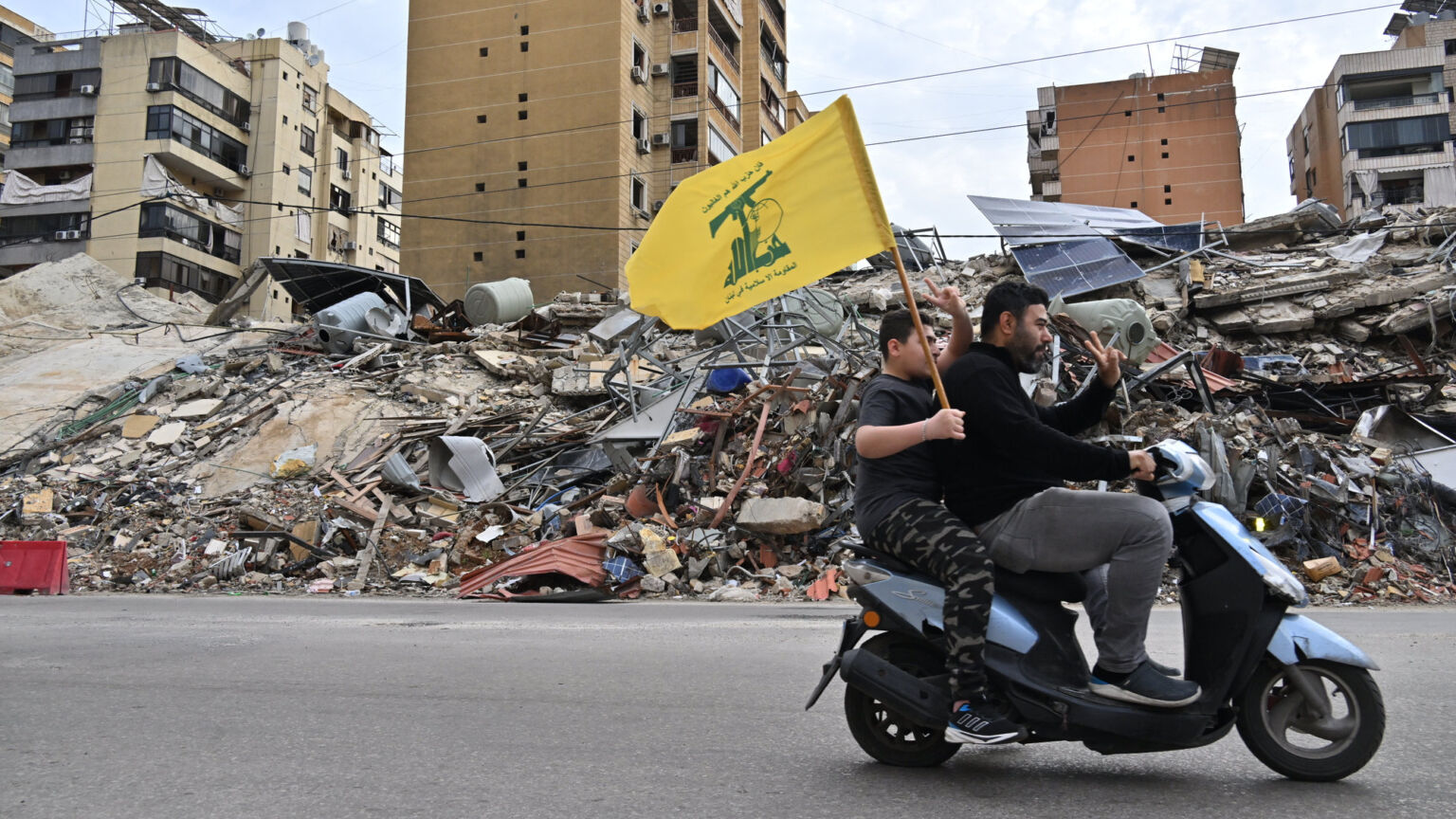
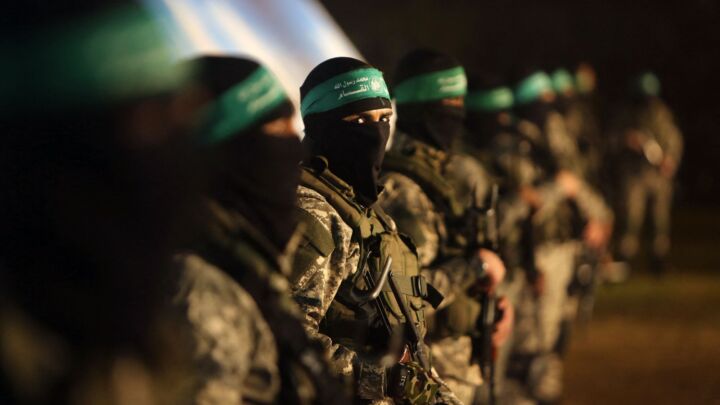
With good reason: Hezbollah was founded by the Iranian regime, is fanatically committed to Israel’s destruction and has even adopted the Sieg Heil as its salute. Meanwhile, it has infiltrated Lebanese politics and society like a parasite, turning the country into a zombie state designed for the death of its neighbour.
As the Lebanese academic Makram Rabah pointed out this week on The Brink, a podcast I co-host with Andrew Fox, Hezbollah is inherently anti-Lebanese. It was set up as an Iranian puppet in 1985 to establish a Tehran-style Islamic Republic in Lebanon.
‘As a young kid in the streets of Beirut, I still remember their banners’, Rabah said. ‘They had the same AK-47 on them, but they used to read “Islamic Revolution in Lebanon”.’ Hezbollah, which runs international drug-trafficking networks and has dabbled in prostitution, is widely hated, he said, not least because it plays a large part in the corruption of Lebanon’s political system.
‘They have a kind of Faustian deal with the political elite. The political elite needs them for muscle. The ongoing clientalist system, which has ruined Lebanon over and over again, takes advantage of this sacred alliance of what we call the mafia and the militia.’
When it comes to the Jewish State, however, the general attitude in Lebanon is far less hostile than many people in the West might hope. ‘Many people are too afraid to publicly say that they don’t have a real problem with the Israelis’, Rabah said.
‘The Israelis withdrew from Lebanon in 2000. But on 7 October, when Hezbollah decided to join Hamas, they invited occupation… What we are seeing right now is a direct implication of such a decision.’
So much for the facts. The gap between the reality on the ground and the story being spun by Israelophobic international institutions and their allies in the Western media tells you everything you need to know about this conflict.
This week, Sky News broadcaster Yalda Hakim interviewed Barham Salih, the United Nations high commissioner for refugees, in Beirut. ‘This is truly a deepening humanitarian catastrophe in every sense of the word’, the former Iraqi president said. ‘There needs to be a peaceful settlement.’ Lebanon, he added, was ‘a haven for tolerance and coexistence’ and ‘for Lebanon to be subjected to this is really, really tragic and sad’.
What? I watched the nearly eight-minute-long conversation very carefully. There was one word that both the softly-spoken diplomat and the Sky News journalist failed to mention. It happens to be the very heart of the conflict, without which it is impossible to understand it. You got it: the word was ‘Hezbollah’.
Of course, if you take any war and edit out one of the belligerents, what you are left with is a crime against humanity. The Second World War without the Nazis and the destruction of Germany would look like the worst atrocity in history. Describing the current war in Lebanon without mentioning Hezbollah is the same. (This is becoming an old trick. Remember when the UN produced a report claiming that Israel’s war in Gaza was a ‘genocide’? The word ‘Hamas’ was largely absent from that one.)
Sky and other outlets have relentlessly framed the conflict as ‘between Israel and Lebanon’, regardless of the fact that not a single Lebanese soldier has attacked Israel. Frankly, Western viewers have been subjected to misinformation on a massive scale.
That’s before you even log onto social media. In truth, the Israel Defence Forces’ (IDF) campaign in the south of Lebanon has nothing to do with territorial expansion, some conception of ‘Greater Israel’ or an unbridled bloodlust for dead babies, as the digital yahoos would have you believe. Rather, it began in response to relentless rocket fire from Hezbollah on civilian communities on the other side of the border.
Back in 2006, the UN adopted Security Council Resolution 1701, which demanded that Hezbollah withdraw north of the Litani River, which bisects Lebanon about 15 miles from the border with Israel. This was a vital security measure to keep Israeli civilians safe from short-range attack and terror infiltration.
Yet because UN peacekeepers were useless and Lebanese political will too weak, the resolution was never enforced. Fast-forward to 7 October 2023, and the results of this failure were clear: Hezbollah unearthed its numerous caches of rockets along the border and lobbed them with impunity into the Jewish State. (Its elite Radwan unit was also planning 7 October-style cross-border raids on the communities in the north. So much was proven when the IDF entered Lebanon in 2024 and unearthed bunkers containing weapons caches, operational plans and maps of Israeli towns and military positions, and written instructions for carrying out the savagery. It was only the reinforcement of Israeli troops in the north after 7 October that deterred this catastrophe.)
Eighty thousand Israelis were evacuated, while those left behind lived under fire for a year. The Majdal Shams attack of July 2024, in which 12 Druze children were killed while playing football, was a sickening case in point. As Hezbollah had been allowed to embed so close to the border, the air-raid siren sounded only a few seconds before the rocket landed.
Given this backstory, you can understand why, when Hezbollah attacked Israel again during the Iran campaign, enough was rather enough. Having seen that the international community was unwilling or unable to respect Israel’s security concerns in southern Lebanon, Jerusalem had no choice but to unilaterally create a ‘security buffer zone’ up to the Litani River. Wouldn’t you want your government to do the same?
This resulted in the displacement of more than a million people from the villages of their grandparents, which is tragic. But what was the alternative? Every other option had been tested – literally – to destruction. It was clear: the lack of resilience in Lebanon meant that if Israel did not act decisively, its citizens would not be safe.
Yet there was UN official Barham Salih on Sky, bleating on about the suffering of Lebanon as if he was ignorant both of the history and the reality on the ground. In fact, he went one step further. It was, he told Yalda Hakim, ‘a fundamental human right for people to go back to their territory and live there’.
On the surface, this sounds fair enough. Take a step back, however, and his language of humanitarianism takes on a rather more sinister significance. What he was demanding was for Israel not to create a security buffer zone, not to defend its people from jihadi savagery, in the name of ‘human rights’. What about the human rights of Israelis?
In Salih’s view, Hezbollah – the organisation that dares not speak its name – should be allowed to return south of the Litani River, near Israeli communities, with ample civilians around them as cover. Anything Israel does to prevent this can then be branded as a moral outrage.
Israel, in other words, must open its throat to the knife. Suicide by Niceism, if you will. If that is not the true moral outrage, I don’t know what is. The unpalatable reality is that Salih, Hakim and all the others have turned themselves into sophisticated mouthpieces for Hezbollah.
Jake Wallis Simons is the author of Never Again? How the West Betrayed the Jews and Itself.
You’ve hit your monthly free article limit.
Support spiked and get unlimited access.
Support spiked and get unlimited access
spiked is funded by readers like you. Only 0.1% of regular readers currently support us. If just 1% did, we could grow our team and step up the fight for free speech and democracy.
Become a spiked supporter and enjoy unlimited, ad-free access, bonus content and exclusive events – while helping to keep independent journalism alive.
Monthly support makes the biggest difference. Thank you.
Comments
Want to join the conversation?
Only spiked supporters and patrons, who donate regularly to us, can comment on our articles.