
Long-read
The authoritarian legacy of the Southport riots
Too many were dragged through the courts and imprisoned ‘to send a message’.
Want unlimited, ad-free access? Become a spiked supporter.
The Holiday Inn, just off Fletcher Street in Manchester, is not the hotel you book if you want to see the best of England’s second city. It sits on the busy Oldham Road on the outskirts of the City Centre. Traffic runs past it all day. It is opposite a huge industrial yard containing a Travis Perkins and a Volkswagen dealership. It is hard to know why anyone would choose to stay there. Yet, on 31 July 2024, the fact of who happened to be staying there became very important. The hotel was being used to house asylum seekers.
Two days earlier, on 29 July, Axel Rudakubana, a British national whose parents were Rwandan immigrants, had arrived at the Hart Space Dance Studio in Southport with a kitchen knife. He proceeded to attack a group of young girls attending a Taylor Swift dance class. He murdered six-year-old Bebe King and seven-year-old Elsie Dot Stancombe. A third child, nine-year-old Alice da Silva Aguiar, died later in hospital. Eight other girls and two adults were seriously injured.
What happened next is now well established. In the aftermath of the Southport massacre, the police released little information about the identity of the attacker. False rumours began to circulate online that the perpetrator was a recently arrived asylum seeker. In the days that followed, violent unrest erupted across the UK. It was later estimated that 29 anti-immigrant demonstrations and riots took place across 27 towns and cities following the Southport massacre.
Migrant hotels were besieged. Mosques were attacked. Individual asylum seekers were targeted. And over 300 police officers were injured.
When it came, the state clampdown was severe. By 30 August, 1,280 people had been arrested and 796 people charged in connection with the disorder. The 2024 summer riots were widely seen as some of the most serious civil unrest in the UK since the London riots of 2011. But the authorities’ response to the disorder – one which dragged hundreds upon hundreds of people through the courts, landing some in prison – has proved just as damaging. This is something that I, as a barrister, have seen first hand.
On 31 July 2024, the disorder then engulfing the UK arrived at the Holiday Inn off Fletcher Street – and so did one of my future clients, James Cooper.
On that day, the following post appeared on Facebook:
‘On our doorsteps, a hotel full of men, the government don’t know who they are yet they get to walk past our kids school’s playground wake the fuck up people it juts matter of time, let’s get them out 6pm today stand up and take note because if you don’t no1 will.’ (Sic)

James Cooper, a 36-year-old man who lived locally to the Holiday Inn, saw this post. James is a cabin fitter, meaning that he helps set up the interior of portable cabins for use on building sites. When James saw the post, he noticed that several of his Facebook friends were galvanised by it and wanted to demonstrate. He had seen a lot of content circulating about Southport since the attack. He was aware of the rumours about a recently arrived asylum seeker being responsible for the massacre. And he had worked at a site on the industrial estate directly opposite the Holiday Inn, so knew something of the asylum seekers who had been housed there. He had also heard rumours that the men had been committing crimes in the local area, including threatening children.
James wasn’t sure whether any of these rumours were true, but he was uncomfortable with large numbers of unvetted men living in a hotel close to his family. He knew that these men came from places with significantly different values to those held by people in Britain. He didn’t like the fact that they were anonymous, or that they appeared entitled to a free hotel room merely for showing up in the country. And after Southport, amid the rumours, it felt like the men in the hotel represented a threat to him and his family. He felt the danger viscerally.
So, when he saw the Facebook post and the reaction of his friends, he decided to go to protest on Fletcher Street. That decision would end up shaping his life for the next two years.
The Facebook post had been reported to the police. At around 5pm, police officers arrived at Oldham Road, the main arterial road that runs outside the hotel. They found no protesters. Some began to arrive at 5.20pm, but they were initially peaceful. The size of the crowd increased to 60, at which point they became ‘increasingly vocal’ according to one of the police officers present. By 5.30pm, the crowd had started to chant ‘Go home, get out of our country’. By 6.30pm, missiles were being thrown towards the police carriers and the Holiday Inn itself. An officer described seeing eggs, glass beer bottles and stones being thrown.
By 7pm, more officers from Greater Manchester Police had arrived at a scene of developing disorder. Footage shows protesters in masks, shouting and wandering across the road. They reportedly kicked out at a bus being driven down Grimshaw Lane, around 300 yards from the hotel. The driver said he was abused by the demonstrators, while the passengers hurriedly disembarked in panic.

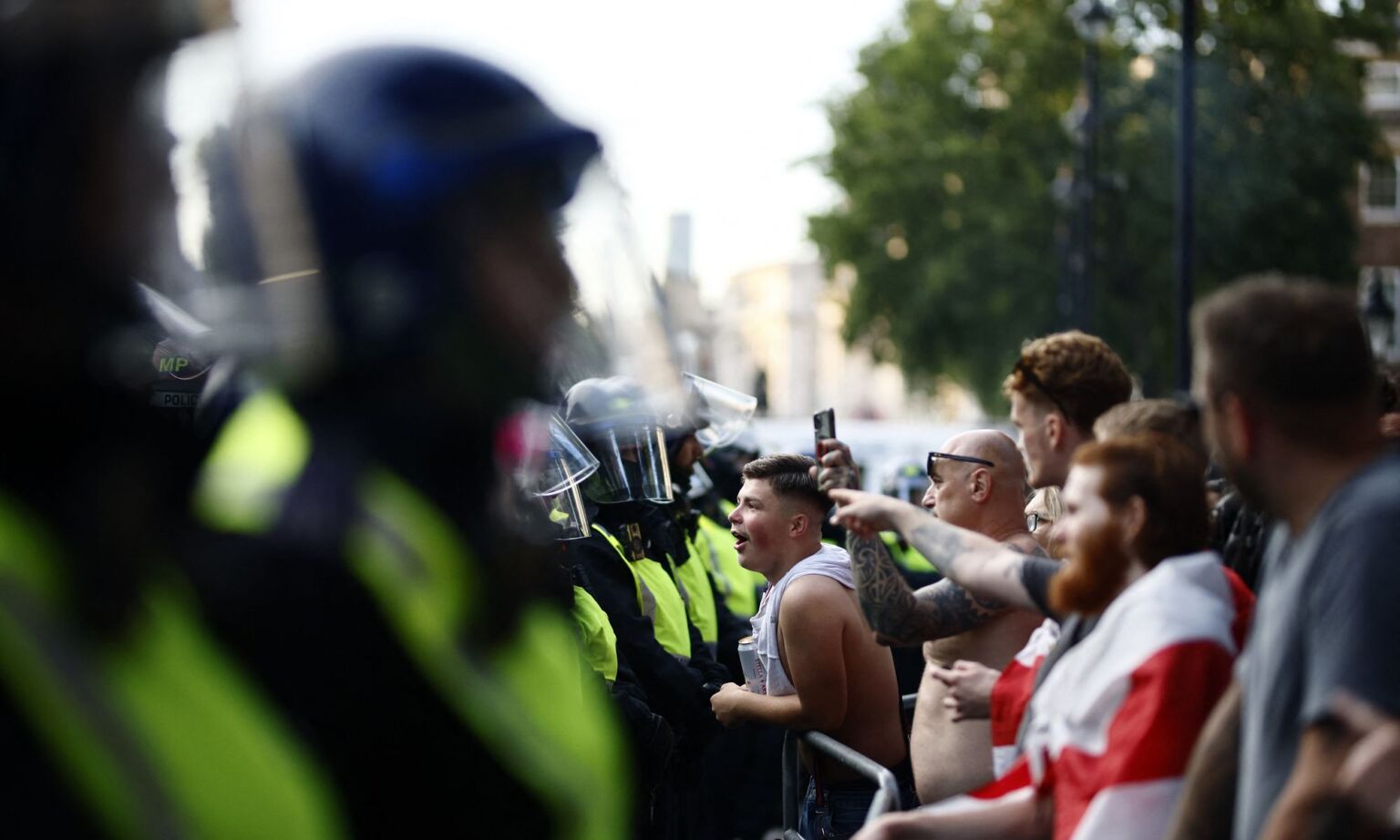
There was no evidence that James was involved in any of this. But by 7.43pm, he was outside the Holiday Inn. He was captured, dressed in a beige t-shirt and jeans, on the body-worn video of one of the riot officers. The footage of James, which was relied on by the prosecution, is very brief – just 90 seconds. It was never established how long the police officer had been recording, or how much of the footage he captured that day had been retained.
When the footage begins, James can be seen walking away from the officer who is filming him. It looks like the police are advancing towards a small group of protesters who had congregated on the street. No one around him is throwing anything, or even appears to be particularly threatening. James later explained that this is because most of the serious disorder was happening around Grimshaw Lane, where the bus had been attacked. This was around 500 feet away from where he and his group were standing.
In the short video, James says to the officer, ‘There’s no need for that, mate’, clearly referring to something that has happened prior to the start of the footage. The officer replies, ‘You need to get out of the road mate’, and pushes James in the back to move him along. It is worth noting that, in English law, police officers are not normally allowed to place hands on a person without justification. In a riot, reasonable force can be used to bring someone under control. But it is not lawful to use force to simply ‘move someone along’.
The same officer then remonstrates with a woman standing next to James. She calls the officer a ‘prick’. James tells the officer to ‘calm down’. He looks like he is attempting to defuse the conflict between the woman and the police officer.
The officer produced a second piece of footage. In it, James can be seen filming the officers on his mobile phone. He stands in front of the line of police officers with his phone in the air, and says:
‘You got kids yourself? You not talking? What would you do if it was one of your kids – what would you do? Shithouses the lot of you, shit bags, You’re a fucking disgrace the lot of you.’
It looks like a heat-of-the-moment outburst. As though James had lost patience with the officers’ behaviour. It wasn’t pleasant, but it also wasn’t threatening. There was no hint that James was about to use violence against anyone.
Yet it was these remarks that, two years later, landed him in court, facing a charge of violent disorder – an offence that carries a tariff of up to five years in prison.
It is striking that most of the people who went through the courts were eventually convicted of the same offence for which James was arrested: violent disorder. Sentencing statistics showed that 71 per cent of prosecutions related to the riots were for public-order offences, and ‘principally violent disorder’. A further seven per cent were for a range of summary-only offences, meaning the least serious offences on our statute book. Four per cent of these convictions were for violence against the person.
Violent disorder has a broad definition. In 2020, the Court of Appeal ruled that creating an ‘aura of menace’ could be enough to meet the requirement of the offence. In other words, the Crown no longer has to prove that the defendant did anything violent – only that he or she generated an ‘aura of menace’.
The courts sentenced harshly. Of those convicted after the riots, 76 per cent received immediate custody – roughly 495 people. The mean custodial sentence imposed was 23.3 months. Any prison sentence under two years can, in theory, be suspended by the sentencing judge. This means that instead of incarceration, the defendant will serve their sentence in the community. This is common in cases where the defendant is getting into trouble for the first time, or where they do not pose an obvious further risk to wider society. The fact that the mean sentence was relatively low, but that most sentences were not suspended, suggests that the courts were less willing to suspend sentences for offences related to the riots.
In 2024, the Court of Appeal reviewed several of these sentences. One of the men convicted was Paul Williams. He had attended the disorder in Sunderland. He was drunk, had removed his top and assumed a ‘boxer’s stance’ in front of the police officers. He later threw a drink at the officers, which landed on a shield, and then a ‘piece of metal’, which landed short of the police lines. For this, Williams received a sentence of over two years, with immediate custody.
This was, on any reading, a harsh sentence. But the Court of Appeal, in refusing to shorten Williams’s time in custody, emphasised that tough sentences are meant to be a deterrent, and reflect the role that an individual’s behaviour has played in exacerbating wider disorder. The court quoted, with approval, the judge who originally sentenced Williams:
‘It is an unavoidable feature of mass disorder that each individual act, whatever might be its character taken on its own, inflames and encourages others to behave in similar fashion. That is why the court will have regard to the overall picture. Those participating in mass disorder must expect severe sentences, intended not only to punish but also to deter others from copying their example.’
You can see the sense in this. There is a difference between a solitary person throwing objects at the police, and doing so in the middle of a riot. Nevertheless, men like Paul Williams were, in effect, punished more harshly because it was deemed their behaviour encouraged others to act violently. What might have been considered fairly minor criminality at any other time was treated very harshly because of its extraordinary context. This may be justifiable when someone throws missiles towards the police. It is clearly less justifiable when all the defendant throws at officers is insults.
When James was interviewed after his arrest, he provided a prepared statement. This means that his lawyer read a short statement into the interview record, and then James answered ‘no comment’ afterwards. The statement read on James’s behalf said that there was no evidence that he had engaged in or threatened unlawful violence. He was bailed from the police station and told to come back in three months’ time.
In our legal system, the process can often be the punishment. Being on bail for a serious crime puts your life on hold. You could be facing a trial and a prison sentence. Clients often describe how, by the time they get to trial, years after any alleged crime has been committed, they feel as though they have already served their sentence. They may have restrictive bail conditions, affecting where they can and cannot go, or who they can and cannot meet up with. They possess physical liberty, but the possibility of a potential prison sentence makes planning a life all but impossible.
When I met James and saw the footage, I could not believe he had been charged. He used some heated language with the officers, but riot police are normally assumed to be able to deal with harsh words from the public. It is not illegal, in this country, to insult a police officer.
Before he instructed us, James had been represented by a previous legal team who had applied to have the case dismissed. But the judge had allowed the case to continue to the jury. He must have thought that a jury could conclude that James’s actions contributed to an ‘aura of menace’ against the officers and the men inside the hotel. So, we had to prepare James for a criminal trial.
He took me through his movements at the demonstration in detail. His case was, as stated above, that the serious disorder was happening elsewhere. He pointed out that the officers who were marching forward – towards him and the others on Fletcher Street – pushed them towards Grimshaw Lane, where bottles and other missiles were being thrown at police. James had driven to the demonstration and parked his car a few roads away. He insisted he just wanted to get back to his car when he saw that the demonstration had become violent, but was stopped from doing so by the riot officers. James was angry that the police officer had pushed both him and the woman he was with. He did not say anything that would have made the officers fear for their safety – far from creating an ‘aura of menace’, he was walking away throughout most of the footage shown to the jury.
Often, in these cases, it is not possible to discern the full picture. The evidence produced by both the defence and the prosecution might be incomplete. Here, James had decided to attend a protest outside a hotel where asylum seekers were housed. Whatever the law says, most people would think this method of ‘protest’ is wrong. The UK’s dysfunctional asylum system is not the fault of those who are caught up in it. It’s not right to protest government policy by targeting individuals.
Yet the idea that people should face lengthy prison sentences merely for showing up at a demonstration and shouting at the police has been alien to the law in the UK for a long time. The law generally allows the freedom to protest, including shouting at the police. We don’t live in a country where the state punishes people for being in the wrong place at the wrong time. Whatever you think of James being at such a demonstration in the first place, the law does not tend to punish people who behaved like he did.
He could very easily have been one of the defendants who pleaded guilty at the magistrates’ court. He might have been told by his lawyer that he had no chance of being cleared, given his presence at the scene of the disorder. He might have been advised that, by pleading guilty, he would receive credit from the court and a reduced sentence. Yet had he pleaded guilty, he would have been held in custody. It is a good bet that he would have been given a lengthy prison sentence. Instead, he took his chance with a jury trial.
He won very quickly. He gave evidence in his defence and was acquitted unanimously. By this point, he had been on bail for close to two years.
The personal costs of this legal process have been enormous. While on bail, James had to find a new job. He was prevented from attending his place of work, which was opposite the Holiday Inn on Fletcher Street. He had to attend a new site, on the opposite side of town, which added two hours to his working day. The possibility that he would serve a sentence of up to five years beyond the date of his trial overshadowed his life. In today’s desperately overstretched court system, defendants on bail can expect very long waits for their trials. While most of us can plan for what we would like to be doing in three years’ time, when you are awaiting a trial for an imprisonable offence, such planning becomes impossible.
Anyone who saw footage of the riots in 2024 would have recognised the need for a tough law-and-order response. Fuelled, in part, by racism and misinformation, the levels of violence were often serious and the potential for harm was immense. That goes some way to explain why the police and the justice system felt they had to use the law to ‘send a message’.
Yet it is hard to resist the conclusion that James and people like him were punished not just for their actions on the street – but for being on the street in the first place. It is hard to know how many of those involved in the 2024 disorder pleaded guilty to riot-related offences because they felt they had to, rather than because they genuinely believed they had broken the law.
The use of the law to ‘send a message’ may seem necessary when faced with a national crisis, yet such crackdowns create ripple effects that aren’t always immediately visible. Individual justice is suspended. The normal rules cease to apply. We may welcome this when coping with an immediate emergency, but James Cooper’s case suggests the harm to individual defendants can be immense. We must remain vigilant to ensure that states of emergency do not create lasting precedents that further limit our everyday freedom.
Luke Gittos is a spiked columnist and author of Human Rights – Illusory Freedom: Why We Should Repeal the Human Rights Act.
You’ve hit your monthly free article limit.
Support spiked and get unlimited access.
spiked is even better on the app
Read, watch and listen to spiked wherever you are. Our brand-new app brings everything together, with ad-free reading, audio articles and offline access.
Become a spiked supporter to unlock exclusive app access, unlimited articles, bonus podcasts, discounts and special events.
Monthly support makes the biggest difference. Thank you.



Comments
Want to join the conversation?
Only spiked supporters and patrons, who donate regularly to us, can comment on our articles.