Why the fall of Jensen Huang is shaking the world
AI’s concentration in a tiny coterie of nerds and capitalists poses a threat to our prosperity and security.

Want unlimited, ad-free access? Become a spiked supporter.
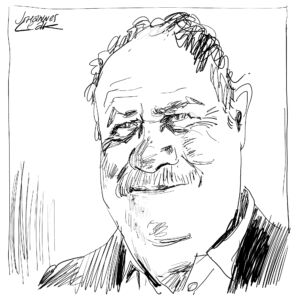
As it has grown and gorged on investment capital, Silicon Valley has become remarkably bland, dominated for more than two decades by the same once-youthful companies. Now Nvidia’s Jensen Huang – arguably the Valley’s last true star and the reigning king of artificial intelligence – has self-imploded after public revelations about his extramarital affairs, one of which is alleged to have involved a Chinese spy. His company was worth an astounding $5.8 trillion at its peak last month. But not anymore.
Huang’s fall, which has compounded a stock-market rout that could exceed $1 trillion, also shows how the AI industry has become both far too concentrated in a few hands and far too important to the wider economy. Seen as the creator of a future tech utopia, AI is becoming an industry more akin to the pre-war Japanese zaibatsu – a set of conglomerates empowered by money and political connections. Nvidia itself has large investments in several other chip firms, as well as companies building data centres.
To its cheerleaders, largely on the right, AI is the elixir that will fix whatever plagues us, from disease to low productivity and sluggish economic growth. It has certainly proved, at least until now, a remarkable engine, accounting for something like one-third of the US’s escalating GDP growth. The share of the S&P 500 controlled by the biggest firms, mostly in tech, has risen from under 20 per cent a decade ago to nearly 40 per cent today.
Yet the AI boom also exposes the economy to potentially devastating losses. Valuations are based not on current sales or even on likely sales in the near future. Only two to three per cent of households pay for AI subscriptions: the growth comes from investment and stock wealth, not consumers, with the vast majority of the profits accruing to the top one per cent.
Nor has it led to the major re-industrialisation the West needs to contest China. As the Wall Street Journal notes, Huang’s chips are made in his native Taiwan, contributing to America’s $7 billion monthly semiconductor trade deficit.
Perhaps the closest analogue to the current situation is the dotcom crash of the early 2000s, which devastated both Wall Street and California – although this time the effects may be far more pervasive. Nvidia grew its Bay Area workforce by about 1,000 in 2025, the biggest increase among the region’s 20 largest tech employers, according to Joint Venture Silicon Valley’s 2026 Silicon Valley Index. Overall, however, those 20 companies collectively cut their Bay Area workforce by about 13,400, or five per cent.
California governor Gavin Newsom, a perennial tech booster, has already sounded the alarm. After all, as the Legislative Analyst’s Office notes, the state already faces structural budget deficits of $22 billion to $35 billion a year over the next few years, even without a market downturn. New York State and City also face mounting deficits, despite all the new cash coming in from Wall Street.

We Californians have seen this before. The state’s economy was battered when the last tech bubble burst and, as other industries have faded, is now even more dependent on the whims of the technoids. In the dotcom crash of 2000-01, state income taxes plummeted. Capital-gains revenue fell from $17 billion in 2000 to $5 billion in 2003, creating a shortfall of more than $20 billion. Even the relatively small tech correction of 2022-23 and 2023-24 left revenues $65 billion below estimates.
The pain will be felt elsewhere, too. Building data centres has become very unpopular, as the midterm elections showed. They are unpopular not only in deep-blue states but also across the country, including among Republicans. As energy analyst Robert Bryce points out, rejections of data-centre projects have risen from nine in 2024 to 48 last year and 70 in the first quarter of this year. Many good blue-collar jobs tied to these centres may be lost in the current anti-AI wave.
Even Europe, and particularly Britain, is vulnerable to an AI crash. After all, AI has been among the few forces lifting Britain out of its pervasive doldrums. With its considerable chip-design expertise and financial power, the country has benefited from AI. Now an AI crash could plunge the UK economy into an even deeper slump.
The Huang humiliation further worsens the already awful image of the tech oligarchs, who have become the favourite whipping boys of the rising socialist left. For all his allegedly abusive behaviour and extracurricular activities, Huang was at least a true entrepreneur rather than a corporate bureaucrat and, unlike many of those lifted up by the AI boom, remained something resembling a human being.

The other leading figures in the AI industry are people you would certainly not want in control of your life. Anthropic’s Dario Amodei and his merry band are fond of joking about their agents destroying humanity, perhaps thinking that it does not include them. Amodei is obsessed with his ‘machines of loving grace’, which he sees as a general labour substitute for humans, adding that ‘it cannot be more than a few years before AI is better than humans at essentially everything’.
Machines might seem preferable to AI designers, given their own rather pathetic social skills. Prominent tech innovator Rony Abovitz told me that many are simply disconnected from normal humanity and firmly on the autism spectrum. Many allegedly have problems relating to the opposite sex. The beneficiaries of Anthropic’s upcoming IPO are now being gussied up and taught the tricks of intimacy, while counting on their newfound millions and billions to make them attractive. Maybe they could get some clues from Amodei’s wife, Cami Clark, who previously dreamt of setting up ‘a revolutionary porn site’.
Given the combination of social awkwardness and big bucks, it’s not surprising that the Chinese aim their ‘assets’ at the tech elite.
For now, Huang’s affair with Alice Huang (no relation) looks like an exercise in the power of guanxi – the old Chinese notion of networking among relatives and close acquaintances. He even reportedly met Alice through her husband, an old friend. In this world, relationships are critical, and those with women outside marriage are widely accepted. As one Chinese banker in Los Angeles once told me: ‘It’s better to leave the wife in charge of the home than divorce her to marry your secretary.’
Huang’s paramour was likely not just enamoured of his personality but also saw him as a means of selling Nvidia’s chips to China. Beijing identifies AI as critical to its goal of economic supremacy, and Huang seems to have been willing to act as an important fellow traveller. Whose payroll Alice was on may prove immaterial; all Chinese businesses are expected to act as willing servants of China’s ‘surveillance state’.
This kind of influence by proximity is not unusual, particularly here in California. Recently, a San Gabriel-based tech executive was arrested on suspicion of selling $300million worth of restricted AI chips to China. The driver of the late senator Dianne Feinstein was apparently a Chinese asset, while congressman Eric Swalwell, a consistent critic of Donald Trump’s alleged Russian ties, was involved with yet another alleged Chinese femme-fatale agent. In the heavily Asian city of Arcadia, east of Los Angeles, the mayor was exposed as an agent of Beijing. In another case, an Irvine real-estate agent has been accused of spying, at China’s behest, on a relative of a high-ranking Taiwanese official.
The California penchant for kowtowing to China was plainly evident in 2023, when Newsom and much of the Silicon Valley oligarchy toasted Xi at an event in San Francisco. The Valley elite and their favourite governor were seen clinking glasses with China’s president and giving him a standing ovation. The city even managed to clear its homeless off the streets while the emperor was in town. Calls by some Big Tech and Wall Street figures for Huang’s return to power suggest that a form of guanxi does exist in Silicon Valley. The Valley was once a highly competitive environment dominated by upstarts; it is now a near exclusive club of venture-capitalists and investment bankers hoping to profit from the latest geek product. These are not traditional, independent entrepreneurs: companies such as Anthropic and OpenAI are largely owned by the usual roster of large tech firms.
Unfortunately for the West, the Trump team’s widely corrupt version of guanxi plays into the hands of both the Chinese and the tech oligarchs – probably at the expense of national security. Although reportedly warned of the risks by secretary of state Marco Rubio, commerce secretary Howard Lutnick and figures such as AI adviser and venture-capitalist David Sacks could bear ultimate responsibility for allowing critical chip sales to China. Their culpability follows the Trumpian pattern – whether in the Gulf or Venezuela – of favouring whoever offers the greatest opportunity for plunder.
What happens next is somewhat predictable. Democrats will demand hearings, and Huang, Lutnick and perhaps Sacks, who is still openly defending Huang, may face public humiliation. They will rightly be questioned about how the supposedly nationalist MAGA administration allowed the sale of advanced chips to America’s biggest rival while failing to cooperate with Singapore’s efforts to investigate the alleged Chinese asset, Alice Huang.
The Democratic left in particular feels empowered. Bernie Sanders, Ro Khanna and Elizabeth Warren will demand control over these companies, and even nationalisation. There will certainly be attempts to further regulate AI data centres, which would also be in Beijing’s interests. But ultimately the Democrats are unlikely to abandon the oligarchs, and the oligarchs themselves already seem to be preparing to reverse their short rightward shift. Almost all contributions from employees at firms such as Meta, Google and Amazon go to the Democrats. In 2026, employees at top AI firms gave $2million to Democrats, almost 10 times what they gave the GOP. Much is made of Jensen Huang’s supposedly chummy relations with Trump, but in 2024 nine of the top 10 candidates backed by Nvidia were Democrats, led by Kamala Harris.
Rather, the Democrats are likely to do with AI what the country has done to rein in previous quasi-monopolies such as Microsoft, Google and Amazon – nothing. Expect instead oligarch-directed collusion with the bureaucracy, the model favoured by the Biden administration. Society’s defence against AI will come not from public agencies but from self-appointed experts, as Anthropic’s Dario Amodei, among others, suggests.
If a Democrat wins in 2028, expect the media to change their anti-tech tune as soon as the Trump ‘tech bros’ have lost out. After all, AI already has a friendly left-leaning bias that helps the Democrats. Collusion with Washington could also help the AI oligopoly kill off unwanted competition. Whether this is better than Trump’s greed-infused ‘deal-making’ is debatable, although it is at least cloaked in something other than avarice. What will continue to erode is the Californian entrepreneurial spirit once epitomised by Jensen Huang but now long gone.
Joel Kotkin is a spiked columnist, the presidential fellow in urban futures at Chapman University and executive director of the Urban Reform Institute.
You’ve hit your monthly free article limit.
Support spiked and get unlimited access.
spiked is even better on the app
Read, watch and listen to spiked wherever you are. Our brand-new app brings everything together, with ad-free reading, audio articles and offline access.
Become a spiked supporter to unlock exclusive app access, unlimited articles, bonus podcasts, discounts and special events.
Monthly support makes the biggest difference. Thank you.





Comments
Want to join the conversation?
Only spiked supporters and patrons, who donate regularly to us, can comment on our articles.