Is Palestine hysteria threatening the integrity of jury trials?
We must defend the right of jurors to act according to their conscience – even if we hate the outcome.
Want unlimited, ad-free access? Become a spiked supporter.
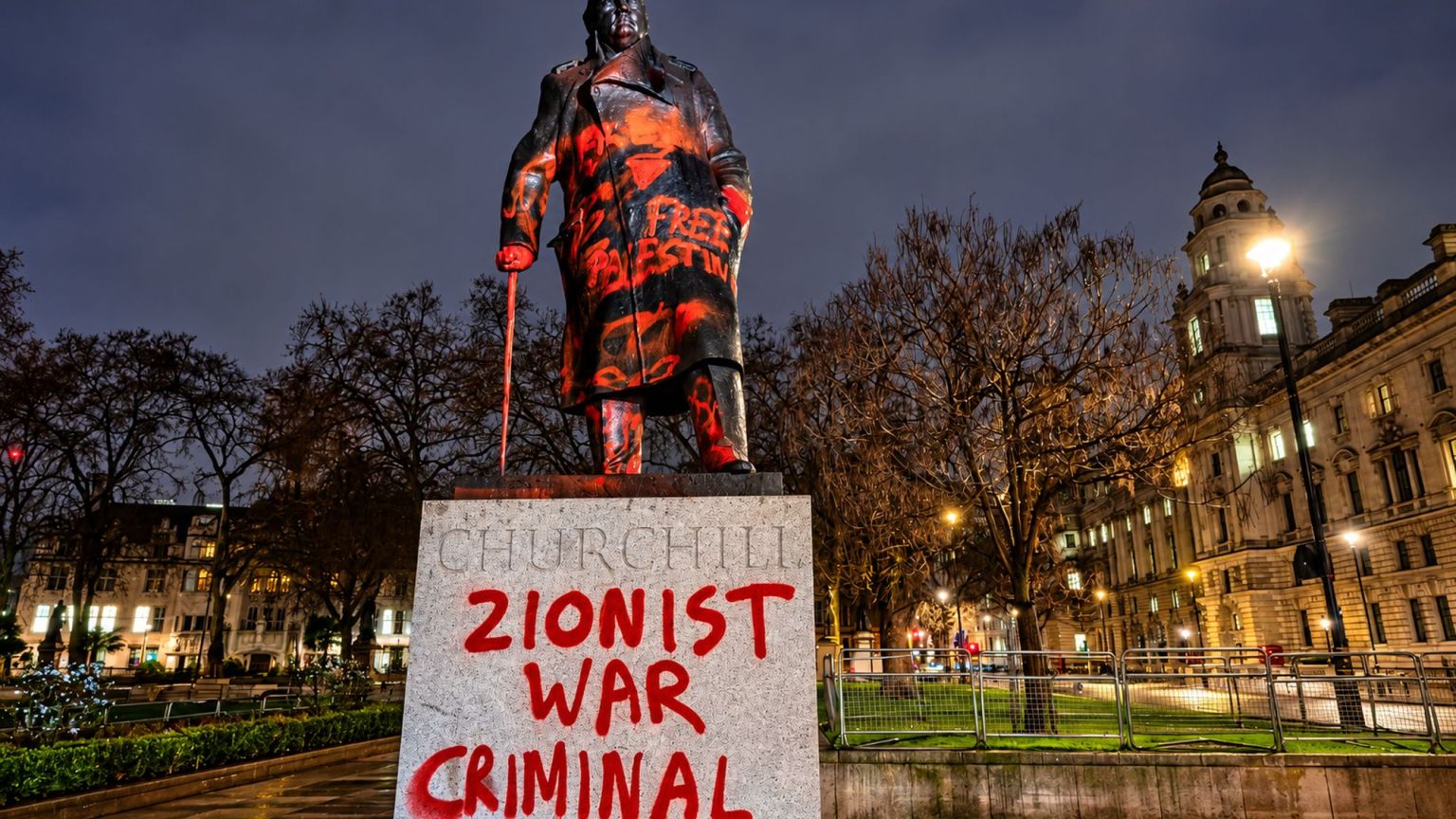
A pro-Palestinian activist who vandalised a statue of Winston Churchill in Parliament Square was acquitted of criminal damage earlier this month by a jury at Southwark Crown Court. Having travelled to the UK from the Netherlands on 27 February, Olax Outis (also known as Caspar San Giorgio) sprayed the statue with ‘Stop the Genocide’, ‘Free Palestine’ and ‘Zionist war criminal’. He was held in custody for six months following his arrest.
Outis told the jury he was sending a message to the UK parliament and disputed actually damaging the statue, claiming the paint could be easily washed off. He later made a social-media video in which he claimed he should have gone further, given his ‘enemy’ is an ‘anti-democratic, genocidal state’. That’s quite a thing to call the only democracy in the Middle East, which was established in response to an actual proven genocide – ie, the Holocaust – whereas no court has ever established that the war in Gaza amounts to any such thing.
Jury verdicts have been hotly debated in cases related to anti-Israel activism and especially Palestine Action (PA), which is currently proscribed in the UK as a terrorist organisation. Earlier this year, Rajiv Menon KC represented Charlotte Head, one of four PA activists accused of committing criminal damage after she broke into the site of Israeli defence firm Elbit Systems, near Bristol, in August 2024. Menon is currently facing proceedings for contempt of court for reminding the jury of their right to acquit in accordance with their ‘convictions’ – a move that his critics claim defied the judge’s directions on the law. Head and her co-defendants initially escaped convictions at this trial, before being found guilty at a re-trial.
In Outis’s case, it’s hard to know what the jurors were thinking in acquitting him. Maybe they couldn’t be sure that he had actually damaged the statue. Maybe they accepted the vandalism was somehow legitimately ‘sending a message’. We will never know. After all, asking juries why they have reached particular verdicts is banned in our justice system. Historically, this was meant to protect juries from being interrogated about why they had acquitted particular defendants.
And long may these protections remain. We might not agree with a jury’s verdict in Outis’s case, but that’s not the point. Jurors are supposed to represent the conscience of society at large. Some of us might dislike certain verdicts. But that’s far preferable to the alternative – namely, passing these decisions over to judges. Case-hardened judges cannot represent public morality in the same way that 12 ordinary citizens can.
The jury had a right to acquit Olax Outis. We have to stand up for this right, even when we don’t like the outcome.
Luke Gittos is a spiked columnist and author of Human Rights – Illusory Freedom: Why We Should Repeal the Human Rights Act.
You’ve hit your monthly free article limit.
Support spiked and get unlimited access.
Support spiked and get unlimited access
spiked is funded by readers like you. Only 0.1% of regular readers currently support us. If just 1% did, we could grow our team and step up the fight for free speech and democracy.
Become a spiked supporter and enjoy unlimited, ad-free access, bonus content and exclusive events – while helping to keep independent journalism alive.
Monthly support makes the biggest difference. Thank you.


Comments
Want to join the conversation?
Only spiked supporters and patrons, who donate regularly to us, can comment on our articles.