The man jailed for two years for throwing a plastic bottle
Anti-immigration protesters are being punished more severely than some sex offenders.
Want unlimited, ad-free access? Become a spiked supporter.
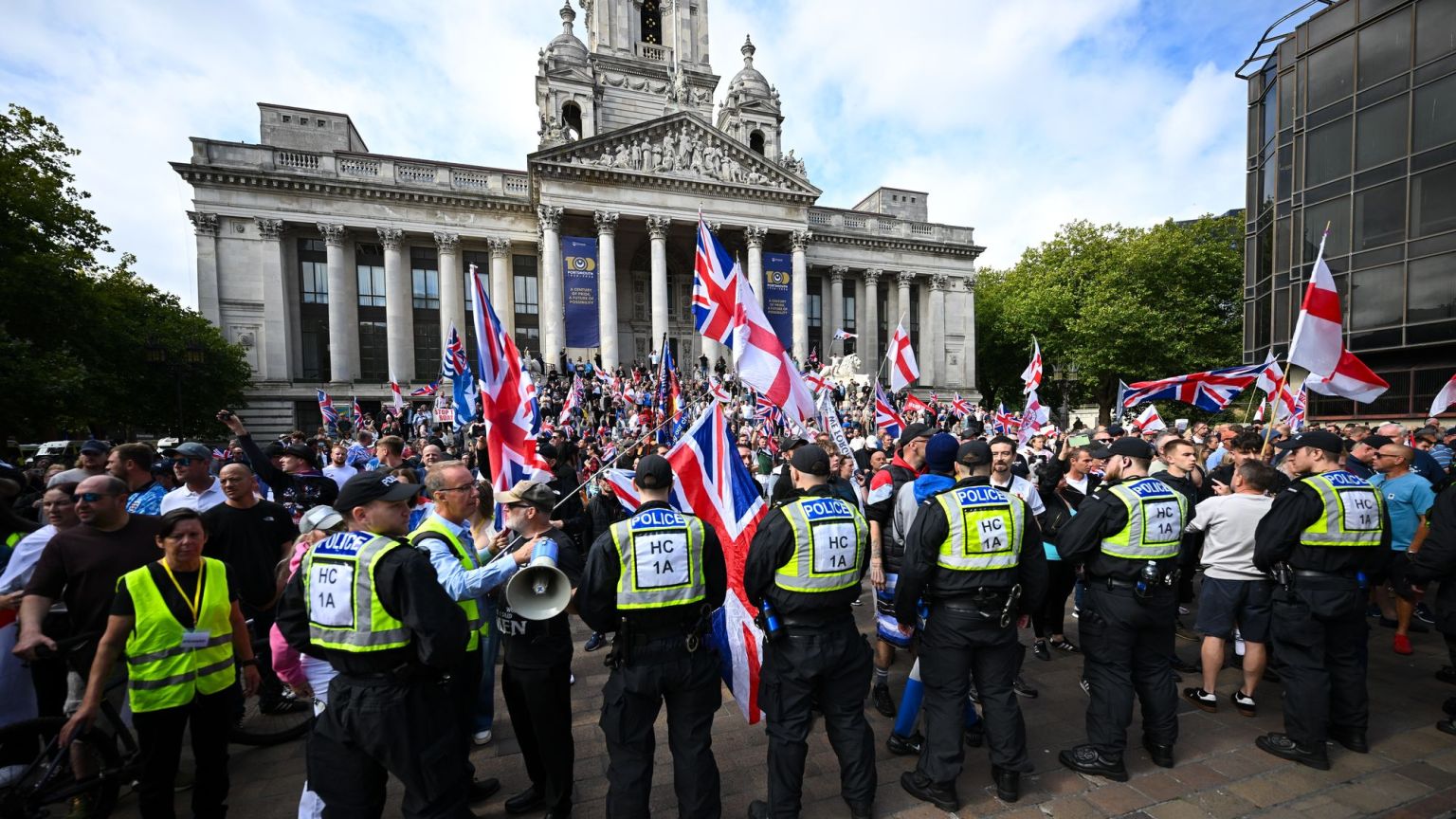
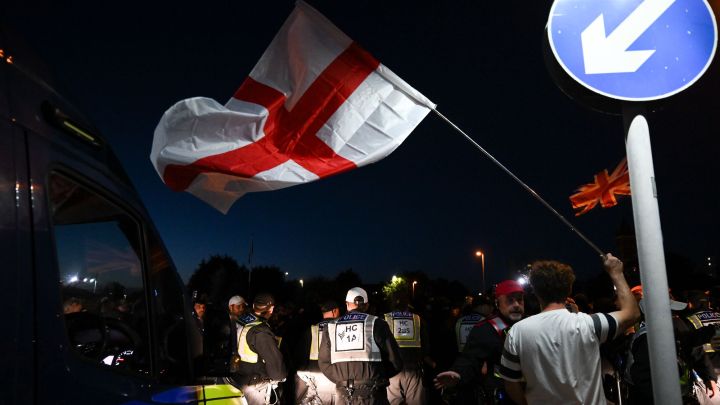
A man who threw a plastic bottle and swore at the police while taking part in an anti-immigration protest in Portsmouth has been sent to prison for two years.
Del Somerville was given a jail sentence on Thursday after pleading guilty to violent disorder following unrest, involving around 200 people, at Eastney Marina on 6 September. Yes, Somerville threw a plastic bottle at police officers, which he shouldn’t have done. But it’s notable just how quickly and severely the courts moved to punish him. It was clear the legal establishment was looking to make an example of him. At Portsmouth Crown Court, the judge explicitly stated that the severe sentence was intended to ‘act as a deterrent’ to others.
There is clearly an important principle at play here that should withstand any political disagreement. You have a right to protest. You have a right to oppose immigration, illegal or otherwise. You have a right to hold views others might find objectionable. But you don’t have a right to use physical violence as coercion. Indeed, the 1986 Public Order Act makes ‘violent disorder’ a specific offence.
Still, throwing a plastic bottle and swearing at specially trained police officers, who were fully kitted up for trouble? Calling two years in prison ‘disproportionate’ doesn’t really cover it.
At the same time as a plastic-bottle-throwing protester was being sent to prison, Metropolitan Police commissioner Sir Mark Rowley was speaking on a seemingly separate issue. He was warning of the leniency with which those accused of serious crimes are being treated. He pointed to people repeatedly charged with knife offences and even gun offences being bailed, and drew particular attention to the case of Zafer Dogan.
Dogan had been charged with taking thousands of pictures of women and girls, often from his bedroom window, which overlooked a playground. He then used AI technology to turn them into sexual images for his gratification. Yet rather than remand him in custody ahead of his trial, the authorities granted Dogan bail, allowing him to return to his original north London address overlooking the very playground he had frequently targeted. This forced one family who had fallen victim to his crimes to move into temporary accommodation. He was eventually sentenced to two years and four months in jail.
Dogan’s sentence is only four months longer than Somerville’s, even though his offence was far more serious. If you’re looking for yet more evidence of a two-tier justice system, it’s there in the contrast between the treatment of Dogan and that of Somerville.

Politicians have spent decades expanding the reach of the criminal law in England and Wales, increasing sentences and creating new offences, while allowing the machinery required to enforce them to buckle. This has led to prison overcrowding and thousands of serious offenders being released back into the community way before they should have been, many to re-offend.
Yet at the same time, when it comes to someone involved in anti-immigration protests or disorder, concerns about the size of Britain’s prison population seemingly go out of the window. We saw this after the Southport riots, when Lucy Connolly was jailed for 31 months in October 2024 for ‘stirring up racial hatred’ with a social-media post. Or when Jamie Michael was remanded in custody for 17 days, rather than released on bail, after being charged with the same offence as Connolly (he was eventually found not guilty). And it seems we’re seeing it again in the case of Somerville.
On the one hand, the state is cracking down hard on immigration-related discontent. On the other, a creaking justice system is failing to restrain people who pose a genuine threat to others.
If political expediency determines how aggressively the state responds to a charge or an offence, trust in the justice system breaks. Once people stop believing in the impartiality of the law, the law itself loses authority.
The purpose of the criminal law is simple – to protect people from criminality and provide a fair mechanism for resolving disputes. Where there is a credible case for detention, either pre- or post-trial, courts must have the capacity to make that decision.
This is why the Portsmouth case and Rowley’s warning belong in the same discussion. A government that can’t enforce its laws can’t demand that its citizens respect them. And a government that applies those laws according to the political salience of an offence risks undermining something even more important – the legitimacy of the rule of law itself.
Paul Birch is a former police officer and counter-terrorism specialist. You can read his Substack here.
You’ve hit your monthly free article limit.
Support spiked and get unlimited access.
Support spiked and get unlimited access
spiked is funded by readers like you. Only 0.1% of regular readers currently support us. If just 1% did, we could grow our team and step up the fight for free speech and democracy.
Become a spiked supporter and enjoy unlimited, ad-free access, bonus content and exclusive events – while helping to keep independent journalism alive.
Monthly support makes the biggest difference. Thank you.




Comments
Want to join the conversation?
Only spiked supporters and patrons, who donate regularly to us, can comment on our articles.