The Islamo-left has conquered Berlin
Die Linke has rebranded itself as a party of migrants, students and Hamas sympathisers.
Want unlimited, ad-free access? Become a spiked supporter.
After Berlin’s state election last Sunday, as so often these days, there was once again talk of an earthquake. This time it was not the right-populist AfD, but Die Linke (the Left Party), causing the biggest shockwaves. The party, which two years ago was largely deemed dead, came first with 25.3 per cent of the vote. The centre-right Christian Democratic Union (CDU) trailed at just under 19 per cent, and the right-populist AfD came third with 16 per cent.
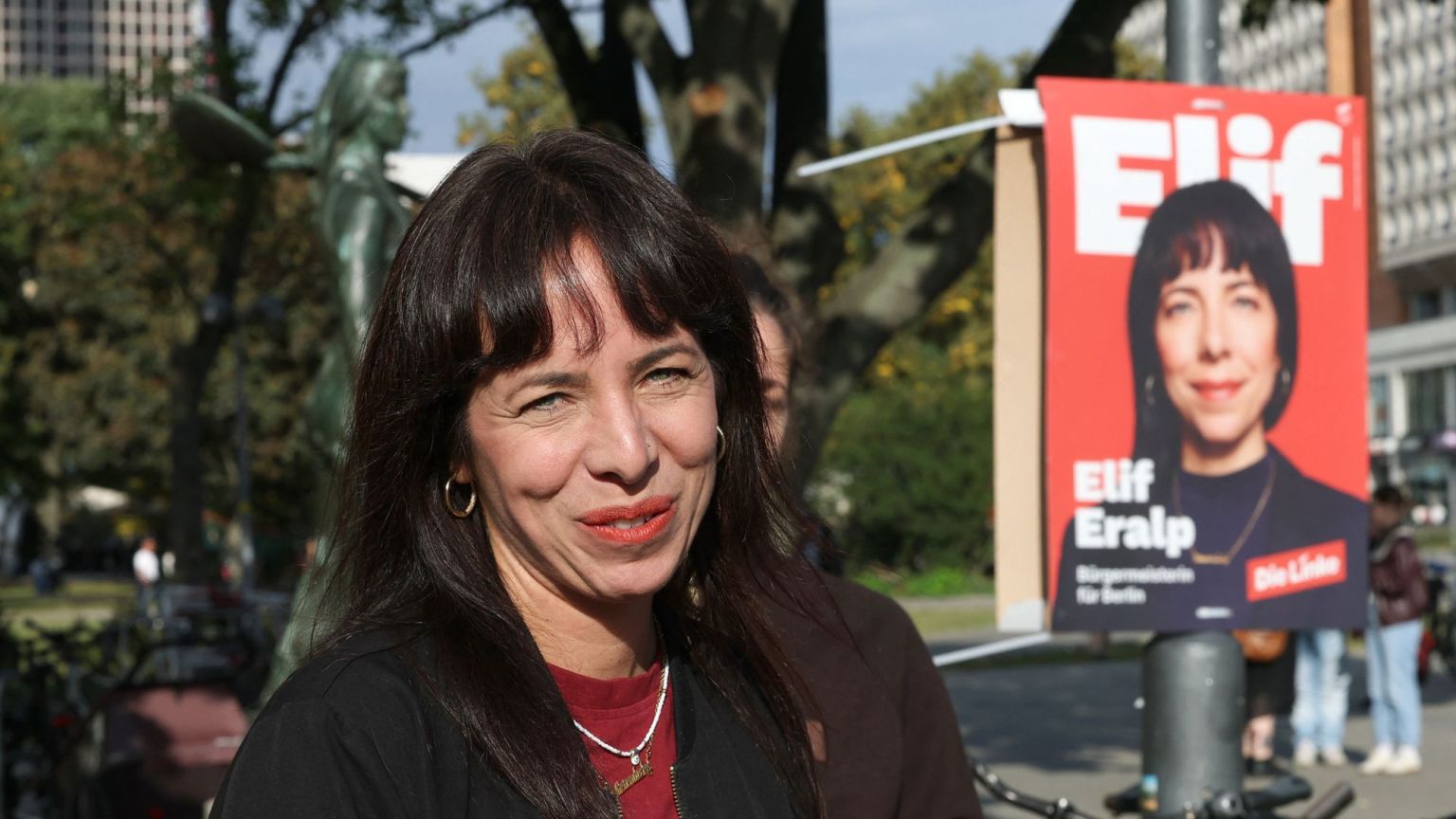
‘Elif Eralp: The Spree’s Mamdani’ is how the press has referred to the party’s lead candidate (the Spree being the river that flows through Berlin), who is now demanding to become Berlin’s new mayor.
The parallels with Zohran Mamdani, the mayor of New York City, are clear. There is Eralp’s personal background, which she put front and centre in the election campaign. She was born in Germany to left-wing, activist, academic Turkish parents who had fled their home after the 1980 coup (Eralp’s mother was pregnant with her at the time). Though she claims it was only thanks to Amnesty International that she didn’t end up in a refugee shelter as a baby, her story has nothing in common with that of the many Turkish workers who laboured in Germany’s factories during the Wirtschaftswunder. Her family was well off: her father was a doctor, her mother a feminist activist and publicist. Eralp herself studied law at the University of Hamburg.
It’s not without irony that a party that has expressed the most open anti-Americanism – referring to the US as an oil-greedy state and a ‘billionaires’ republic’ – should, in its election campaign, emulate America’s biggest city. As Marx might have said, first as tragedy, then as farce.
As with Mamdani, Die Linke is performatively anti-Western and anti-capitalist. Along with a toxic dose of anti-Zionism, this proved to be a winning formula.
In its election manifesto, Die Linke promised to expropriate large housing corporations and impose even stricter rent caps than Berlin already has. ‘We will lower the cost of living immediately and effectively’, the manifesto declared. Few would likely have read this document in full, given its assortment of obscure demands, such as a ban on millionaires. Other plans were entirely outside the scope of local politics, like a ‘good university education for everyone’ or ‘protection of the climate and the oceans’.
Notably, the manifesto called for greater ‘police restraint’ in dealing with minority communities and the reduced use of stop-and-search. It even pledged to cut funding for the police – something that plays well with both the far left and some migrants, but which will do little to reassure Berliners who are anxious about rising crime.
Most critics have focussed on the party’s anti-Semitic undertones. Young activists wear keffiyehs and wave Palestinian flags at election rallies. Die Linke, writes Philipp Peyman Engel of the Jewish newspaper Jüdische Allgemeine, is a party that ‘wants to hand Ukraine over to the Kremlin sooner rather than later; a party thoroughly riddled with hatred of Jews and Israel; a party that the last politicians with decency and a moral compass fled long ago’.
He is right. In late August, only weeks before the election, news emerged that Die Linke had invited the rapper Dahabflex to its ‘Angry at Capitalism’ campaign event in Berlin-Neukölln – a district known for its large Arab population. In his song ‘Stop the Genocide’, the rapper chanted ‘Intifada, West Bank, Palestine, Gaza’, as well as ‘Death to the IDF’. Though leading Die Linke candidates, including Eralp, distanced themselves from the event, it was only the latest in a long series of similar scandals.
What this election has shown above all is how politically divided Berlin really is. In the high-rise housing estates of Marzahn and Hellersdorf, it was not the left but the right-populist AfD that dominated, garnering over 40 per cent of the vote. In the better-off, leafy strongholds of the former West, the CDU held its ground.
Die Linke's stronghold spans both Berlin’s hip, alternative neighbourhoods and the inner-city areas shaped by Muslim and migrant communities. It polled best in ‘alternative’ Friedrichshain-Kreuzberg, with its trendy bars and student milieu, and in migrant-heavy Neukölln.
Die Linke draws support from two milieus. First, a middle-class student precariat – young people who not only struggle to find good, affordable housing, but who also believe that their standard of living, unlike their parents’, may never improve. Then, a Muslim immigrant population that has grown massively in recent years. This group generally identifies more with Palestine than Germany. Die Linke’s platform – which, alongside housing, continues to call for open borders and voting rights for all – appeals to both groups.
In and around the Sonnenallee in Neukölln, popularly known as ‘Little Arabia’, Die Linke garnered well over 40 per cent of the vote. This is also where, to Berlin’s utter shame, the Hamas terror attacks against Israel on 7 October 2023 were celebrated. It was here, too, that on the last day of the state-election campaign, a message went out to the local community on social media – shared by a Die Linke candidate – calling for voters to take part in an ‘election intifada’.
Die Linke’s anti-Zionism may have boosted its popularity among sections of the electorate, but this could also prove to be its biggest stumbling block. Though Eralp has staked her claim to the mayoralty, it remains unclear whether she will succeed. To gain a majority, she will need the Greens and the Social Democrats (SPD) as coalition partners. While the Greens had initially suggested they might support a Linke-led coalition, they appear to be reconsidering, as more scandals have emerged in the press. At the time of writing, the support of the SDP looks wobbly, too.
This is hardly a surprise. There are elements within Die Linke that no serious politician would want to be associated with. At Die Linke’s election party, Berlin’s most notorious gangster and clan boss, Issa Remmo, made an appearance. He told reporters he was delighted at the party’s success and to have finally found a party he could support. Authorities link the criminal faction of his family to drug trafficking, money laundering and even murder. Major thefts from German museums have also been traced back to the clan. Standing next to Issa Remo was the known Hamas sympathiser, Ibrahim Ibrahim.
Shortly after the election party, it also emerged that Ferat Koçak – a Bundestag MP for Die Linke – had exchanged messages with the clan boss’s son. According to the messages, the MP conveyed ‘respectful greetings’ to Issa Remmo. Koçak also asked for his recent Bundestag speech, in which he criticised the term ‘clan crime’ as racist, to be shared by Issa Remmo.
Still, the tears being shed by supporters of the established parties over the unsavoury aspects of Die Linke are crocodile tears. After all, it is primarily their own failures that produced this election result. Indeed, the CDU, which had won the previous election with a clear majority, was forced to withdraw its candidate – Berlin’s incumbent mayor, Kai Wegner – before the election. This was because of the many untruths he had told about his conduct during January’s catastrophic blackout, which left nearly 50,000 households without electricity and in freezing temperatures for days.
For all the conniptions over the rise of the AfD, the fact that a party of Hamas sympathisers is within touching distance of running the German capital ought to provoke a lot more soul-searching.
Sabine Beppler-Spahl is spiked’s Germany correspondent.
You’ve hit your monthly free article limit.
Support spiked and get unlimited access.
Support spiked and get unlimited access
spiked is funded by readers like you. Only 0.1% of regular readers currently support us. If just 1% did, we could grow our team and step up the fight for free speech and democracy.
Become a spiked supporter and enjoy unlimited, ad-free access, bonus content and exclusive events – while helping to keep independent journalism alive.
Monthly support makes the biggest difference. Thank you.
Comments
Want to join the conversation?
Only spiked supporters and patrons, who donate regularly to us, can comment on our articles.