Friedrich Merz’s betrayals have finally caught up with him
The CDU’s wipeout in Mecklenburg-Western Pomerania has dealt a well-deserved blow to the flip-flopping chancellor.
Want unlimited, ad-free access? Become a spiked supporter.
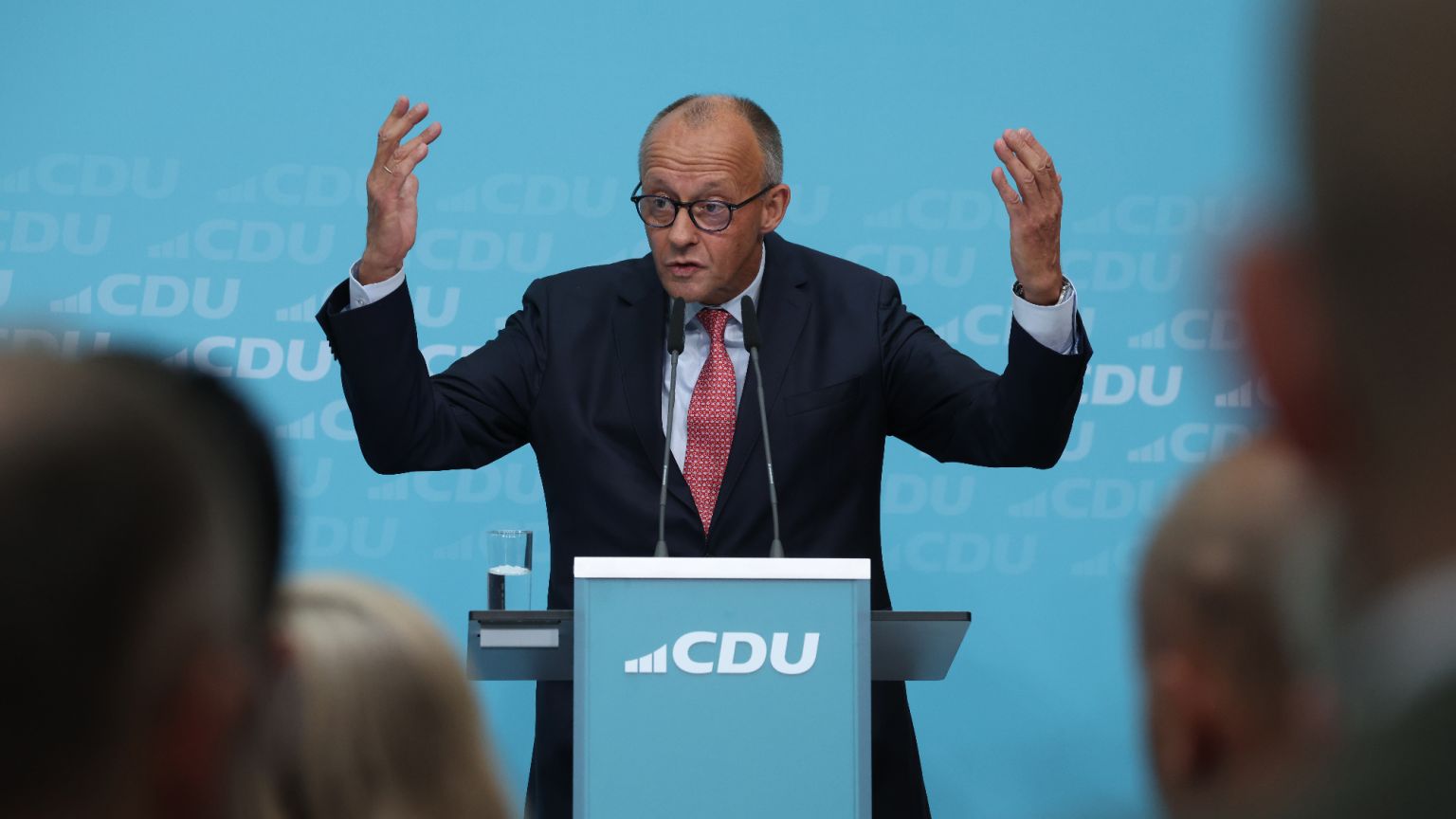
‘There can be no sugar-coating these results’, conceded German chancellor Friedrich Merz last night, following a historic, humiliating defeat for his Christian Democratic Union (CDU) in the regional elections. ‘It is a disaster.’
In the north-eastern state of Mecklenburg-Western Pomerania, the centre-right CDU obtained its worst-ever result in any regional election. With just 4.9 per cent of the vote, the CDU failed to reach the five per cent threshold needed to gain a single seat in the state parliament – the first time this has happened since the Second World War. Meanwhile, Merz’s main rivals to his right, the Alternative for Germany (AfD) party, stormed into first place on 38 per cent, yet they will almost certainly not be able to form a government. The second-placed Social Democrats (SPD) won enough seats to remain in power, likely in coalition with the Left Party (Die Linke) and the Greens.
The CDU also faced setbacks in Berlin’s state elections on the same day, where it was knocked back from first to second place. This time, a resurgent Left Party became the first party outside of the old CDU-SPD duopoly to win in the capital since reunification in 1990.
Although Merz was quick to declare that he would stay on as chancellor, appearing on television just minutes after the polls closed on Sunday, there is no doubt that this wipeout leaves him fighting for his political survival. For months, there had been open discussion in the CDU of a possible Kanzlertausch or ‘chancellor swap’, even before the recent spate of disastrous regional elections. Changing leaders mid-term may be exceedingly rare in Germany, having only happened on three occasions since 1945, yet Merz is now a singularly unpopular and ineffectual leader.
In fact, the Saxony-Anhalt elections earlier this month, in which the AfD almost obtained an absolute majority, were arguably an even bigger catastrophe for the chancellor. After all, Merz had staked his reputation on beating back the AfD. Yet where he promised to halve the AfD’s support, in both Saxony-Anhalt and Mecklenburg-Western Pomerania, the vote share for the populist right has actually doubled since elections were last held in 2021.
There is no doubt that Merz bears a great deal of responsibility for both his own party’s losses and the AfD’s gains. Since winning the 2025 federal elections, his approval ratings have plummeted at an astonishing rate. Within his first 100 days, he became the most unpopular German chancellor in postwar history. According to polling ahead of last weekend’s elections, just one per cent of voters in Mecklenburg-Western Pomerania – including only one per cent of CDU supporters – thought he was an asset, rather than a hindrance, to his party.
And it isn’t hard to see why. Merz has repeatedly and consistently betrayed his voters by flip-flopping on every major issue. In the run-up to the 2025 federal elections, he presented himself as a conservative firebrand. Yet having attacked the Social Democrats for appeasing ‘green and left nutters’, he then immediately hopped into a grand coalition with them. He promised not to tamper with Germany’s debt brake – a constitutional provision that limits government deficits – only to agree to an additional €500 billion worth of borrowing for infrastructure, defence and climate projects. He vowed to reverse Germany’s disastrous, self-defeating policy of shutting down its nuclear-power plants, but later refused to do so, as overturning it in the Bundestag would have required the support of the AfD. Meanwhile, his pledges to tighten up immigration and asylum rules have run aground in the courts. On the economic front, Merz has similarly failed to arrest Germany’s decline.

Yet it would be a mistake to think that a change of chancellor would be enough to halt the AfD’s rise and revive Germany’s beleaguered centrist parties. Merz began his chancellorship at an historic low point for the CDU, which, despite topping the polls in 2025, in percentage terms, had its second-worst result since its founding. Many of Germany’s most acute problems – from mass migration to energy shortages and deindustrialisation – began during the 16-year-long misrule of the CDU’s last chancellor, Angela Merkel, before these were compounded by the SPD and the Greens under Olaf Scholz. It seems that no matter who Germans vote for, they end up with governments pursuing the same failed programmes. Parties can lose significant ground and yet still be propped up in increasingly fragile coalition governments. Excluding the AfD, rather than delivering for the public, is now the overriding goal of all the mainstream parties.
Yet while the CDU and SPD struggle to offer anything distinctive worth voting for, the AfD and, to a lesser extent, the Left Party are mobilising those who wouldn’t normally vote at all. In Mecklenburg-Western Pomerania, around 67,000 former non-voters plumped for the populist right – representing around 29 per cent of the AfD’s support.
Nevertheless, the establishment parties only seem to be able to respond to this mass mobilisation of voters with insults, censorship and other anti-democratic measures. Merz warned darkly last night that the AfD’s success represented a ‘fascination with authoritarianism’ that is ‘penetrating ever deeper into our society’. In the wake of the Saxony-Anhalt results, Hendrik Wüst, minister-president of North Rhine-Westphalia, tipped as a possible successor to Merz, became the first major CDU figure to moot a ban on the AfD. Before that, Boris Pistorius, the SPD defence minister, became the most senior figure in Merz’s coalition to call for ‘an initiation of a prohibition procedure’ against the populists. For the parties in Germany’s political cartel, the voters and their desire for change are framed as a problem to be quashed, rather than a plea to be answered.
Friedrich Merz may well be swapped out before his term is up. But changing leaders while pursuing the same policies – and insulting the voters instead of listening to them – will only lead more Germans to seek an alternative. The CDU’s wipeout is a taste of things to come.

Fraser Myers is deputy editor of spiked and host of the spiked podcast.
You’ve hit your monthly free article limit.
Support spiked and get unlimited access.
Support spiked and get unlimited access
spiked is funded by readers like you. Only 0.1% of regular readers currently support us. If just 1% did, we could grow our team and step up the fight for free speech and democracy.
Become a spiked supporter and enjoy unlimited, ad-free access, bonus content and exclusive events – while helping to keep independent journalism alive.
Monthly support makes the biggest difference. Thank you.





Comments
Want to join the conversation?
Only spiked supporters and patrons, who donate regularly to us, can comment on our articles.