Long-read
The challenge of Islam to British society
Immigration, segregation and Islamist activism are creating a crisis.
Want unlimited, ad-free access? Become a spiked supporter.
There is little doubt that Islam poses a challenge to British society. It is growing in influence and has political as well as religious ambitions.
It is already affecting our democracy and changing our culture. Former home secretary Suella Braverman didn’t hold back in a Telegraph op-ed in February 2024:
‘The truth is that the Islamists, the extremists and the anti-Semites are in charge now. They have bullied the Labour Party, they have bullied our institutions, and now they have bullied our country into submission. This is a crisis. And the fightback must start now, with urgency, if we are to preserve the liberties we cherish and the privileges this country affords us all. If we are to have any chance of saving our country from the mob.’
Braverman made these comments in response to the decision of Lindsay Hoyle, the speaker of the House of Commons, to break with parliamentary convention and allow a Labour amendment on Gaza to be debated on the Scottish National Party’s ‘opposition day’. Hoyle made this decision because of credible threats made to MPs and on parliament itself. By allowing Labour MPs to endorse their party’s own anti-Israel amendment on Gaza, rather than reject the SNP’s more stringently anti-Israel one, Hoyle felt that this would spare Labour MPs from more death threats. He didn’t need to say from whom.
This was not an overreaction. Islamists had struck before. In 2021, the Conservative MP for Southend West, Sir David Amess, was stabbed to death by Islamic State sympathiser Ali Harbi Ali. He told the court: ‘If you encourage someone to an act of jihad it is a good thing.’ Harbi Ali also stated plainly: ‘I killed him in the cause of Muslims and for the sake of Allah.’
And before that, in 2010, Labour MP Stephen Timms was stabbed by a Muslim woman with Islamist motives. He was fortunate to survive the attack. In early 2024, Conservative MP Mike Freer announced that he was to step down as an MP because of serious threats to his personal safety. Freer mentioned that a group called Muslims Against Crusades had told him as early as 2011 to ‘let Stephen Timms be a warning to you’ and urged supporters to target him. Several of these supporters subsequently interrupted an event he was holding at North Finchley Mosque, calling him a ‘Jewish homosexual pig’ who was ‘defiling the house of Allah’. On Christmas Eve 2023, Freer’s office was firebombed.
During recent debates on Gaza in the House of Commons, a journalist reported that one MP had told him that ‘he had weighed up his own physical safety when deciding how to vote’. How many other MPs did this?
Even when not violent, the impact of a growing Islamic sectarianism on our democracy has been profound. Understanding Islamopopulism, a Policy Exchange report published in May, revealed that the most important concern for Muslim voters is not the economy, education, housing or healthcare, but Gaza. The poll also found that 63 per cent – nearly two-thirds – prioritise their Muslim identity over their British identity. This is something that the Green Party and Muslim independent candidates have exploited. They won seats at the 2024 General Election by appealing to Muslim-identity issues in constituencies with large Muslim populations, and this year, the Green Party won the Gorton and Denton by-election, deploying campaign leaflets and videos in Urdu, and prioritising the issues of Gaza and so-called Islamophobia.
There is a demographic context to all this. In 1960, Britain’s Muslim population numbered just 105,000. By 2011, there were 2.7million Muslims in Britain. At the most recent Census in 2021, that number had risen by 44 per cent, to 3.9million. That is about 6.5 per cent of the population. Islam is now the fastest-growing religion in the UK. Researchers estimate that by 2050, 17 per cent of the population will be Muslim, based on moderate migration.
The Policy Exchange report, Unsettled Belonging: A Survey of Britain’s Muslim Communities, published in 2016, claimed to be the most extensive research of British Muslims ever conducted. It found that 53 per cent of Muslims were born outside the UK, while 93 per cent had parents born outside the UK. This shows that much of the growth is occurring through immigration.
These huge demographic changes have gone hand in hand with a crisis of integration. According to Unsettled Belonging, 43 per cent of Muslims supported the introduction of Sharia law broadly defined, 53 per cent preferred to send their children to a school with strong ‘Muslim values’, and 44 per cent said that schools should be able to insist on ‘a hijab or niqab’ in uniform.
A 2015 ICM survey found that seven per cent of Muslims support the objective of creating an Islamic state, while three per cent said they supported ISIS’s attempt to establish a caliphate – this is a small minority of British Muslims, but it still amounts to 120,000 people. (An estimated 900 actually travelled to Syria or Iraq to join ISIS.)
When it comes to free speech, the same survey found that 78 per cent of Muslims believed that no publication should have the right to publish pictures of Muhammad. This rose to 87 per cent when talking about the right to publish pictures making fun of Muhammad. Furthermore, 18 per cent sympathised with violence against those who mock Muhammad.
Dame Louise Casey’s government-commissioned review into opportunity and integration, published in December 2016, painted a similarly segregated view of Britain’s religious minorities. She said that all submissions to the review indicated a problem with integration, and drew attention to the ‘cultural and religious practices in communities that are not only holding some of our citizens back but run contrary to British values and sometimes our laws’. She was clear that too many institutions ‘have gone so far to accommodate diversity and freedom of expression that they have ignored or even condoned regressive, divisive and harmful cultural and religious practices, for fear of being branded racist or Islamophobic’.
Casey concluded that Islam posed a particular problem: ‘We found a growing sense of grievance among sections of the Muslim population, and a stronger sense of identification with the plight of the “Ummah”, or global Muslim community.’ Sir Trevor Phillips, former head of the Equality and Human Rights Commission, acknowledged in 2016 that ‘the integration of Muslims will probably be the hardest task we have ever faced’.
The lack of integration – and accompanying segregation – is exacerbated by the concentration of Muslims in certain urban areas. The 2021 Census showed that major cities and towns such as Bradford, Luton and Birmingham all have populations that are over 30 per cent Muslim. Ahead of the 2024 General Election, an organisation called the Muslim Vote compiled a list of parliamentary constituencies where the Muslim vote is at least 10 per cent. It found 14 constituencies that are over 30 per cent Muslim, and 31 constituencies that are over 20 per cent Muslim. The concentration of Britain’s growing Muslim population in certain areas is creating segregated communities where some Muslims have little interaction with people from other communities, and where children attend Muslim-majority schools.
The cultural influence of Islam has certainly increased over the past few decades. Mainstream retailers like Marks and Spencer sell Islamic clothing such as hijabs. Multiple mainstream supermarkets and restaurant chains sell halal meat – the UK carries out more halal slaughter than the rest of Europe. London hosts an Islamic shopping festival, and a London Eid festival claims to attract 350,000 people. Is there any Christian festival that can compare?
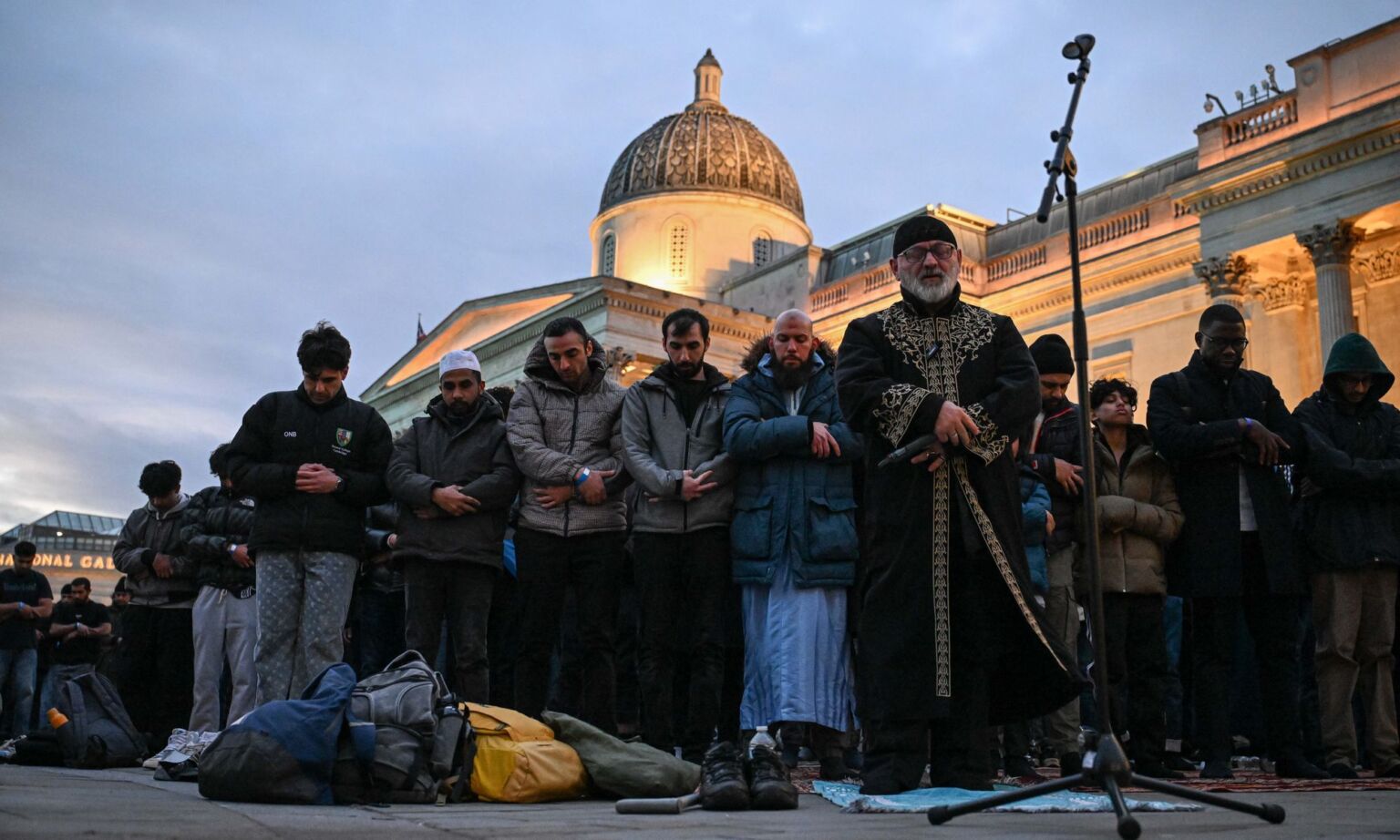
In his 2021 book, Among the Mosques, Muslim commentator Ed Hussain wrote about his experiences travelling around Muslim Britain. It makes for a disturbing read. He found that some places are considered no-go areas for ‘whites’. He found Islamic monocultural areas that demonstrate the abject failure of multiculturalism. Major retailers have deserted such areas, and there are no pubs at all. He also found that fundamentalist literature of the kind banned in Saudi Arabia is on sale in virtually every Islamic bookshop he visited.
Hussain warns:
‘What will happen when Birmingham or Bradford have a Muslim majority and organised caliphists hold the balance of power? Does the city begin by banning alcohol sales, using council funds to remove statues offensive to monotheism, enforcing new school uniforms for girls that exclude short skirts, banning nightclubs and gay bars, or making Fridays a local holiday for communal prayers? Caliphism and clericalism are sequestering an entire community away from meaningful contact with mainstream Britain. The cordon sanitaire around many minds will become solidified unless we change course.’
As far as religious influence goes, this is most symbolically demonstrated by the conversion of many church buildings into mosques.
Education is becoming a key battleground. Exam boards have rescheduled exams to avoid clashing with Ramadan. Islamic schools have been found to contain extremist material. One teacher at a mostly Muslim school, writing anonymously in The Times in 2024, related how some of her pupils tried to convince her that Afghanistan was much nicer now with the Taliban back in control. When she asked her class of 12- to 13-year-olds to raise their hands if they hated Britain, 30 hands immediately shot up with absolute certainty. She said: ‘Most of the lads I teach think women should have fewer rights than men. They spend citizenship lessons arguing that wives should not work.’
In recent years, there have been several examples of Muslim-led protests leading to the increased Islamisation of schools. St Stephen’s School in Newham was named the best primary school in England in 2017. But in 2018, it faced a targeted campaign from activists after it banned girls under eight years old from wearing the hijab in school. The school asked for government support, pointing out that standard Islamic teaching does not require the hijab until puberty, but the government refused to intervene. St Stephen’s was then forced to reverse its decision. Indeed, it was reported that there are now 150 schools around the country that make it compulsory for children to wear hijabs.
In 2019, Muslims parents withdrew their children from Parkfield Community School in Birmingham, in protest at lessons on homosexuality and gender equality. An estimated 600 pupils were withdrawn, or 80 per cent of the school enrolment. In 2023, over 300 Muslim children were kept out of a school in Manchester for three days in protest about ‘age-inappropriate sex-education teaching’. Two hundred parents wrote to the school to voice their complaints.
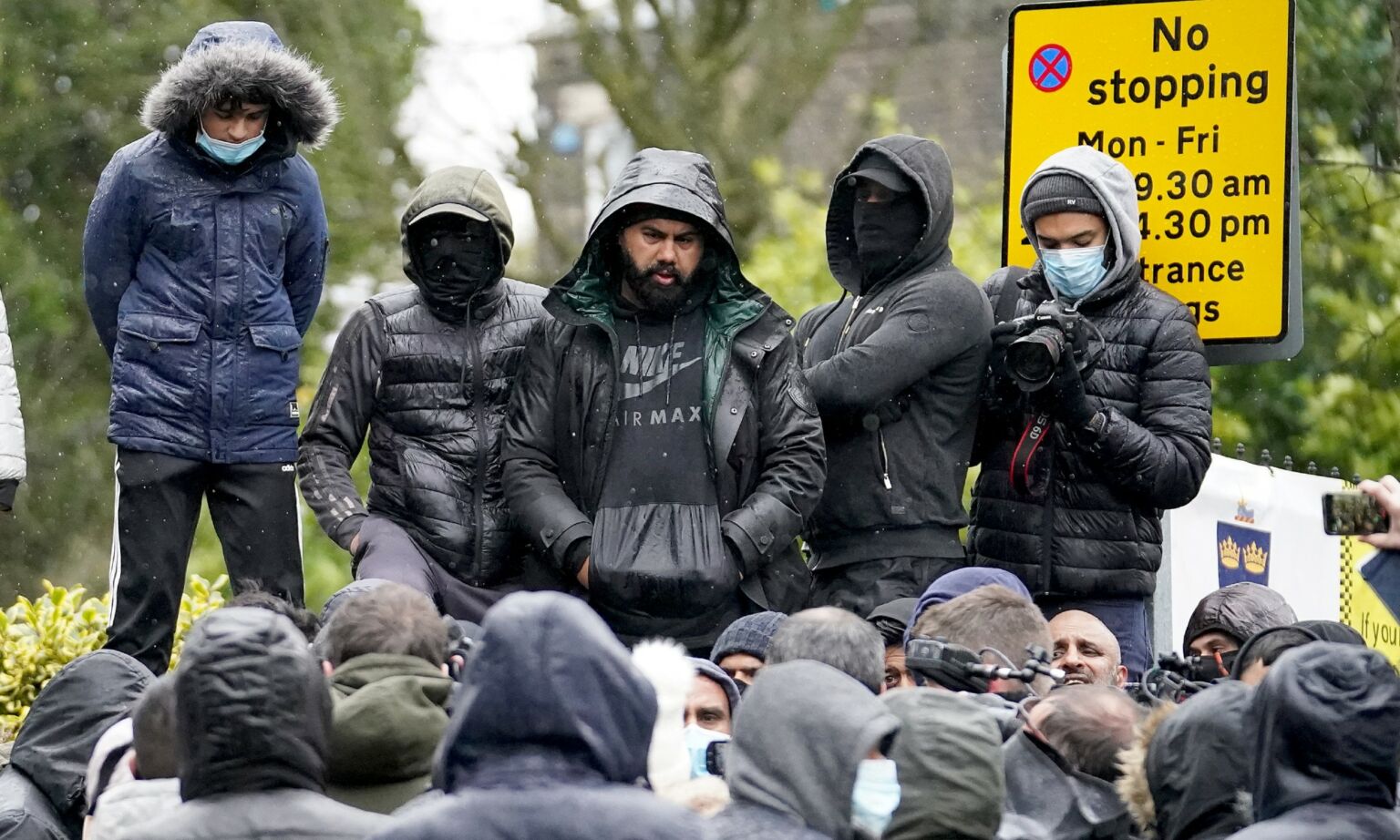
In 2021, a teacher at Batley Grammar School, in Yorkshire, showed a cartoon of Muhammad during a lesson on blasphemy and free speech. Crowds of Muslim activists later gathered outside the school to protest, forcing the school to shut for two days in a row. The teacher was subsequently suspended and was forced to go into hiding for his own safety. He remains in hiding to this day.
In 2023, four boys were suspended from a school in Wakefield after a copy of the Koran owned by one of the boys was dropped on the floor, causing it to be slightly scuffed. The boy and his family subsequently received multiple threats of violence. Astonishingly, the police got involved and recorded the dropping of the Koran as a ‘non-crime hate incident’. This means that police are operating as if there is an Islamic blasphemy law in place. Can anyone imagine a similar response if a Bible were dropped by a school pupil?
And in 2024, there was the case of the Michaela Community School in London, a high-achieving secular school led by high-profile headteacher Katherine Birbalsingh. The school banned prayer rituals in the playground, after some Muslim pupils were pressuring others to participate. This resulted in a Muslim-led campaign against the school, featuring multiple threats to staff and a brick thrown through a teacher’s window. Fortunately, the school won the subsequent legal case, but on specific grounds that may not apply to other schools.
Islam is posing a challenge to law and order. In the year ending March 2025, the police recorded 2,949 ‘honour-based’ offences, including female genital mutilation, forced marriage and psychological, physical and emotional abuse. That’s an average of eight offences per day, and many more are undoubtedly unrecorded. Less than three per cent of these crimes were successfully prosecuted, leading police to be accused of turning a blind eye to these kinds of offences.
Prisons in particular are proving a breeding ground for Islamic extremism. Muslims are disproportionately represented, at 18 per cent of the prison population. A government report from 2016 found that prison imams are routinely distributing extremist literature among prisoners. There are also reports of prisoner-run ‘Sharia courts’ operating inside, carrying out various types of corporal punishment. Furthermore, the latest statistics show that 20 per cent of Muslim prisoners are white, compared with 7.8 per cent of Britain’s general Muslim population. This indicates the extent of Islamic conversions among the prison population. The net result is that prisoners leave prison more radicalised than when they went in, with many converting to Islam in prison.
This brings us to the threat of violent jihadism. In 2020, the Telegraph reported that 90 per cent of MI5’s 43,000-person terror watchlist were classed as jihadists. The government’s most recent report on countering terrorism from 2023 makes clear that the primary domestic terrorist threat comes from Islamist terrorism, which accounts for approximately 67 per cent of attacks since 2018, and around 75 per cent of MI5’s caseload. The current terrorism threat level was upgraded earlier this year to ‘severe’, meaning that an attack is highly likely.
At the same time, those tasked with protecting British citizens appear to be losing sight of the threat. In 2024, it emerged that police were being educated about ‘Islamophobia’ by radical campaign group MEND, which has defended jihadists and led prayers for ‘Palestinian victory’ in Israel. In a separate incident that same year, the Metropolitan Police were forced to cut ties with an adviser, Mohammed Kozbar, chairman of the Finsbury Park Mosque, after it emerged that he had ‘liked’ a post on X from the head of proscribed extremist group Hizb ut-Tahrir and had praised Hamas’s founder as ‘the master martyr of the resistance’. There are real concerns about infiltration into mainstream and government-linked organisations by Muslims with radical sympathies.
Then there’s the presence of Sharia law in the UK. It has been estimated that there are over 85 Sharia courts operating in the UK. This has created a de facto parallel legal system for people in some communities. Women, in particular, may face tremendous family pressure to use Sharia courts, and may lack both the necessary English-language skills and a proper understanding of their rights under British law to otherwise enjoy the protections that would be afforded them through the English court system. Dutch political scientist Machteld Zee has exposed how many of those promoting the operation of Sharia councils in the UK are actually fundamentalists who want to turn the UK into an Islamic state, imposing Sharia law on all citizens.
Sharia law is inherently discriminatory against both women and non-Muslims. In these courts, a woman’s voice counts half as much as a man’s voice. Some Sharia court judges have argued for child marriage, or say that ‘a husband should not be questioned why he hit is wife’.
Among Western societies, Britain seems particularly receptive to Sharia law. In 2014, it became the first non-Islamic country to issue a sovereign Sharia bond. There are now nine banks offering Sharia-compliant products in the UK. In 2014, a government report stated that these had over 100,000 retail customers. The UK seems committed to London becoming a centre for Islamic finance.
It’s clear that Islam poses a profound challenge that requires bold and courageous responses from British society, from faithful Christians to secular-minded citizens. In my book, The Challenge of Islam, and in this essay, I have sought to highlight the role and influence that Islam now has in the UK. We need to understand the challenge of Islam and work out how to respond. At its root, this is a battle for the soul of the nation. A battle for tolerance and integration against the sectarian forces of intolerance and segregation. And it is a battle we cannot afford to lose.
This is an edited extract from The Challenge of Islam, published by Wilberforce Publications.
Tim Dieppe is a writer and head of public policy at Christian Concern.
You’ve hit your monthly free article limit.
Support spiked and get unlimited access.
Support spiked and get unlimited access
spiked is funded by readers like you. Only 0.1% of regular readers currently support us. If just 1% did, we could grow our team and step up the fight for free speech and democracy.
Become a spiked supporter and enjoy unlimited, ad-free access, bonus content and exclusive events – while helping to keep independent journalism alive.
Monthly support makes the biggest difference. Thank you.
Comments
Want to join the conversation?
Only spiked supporters and patrons, who donate regularly to us, can comment on our articles.