What has Europe done to deserve Ursula von der Leyen?
Her big ‘State of the European Union’ speech proved that the EU has no answers to the pressing issues of our age.
Want unlimited, ad-free access? Become a spiked supporter.
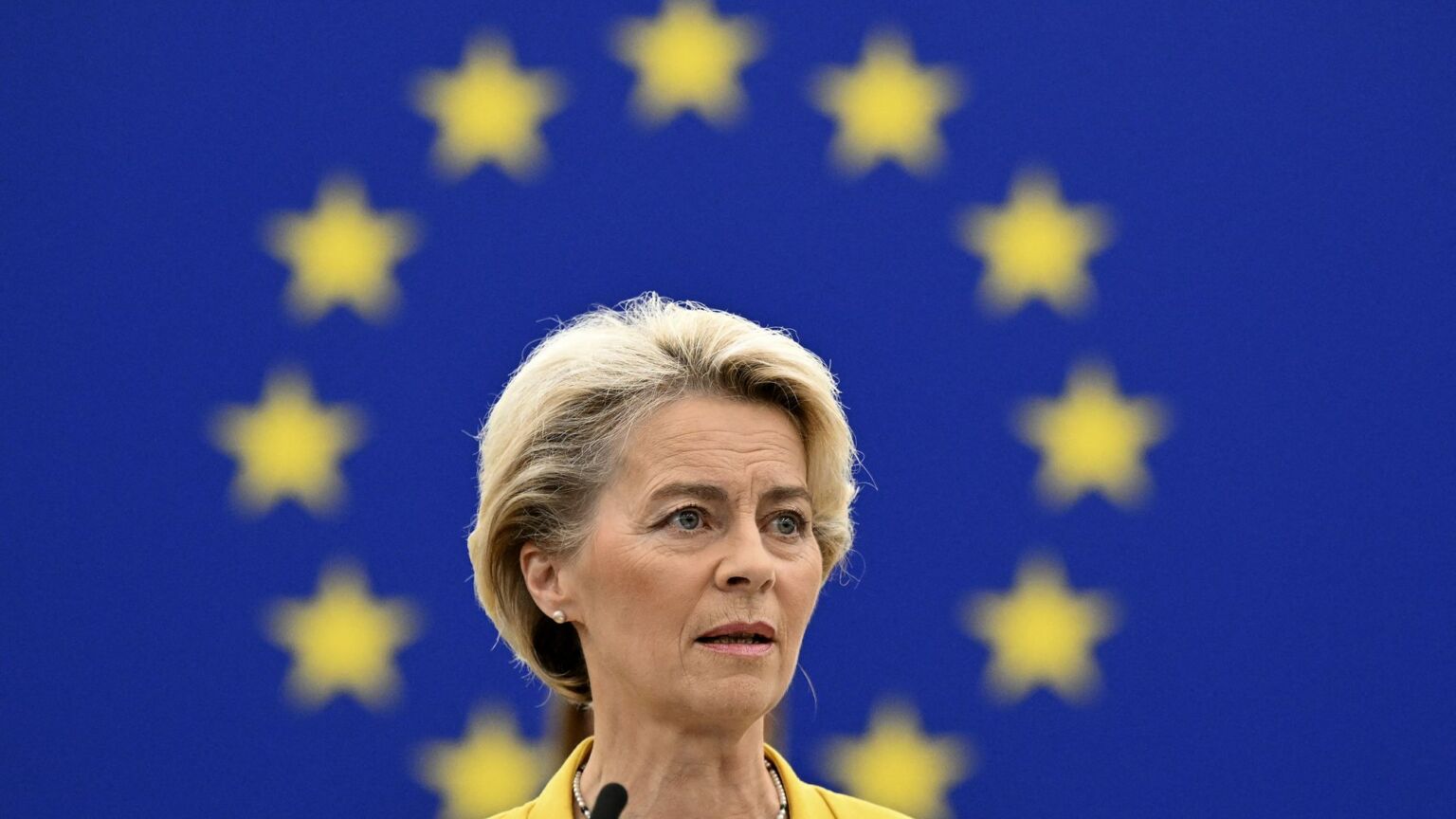
Ursula von der Leyen, the president of the European Commission, delivered her ‘State of the European Union’ speech in the European Parliament on Wednesday. The now annual tradition is the EU’s attempt to channel the grand spectacle of the US president’s far more consequential State of the Union address.
The contrast could not have been more stark. For one thing, the US president is the most powerful elected figure in the world; the president of the European Commission is not elected at all.
Von der Leyen, or VDL as she is known in Brussels, is not noted for her charismatic delivery. But even by her dismal standards, sustaining that drone for 75 whole minutes took some doing. Every Brussels buzzword got a mention. New initiatives were floated. And yet amid it all, she failed to provide any real answers to the gigantic problems facing the bloc.
VDL and other Eurocrats are partly responsible for creating those problems. She may today talk urgently about cutting red tape and reviving European industry. But it was the European Commission that spent years expanding precisely the regulatory machinery that European firms complain about. Brussels constructed an economic model in which producing things became harder and energy became dearer. The sole growth industry is now bureaucracy.
As is common among European elites, VDL only seemed impassioned when talking of the enemies of ‘European unity’. She invoked the familiar bogeymen of ‘ultranationalists’, ‘anti-Europeans’, ‘Russian interference’ and ‘disinformation’. Their goal, she said, was to ‘shatter our European unity’, because they ‘despise our values’.
But what are these EU values exactly? Suspicion of democracy? Regulation? Indeed, the only time the European Commission seems confident is when it is regulating something. VDL’s speech was no exception. She promised to impose an ‘EU Kids Act’ which would ban under-13s from the internet. Even worse, she proudly proclaimed that she would be ‘reversing the burden of proof’ for online companies and platforms – they will now ‘have to prove to us that they are safe’.
She also talked up the ‘Centre for Democratic Resilience’, an EU initiative clearly conceived as a command-and-control centre for monitoring speech and interfering in elections. She said this centre would not just look at Russia but also target ‘anti-European forces’ within the EU, which presumably include any mildly populist, Eurosceptic grouping or party. And she once again celebrated the ousting of Hungarian prime minister Viktor Orbán – she even let slip that Hungary would be rewarded for making ‘the right choice’, with the EU poised to release ‘billions of euros of investment in Hungary’.
When the speech was not sinister, it became surreal. VDL was clearly delighted to have the darling of the technocrats, Canadian prime minister Mark Carney, in the audience. European elites have recently become rather enamoured with the idea of an alliance with Canada to counterbalance the Big Bad America of Donald Trump. VDL went so far as to offer Canada the chance to become ‘the first associate member of the EU’. It did not matter that there is no such thing as ‘associate membership’ in any of the EU treaties. Part of her rationale for the new agreement with Canada was that ‘we share one ocean’ – which is one way of overcoming the fact she was offering a diluted form of membership to a country not in Europe. All this was made doubly surreal by the fact that EU officials had earlier been briefing the Financial Times that Carney’s own offer of a ‘unique alliance’ would not be taken up.
Unfortunately for VDL, most of the problems she doesn’t have answers for can be traced right back to the EU and the European Commission’s door. The majority of these issues stem from the Brussels elite’s radical separation from, and hostility to, the European demos. With unusually amusing timing, elite barometer Politico sent an email update midway through VDL’s speech asking ‘Ursula von der Who?’. This was hooked off a new poll that found ‘more than one in five French respondents said they didn’t know’ who VDL is. Given that no one in Europe was invited to vote for her as Commission president, this is not surprising.
This chasm between the Commission and ordinary people drives much of the EU’s policy machinery. Indeed, in lieu of any connection to the people of Europe, the Commission has long been forced to invent its own parallel version of society. The EU spends billions funding and manufacturing a so-called European civil society – the funding for NGOs and media outlets is set to expand to a staggering €8.6 billion for the next EU budget. One journalist let it slip that there were around 500 journalists in Strasbourg listening to VDL’s speech – and that ‘the vast majority’ of these are ‘subsidised by the European Parliament’. Yet even these astroturfed journalists are increasingly looking more like professional mourners than effective propagandists.
After this deathlessly dull, empty speech, it was difficult to avoid the question: what is the point of Ursula von der Leyen? And beyond that lurks the bigger, existential question: what is the EU itself for? It’s not clear if anyone knows.
Jacob Reynolds is head of policy at MCC Brussels.
You’ve hit your monthly free article limit.
Support spiked and get unlimited access.
Support spiked and get unlimited access
spiked is funded by readers like you. Only 0.1% of regular readers currently support us. If just 1% did, we could grow our team and step up the fight for free speech and democracy.
Become a spiked supporter and enjoy unlimited, ad-free access, bonus content and exclusive events – while helping to keep independent journalism alive.
Monthly support makes the biggest difference. Thank you.

Comments
Want to join the conversation?
Only spiked supporters and patrons, who donate regularly to us, can comment on our articles.