Fury over migration has not been ‘whipped up’ by the right
The ‘lived experience’ of millions of voters cannot be wished away so easily.
Want unlimited, ad-free access? Become a spiked supporter.
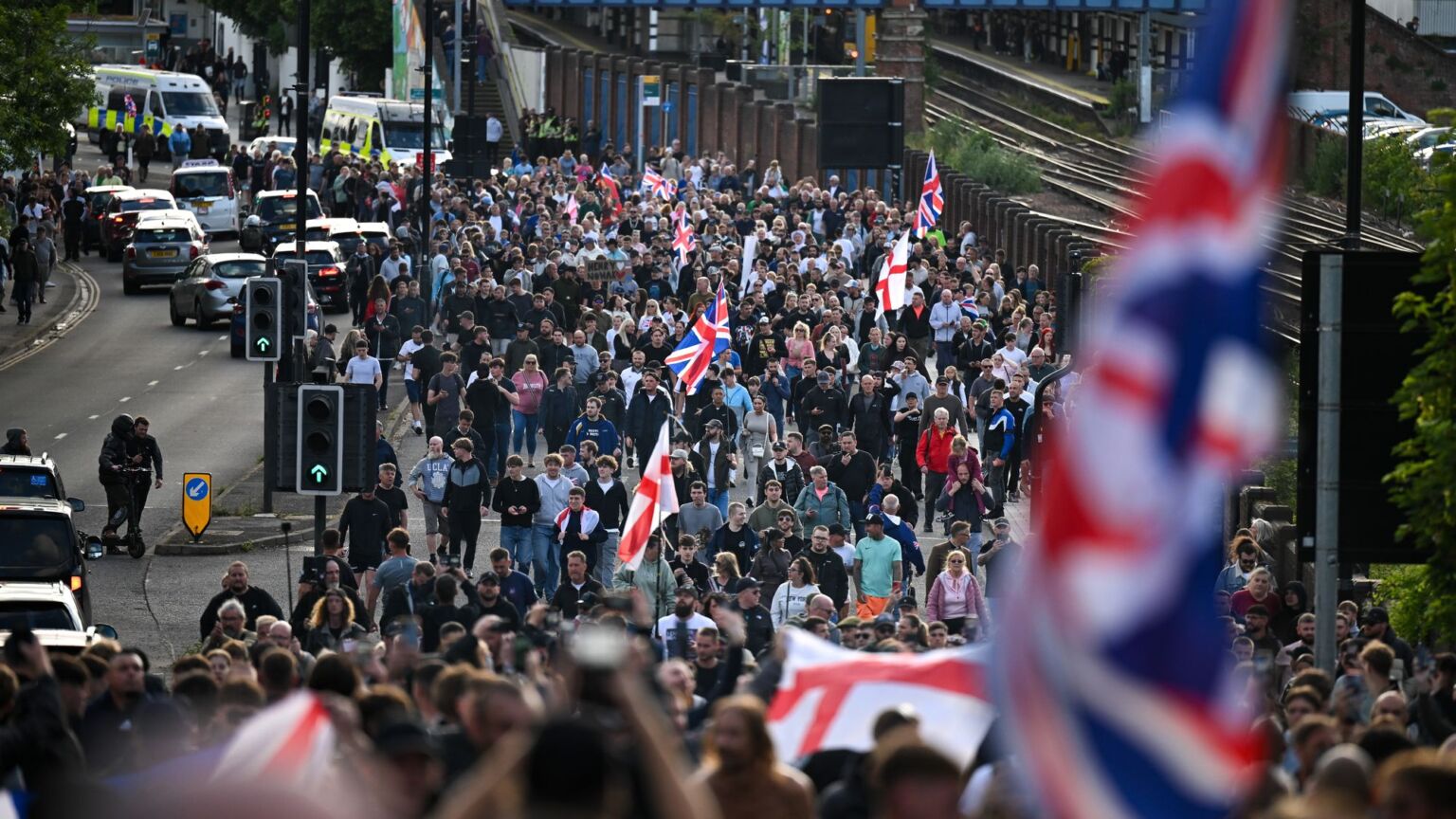
There is usually a very singular and overarching explanation from much of the British establishment when working-class communities express anger over such issues as immigration, crime or economic decline: they must have been manipulated into thinking that way. And when, after years of not having their voices heard, this anger bubbles up into rioting – never a good idea, never to be encouraged, but often understandable in its sentiment – the same explanation comes out again.
We’ve seen this over the past month or so, just as we’ve seen it repeatedly in recent years. When residents protested outside migrant hotels last year – in places as disparate as Epping, Rotherham, Falkirk and Norwich – there was plenty of commentary looking to explain away their concerns as the product of far-right agitation. Few people, it seems, want to ask why ordinary people were turning up in the first place – or, at least, they might have been asking why, but they certainly didn’t seem prepared to hear the answers.
The recent unrest in Belfast – or the outright unconscionable violence in Belfast, to be fair – and demonstrations a few days before that in Southampton have been repeatedly viewed by the left through the same lens: as outbreaks of manipulation, misinformation or extremism.
This explanation often feels both suspiciously convenient and spectacularly patronising. It allows politicians and commentators to focus on who is supposedly influencing people, rather than on the grievances those people are expressing. The possibility that thousands of citizens might have arrived at similar views independently through their own experiences and observations – or, at least, that they might have parsed the media’s output and come to similar conclusions – seems to escape them. Or so they say.
Modern Britain is full of people who speak reverently about the importance of lived experience. We are constantly being told that people understand their own lives better than distant observers ever could. Fair enough, I suppose. Yet this principle seems not to apply when working-class people reach conclusions that the chattering classes dislike. Suddenly, lived experience becomes ignorance. First-hand observation becomes prejudice. Political disagreement becomes evidence of manipulation – a manipulation their own supporters would never fall prey to, to hear the Zack Polanskis of the world tell it. They are presumably too well-educated and / or virtuous for all of that. Some people are just better – you could see it as a modern Calvinism by the back door.
In this way, working-class members of the British electorate are treated more like patients than citizens, suffering from a condition that requires diagnosis and correction, both readily offered.
Of course, politicians, journalists and campaigners influence public opinion. They always have. So they should. Yes, Nigel Farage calling for ‘pure, cold rage’ after Henry Nowak’s murder trial would have been a red flag to many a bull. And yes, the political temperature has been climbing for some time now. But it is absurd to suggest that millions of people have arrived at similar conclusions purely because they have been whipped into a frenzy by demagogues.
They live in their communities, see things they don’t like, consistently vote against those things, and have their views ignored – just as they have been ignored for decades. So it doesn’t take much to mobilise them into the only action that will get them noticed.
People do not need a tabloid headline to tell them that their wages have stagnated, that they or their children cannot find jobs, that it’s taking two people’s full-time wages to fund a household that used to enjoy greater purchasing power on one. They do not need a populist politician to inform them that housing has become harder to access. They do not need a social-media influencer to notice that public services are under strain, that their town centre has deteriorated or that the character of their neighbourhood has changed dramatically over the course of a generation.
These are observations drawn from daily life. All the commentariat can do is gaslight them (as most are doing) or tell them that yes, they’re on to something (these are the ones usually accused of whipping people up, obviously).
Immigration provides perhaps the clearest example. It’s certainly the most tangible one at the moment – it’s in the air. For decades, opinion polls have consistently shown substantial public concern about immigration levels. Election after election, voters have backed parties promising tougher controls. In 2016, immigration was one of the central issues driving support for Brexit. Yet throughout this period immigration levels continued to rise to historically revolutionary levels – all across the country. Not since the Angles, Saxons, Jutes and Frisians argued over ancient Britannia have we seen such radical change.

People have noticed, and most people are unhappy about it – they just happen not to be the ones in power.
One need not oppose immigration to recognise the democratic significance of this fact. Millions of voters have repeatedly expressed a preference. Governments of various political colours have repeatedly failed to act upon it. To suggest that concern about immigration persists only because newspapers keep inflaming the issue is to ignore the obvious. People are concerned because they remain unconvinced that their views are being heard.
The same pattern applies to a host of other issues. Whether the subject is crime, anti-social behaviour, deindustrialisation or economic insecurity, ordinary people are often told that the problem lies not with the conditions they describe but with the information they consume. The diagnosis is always the same. The public is wrong. The public has been misled. The public requires re-education. This reveals a profound distrust of democracy itself.
In a healthy democracy – which, I am told, we used to be – citizens are free to reach conclusions disliked by their elected representatives. Disliked by anyone, really. They are free to hold and espouse views that academics, journalists and politicians consider mistaken or morally questionable. The answer is to listen to them and either argue the toss or (preferably) switch course, not to simply shout them down as stupid bigots.
Yet, increasingly, sections of the British commentariat appear unable to accept that voters may have arrived at their opinions honestly. They search endlessly for malign influences, foreign actors and populist agitators – of which, admittedly, there are and always have been plenty. But they are not scapegoats and their existence doesn’t delegitimise a whole body of people and their opinions.
There is a long tradition on the left of criticising the upper classes for assuming they know what is best for ordinary people. Yet much contemporary commentary reproduces exactly this attitude. It assumes that working-class voters are incapable of understanding their own interests and must therefore be guided towards the correct conclusions by enlightened professionals. It’s class prejudice of the worst kind, and it’s bloody hypocritical to boot.
James Dixon is a Glasgow-based novelist, poet and playwright.
You’ve hit your monthly free article limit.
Support spiked and get unlimited access.
Support spiked and get unlimited access
spiked is funded by readers like you. Only 0.1% of regular readers currently support us. If just 1% did, we could grow our team and step up the fight for free speech and democracy.
Become a spiked supporter and enjoy unlimited, ad-free access, bonus content and exclusive events – while helping to keep independent journalism alive.
Monthly support makes the biggest difference. Thank you.




Comments
Want to join the conversation?
Only spiked supporters and patrons, who donate regularly to us, can comment on our articles.