The myth of Europe’s ‘fascist’ revival
From Giorgia Meloni to Nigel Farage, Europe’s populist right is democratic, dovish and conservative not revolutionary.
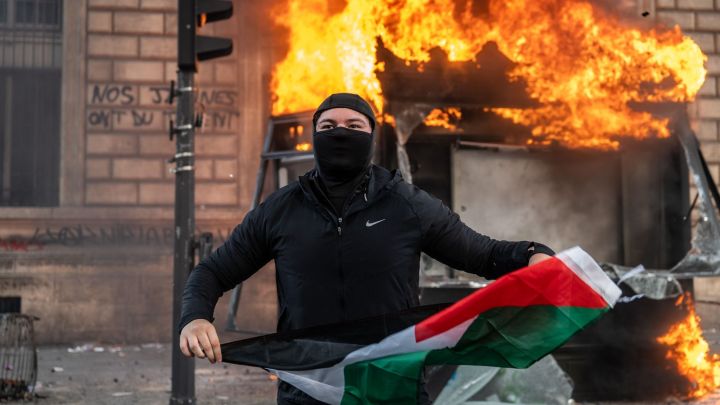
Read our latest coverage of the French riots here – paywall-free all of this week..
There’s a spectre haunting Europe – the spectre of fascism. Or at least that is what the Brussels establishment and its media allies seem to think. They never cease to liken the rise of national-populism to the movement that devastated the continent from the early 1920s until the end of the Second World War.
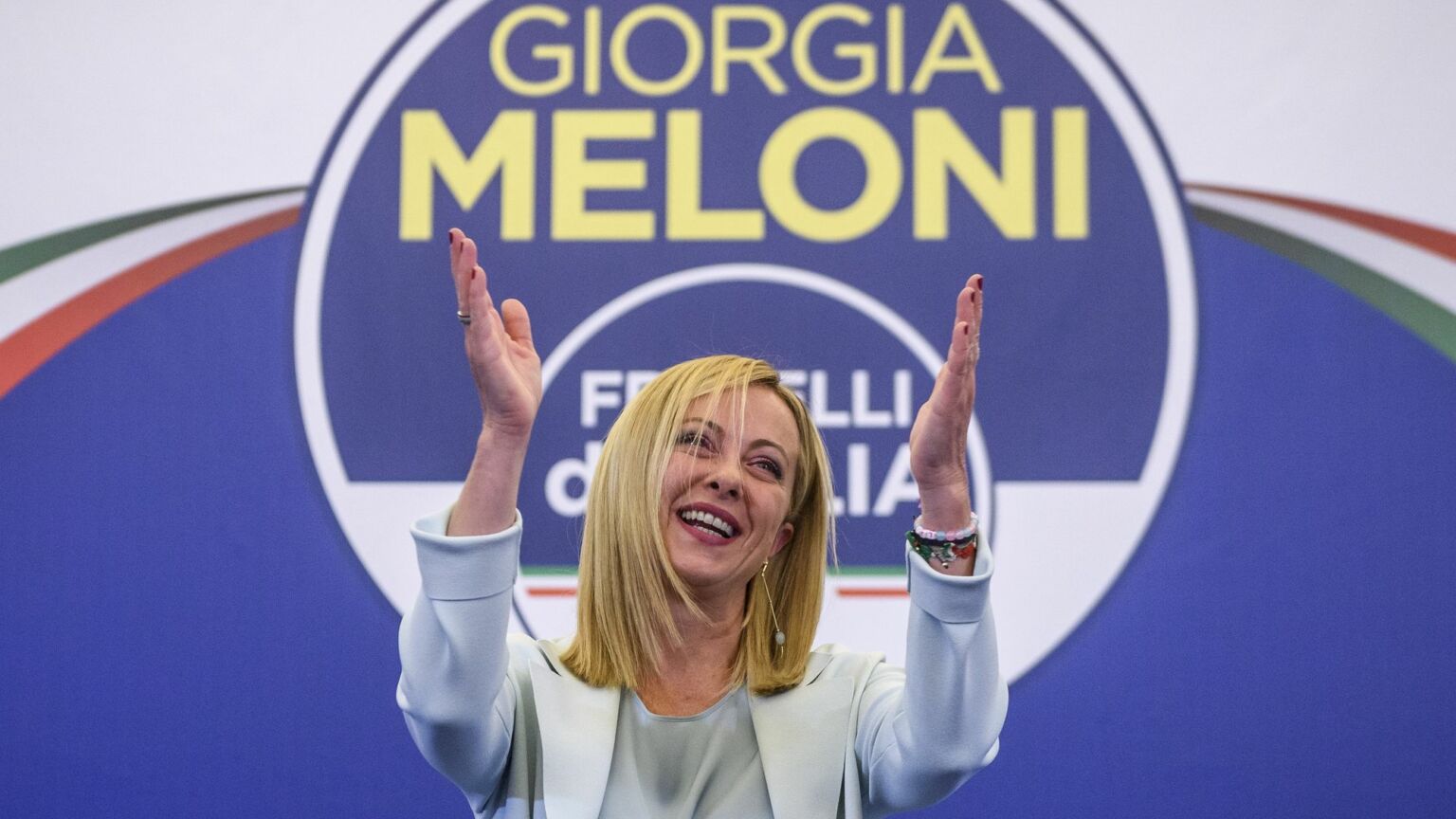
Yet is the right-wing, populist rebellion really a copy of 20th-century fascism? The Guardian, unsurprisingly, thinks so, raising the idea that Italian prime minister Giorgia Meloni, the one right-wing leader currently in office in a major country, represents a new version of Mussolini’s fascist movement. Much the same charge has been levelled at other Europeans labelled ‘far right’.
To be sure, many of the ascendant parties – the National Rally in France, Meloni’s Fratelli d’Italia, Germany’s AfD and even Nigel Farage’s Reform UK – have attracted some unpleasant figures, and even some genuine admirers of Mussolini. But are these parties and their supporters fascist in intent and tactics?
We certainly see nothing like the ecstatic crowds that came to hear Il Duce’s speeches. Right-wing protests do not generate anything like the enthusiasm that fascism inspired in Italian society, or later under Adolf Hitler in Germany.
Let’s look at Meloni, whose party has the closest historical ties to Mussolini’s movement. She hardly governs with dictatorial powers – she recently lost an important referendum on judicial reform and meekly accepted the result. She has also backed away from some of the promised crackdowns on immigration, largely at the behest of the business elite. ‘She has been about standing still’, suggests Mattia Guidi of the University of Siena. ‘She’s muddling through.’
When Meloni lost, no ‘blackshirts’ stormed the streets of Rome holding fasces or pictures of her. Likewise, when Viktor Orbán, often labelled a neo-fascist destroyer of democracy, lost this year’s Hungarian election, he simply yielded to the voters’ wishes and stepped down. He was then replaced by another rightist who promised to continue the country’s closed-door policy towards refugees and illegal migrants.
Yet the term ‘fascist’ does serve a purpose. It allows Europe’s elites, and their mimics in Britain, to deflect attention from the real cause of the rightward turn: their own failures.
In reality, the ‘far right’ of today does not resemble the fascists of the 1920s and 1930s. The son of a socialist blacksmith, Mussolini viewed himself as a revolutionary transforming society. Il Duce defined fascism as ‘organised, concentrated, authoritarian democracy’. His goal was to establish a ‘sublime totalitarian order’. During his heyday, he was widely admired in the West. The usually sober Times of London reported that under the fascists, ‘Italy has never been more united than she is today’, adding that the regime fostered a ‘spiritual revolution’.
The current far right lacks such a revolutionary vision. Italian fascism was profoundly future-oriented. Its ideological framework was captured well by leading Futurist Filippo Tommaso Marinetti, who embraced a vision that celebrated science, violence and a transhumanist ideal linked to technology. ‘War is beautiful’, he wrote, ‘because it initiates the dreamt-of metallisation of the human body’.
Fascism ‘drew in all class levels, from workers to the aristocracy’, notes Martina Caruso, whose great-uncle was persecuted by the regime, but who has been reading the letters of her grandfather, a particularly vicious fascist police commissioner. ‘It stirred people with a contemporary culture including the cult of beauty, the fetishisation of courage (and by extension violence), and the sense of belonging to a community. That’s how it gained hegemony – through symbols, mass rituals, the media and modernist architecture.’
In contrast, the populist right does not appeal to educated elites in the way that Mussolini and Hitler once did. Its appeal is centred more on those who might be considered the losers of globalisation.
Similarly, much of Reform’s base comes from what was once Labour’s bulwark among the working class. Hence Reform has grown most strongly in the once industrial north of England and even in Scotland – it now enjoys as much support among unionised workers as Labour.

Similarly, the AfD has recently made major gains in the Ruhr, the long-time linchpin of Germany’s fading industrial heartland. In Europe’s largest economy, the percentage claiming Germany is in decline rose from 47 per cent in 2021 to 53 per cent today. More than two-thirds of people in most European countries – despite the welfare state – feel that ordinary people matter little to political elites.
Like Hitler and Mussolini, the new right appeals to many people under 30. But unlike the 20th-century fascist movements, it appeals less to middle-class and educated youngsters than those struggling young people worried about their financial futures. And this is bearing electoral fruit, too. In recent elections, Germany’s AfD won more votes among the young than the Greens. Likewise, in Britain’s recent local elections, voters aged 25 to 49 supported Reform as much as the Greens.
There are, of course, some similarities between the fascist era and our own. People in the 1920s and 1930s also experienced economic dislocation and social unrest. There are parallels with the Biennio Rosso of 1919 and 1920, a two-year period marked by strikes and high unemployment that preceded the fascist takeover. This period was followed by two years of fascist oppression – the Biennio Nero of 1921 and 1922 – that all but obliterated Italian democracy.
Yet if the mood music is similar, the cure proposed by Europe’s populists today differs dramatically from that offered by the fascists. Few on the right today adopt the militancy or dictatorial inclinations of Hitler, Mussolini or Spain’s Francisco Franco. Nor do they embrace the idea that the state should become ‘the moving centre of economic life’ through a close alliance with the country’s leading companies.
‘At its fullest development’, writes Robert Paxton in The Anatomy of Fascism, ‘[fascism] redrew the frontiers between private and public, sharply diminishing what had previously been untouchably private’. Lenin was the politician Il Duce most admired.
Hitler’s Germany followed a similar trajectory. Like Mussolini, he made alliances with big business, but once in office, the direction of the economy fell largely to his key ally, Hermann Göring. Krupp, Siemens and AEG may have seen a bright future for themselves in a Greater Germany, but when it collapsed, they survived and prospered.
This model of state-business collusion characterises economies such as Russia, Iran and Saudi Arabia, but perhaps most of all China. The People’s Republic may identify as Marxist-Leninist, but it follows a distinctly Mussolinian approach of exploiting private greed to advance national ends. Since 2000, hundreds of billionaires from technology and other sectors have sat in the country’s Communist legislature, a development Mao Zedong would never have countenanced.
Such a co-dominion between big business and the state is unlikely to appeal to the motley collection of struggling shopkeepers, artisans, pensioners and underemployed young people who favour today’s populist right. In some respects, it is the EU bureaucracy that more closely resembles fascism’s economic essence through its top-down industrial policy.
Indeed, like Napoleon’s ‘European system’ or Hitler’s Festung Europa (Fortress Europe), the unelected EU, operating under what one observer described as ‘fortress liberalism’, seeks to strengthen the continent’s weak economies not through entrepreneurship, but through a cultivated form of corporate manorialism.
Across Europe, the bureaucracy constrains entrepreneurship, regulating small industries, farmers and logistics workers in pursuit of its ideological, and plainly unattainable, goal of Net Zero. This has sparked protests ranging from France’s gilets jaunes to farmers’ revolts in Portugal, the Netherlands and Poland. Not surprisingly, suggests Sebastiano Maffettone, a leading Italian political theorist, ‘there’s no deep love for Europe’.
Critically, parties of the populist right reject the militarism that characterised 20th-century fascism. Meloni and her counterparts, like most Europeans, tend towards caution rather than rearmament. Only 16 per cent of Italians, according to one poll, support higher defence spending.
Rather than ideology, the biggest reason for the rise of the populist right, notes author Frank Furedi in his new book, In Defence of Populism, lies elsewhere – in a grassroots cultural rejection of the globalist, identitarian values of European elites. This populist pushback has focussed above all on opposition to large-scale immigration, which many Europeans believe threatens what remains of the continent’s already beleaguered civilisation.
Some of this is linked to concerns about crime. Immigrants appear to play a disproportionate role in rising criminality in countries such as Spain, Sweden, France and Italy. Some critics regard such assertions as intrinsically racist because many newcomers come from outside Europe.
Ultimately, the populist right in Europe is not concerned with fascist dreams of global greatness. Its supporters are concerned rather with defending a way of life against globalist disruption, both cultural and economic. Europeans, whether on the right or the left, value a slower and more congenial society – even at the cost of economic growth and national power. This is a far cry from the ambitions of fascism.
For all the media hubbub, today’s so-called far right possesses relatively little of the ruthlessness or vast ambition that once defined fascism. Instead, it appears to be a desperate cry from neglected grassroots communities seeking not empire, but something closer to normality.
Joel Kotkin is a spiked columnist, a presidential fellow in Urban Studies at Chapman University in Orange, California, and a senior research fellow at the University of Texas’ Civitas Institute. Find him on Substack here.
spiked summit 2026 – SOLD OUT
Saturday 27 June 2026
10am-6pm, Saturday 27 June
Emmanuel Centre, London, SW1P 3DW
With Lionel Shriver, Brendan O’Neill, Katharine Birbalsingh, Toby Young, Allison Pearson, Paul Embery, Tom Slater, Andrew Doyle, Fiyaz Mughal and more
The spiked summit has now SOLD OUT. To join the waitlist, email:
[email protected]
£80 or £50 for supporters
You’ve hit your monthly free article limit.
Support spiked and get unlimited access.
Support spiked and get unlimited access
spiked is funded by readers like you. Only 0.1% of regular readers currently support us. If just 1% did, we could grow our team and step up the fight for free speech and democracy.
Become a spiked supporter and enjoy unlimited, ad-free access, bonus content and exclusive events – while helping to keep independent journalism alive.
Monthly support makes the biggest difference. Thank you.
Comments
Want to join the conversation?
Only spiked supporters and patrons, who donate regularly to us, can comment on our articles.