The vital, democratic spirit of John Carey
The great literary critic exposed the frothing class hatred of our intellectual elites.
Want unlimited, ad-free access? Become a spiked supporter.
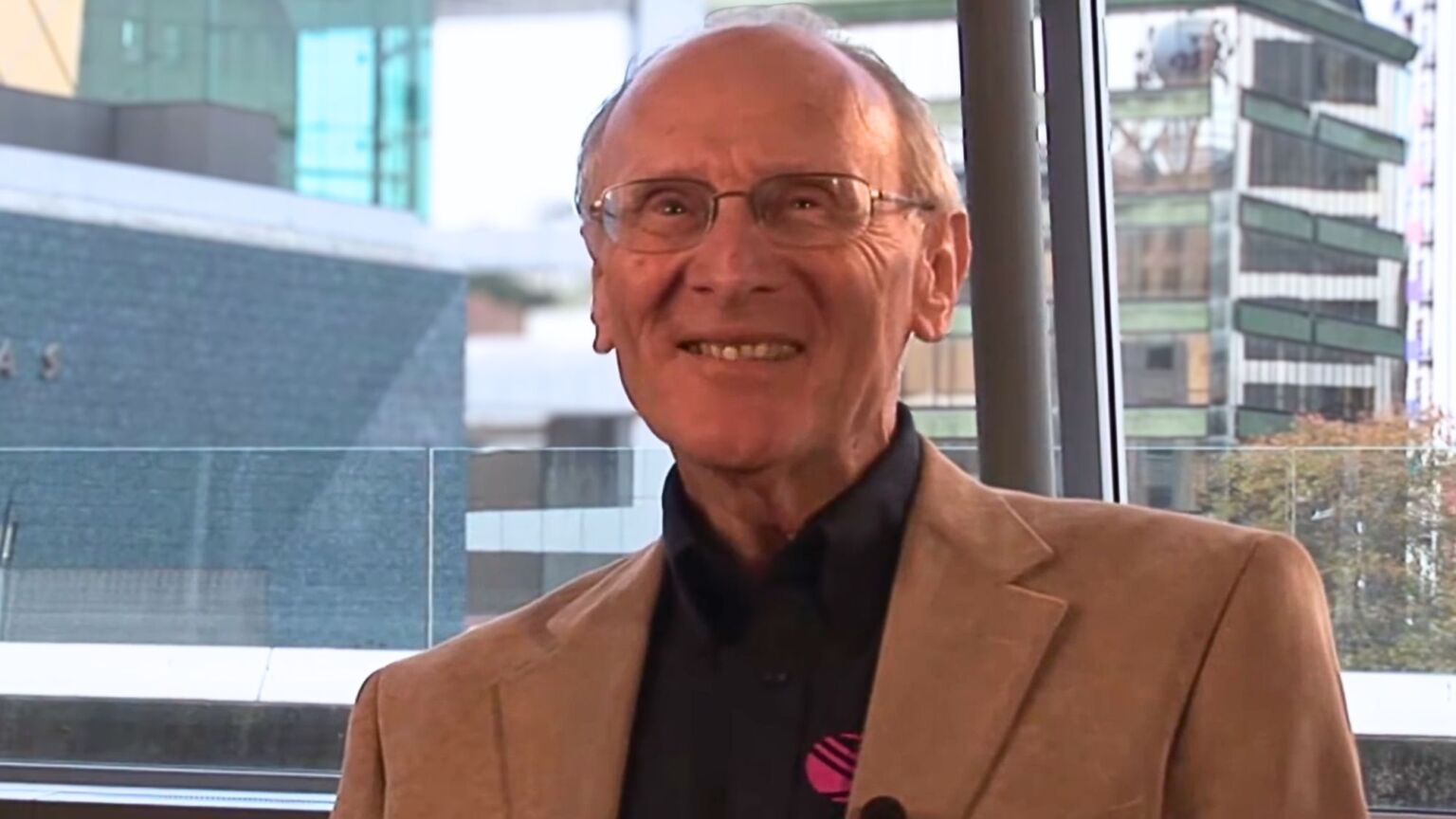
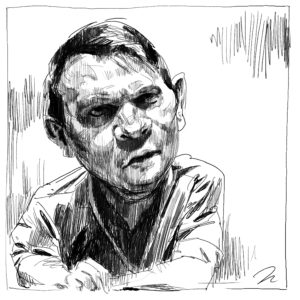
John Carey, who died last week aged 91, was a man of broad democratic instincts. Arguably one of the finest literary critics of his generation, rising to hold the Merton Professorship of English at Oxford, Carey continued throughout his career as a writer, reviewer and lecturer to speak up for, and speak to, people far beyond the academy. People, in many ways, like himself.
He was born in Barnes in south-west London in 1934 to Charles, a clerk, and Winnifred, a secretary. While both his parents left school at 15, Carey was a beneficiary of England’s grammar-school system. During a wartime sojourn in Radcliffe-on-Trent, just outside Nottingham, he struggled at school, thanks in large part to his poor eyesight. He returned with his family to London in 1947, where he acquired glasses and an aptitude for study. He was to become the first pupil from Richmond County and East Sheen School for Boys to attend Oxford University.
Arriving at St John’s College in the summer of 1954, after 18 months of national service in Egypt, he had already decided that Oxford was where he wanted to remain. Excelling academically, winning a scholarship and then a lectureship, he taught at Christ Church, Balliol, Keble and St John’s, before being made the Merton professor of English literature in 1975.
Initially specialising in English Renaissance literature, and John Milton in particular, his academic ascent looked effortless. But this concealed his personal battle against the chronic snobbery prevalent among the overwhelmingly upper-crust, privately educated dons. There were exceptions, such as the great Marxist historian Christopher Hill, whose work on the popular, radical struggles driving the English Revolution had inspired a young Carey, and who warmly greeted his arrival at Balliol. But in the main, the cloistered inhabitants of Oxford were, at best, dismissive towards this grammar-school-educated son of a clerk and secretary, and at worst, contemptuous.
In his wonderful 2014 memoir, The Unexpected Professor, Carey wrote of feeling like an ‘intruder’ while an undergraduate at St John’s. He recounts dining at Christ Church high table one evening, while sat opposite economics fellow Sir Roy Harrod, biographer and friend of John Maynard Keynes. A guest asked Harrod who Carey was, to which he replied, ‘Oh, that’s nobody’. The slight stung so much because it was not just Carey himself being treated with disdain, it was also all those of Carey’s background, his family included. ‘I couldn’t help thinking how Sir Roy Harrod, and people of his ilk, would have despised my father, as he had despised me’, Carey later recalled.
In some ways, this visceral experience of the class contempt rife in academia was to prove the making of Carey. It drove him on to ever greater heights within the university – publishing acclaimed studies, such as the The Violent Effigy: A Study in Dickens’s Imagination (1973) and Thackeray: Prodigal Genius (1977) – and also outside it, where he became a prolific book reviewer, first for the New Statesman and then, from 1977 until 2023, for The Sunday Times.
It was as a reviewer that Carey was able to reach out to a general readership who were looked down upon by haughty academics – those who, as he put it in his 1974 essay, ‘Down with Dons’, liked to lord it over the ‘philistine majority’. Carey’s prose became Orwell-like – limpid, enlightening and often cutting. Sometimes perhaps too cutting. Of poor Clive James’s The Immortal Critic (1974), Carey wrote, ‘Immortal names drop from him like dandruff, so that the airily planted erudition can take on the tone of a sixth-form essay prize’. In 1998, he likened the experience of reading Harold Bloom’s bombastic Shakespeare: The Invention of the Human to ‘chatting with an acquaintance and gradually realising he believes that death rays are issuing from his television screen’.

His aversion to windy pretension and wilful obscurity was born of the anti-elitist spirit forged during those early days in Oxford. It was a spirit at its most impish in What Good are the Arts? (2005), Carey’s entertaining broadside against those who turn their personal taste for ballet or abstract painting into a sign of their moral and social superiority.
But it was an earlier book that arguably captures Carey’s democratic, anti-elitist spirit at its most profound. Published in 1992, The Intellectuals and the Masses: Pride and Prejudice Among the Literary Intelligentsia, 1880-1939, touched a nerve. This ‘simple cultural study’, as he later described it to me, lifted the veil on the repellent class prejudices informing the cultural vision of many of Britain’s most well-known and esteemed 20th-century intellectuals. Carey argued that they were responding not just to the massive growth in Britain’s population during the 19th century, but also to the masses’ political and social empowerment, through the expansion of education and the struggle for suffrage.
Britain’s intellectual elites resented and felt threatened by these developments. They warned, as TS Eliot did, of a ‘deluge of barbarism’ should the working millions enter universities. They talked darkly, as Ezra Pound did, of the folly of giving ‘the mass of dolts’ the vote and of the spectre of ‘democracies electing their sewage’. And from the Fabian Society to the Bloomsbury Group, they dreamed of a eugenicist solution to the ‘problem’ of people power. Or as WB Yeats had it, ‘Sooner or later we must limit the families of the unintelligent classes’. When reading The Intellectuals and the Masses, it is difficult not to conclude that the thirst for others’ annihilation haunted the work of far too many of Britain’s interwar intellectuals.
Carey’s analysis was excoriating. He drew attention to this intellectual elite’s assault on all aspects of middle- and working-class life. The attacks on their newspapers and ‘cheap’ fiction. On their newly suburban homes. On their tinned food. And he showed how this loathing of ordinary men and women, this fear, ultimately, of the growth of their democratic power, culminated in the development of ‘modernism’ – a deliberately rebarbative cultural enterprise in which densely allusive and formally abstract art was elevated above the popular and accessible. It was a way, as lead Bloomsbury Groupie Clive Bell had it, to separate the ‘educated personas of extraordinary sensibility’ from the ‘barbarian’ in his ‘suburban slum’.

Carey delivered a severe judgement. This intellectual elite constructed a high culture around ‘the exclusion of the masses, the defeat of their power, the removal of their literacy, the denial of their humanity’. The proximity at points of modernism to fascism was no accident.
The impact of The Intellectuals and the Masses can be measured by the volume of elite derision that greeted its publication. As Carey recalled in The Unexpected Professor: ‘Reviewers seemed beside themselves with rage. It was alleged that I hated culture, and wished to condemn the population to “an endless diet of television soaps, the Sun newspaper, and royal scandals”. I was a commissar, an ally of Mrs Thatcher in her war against the arts, a lackey of the Murdoch press, and a puritan with a “class-based, priggish horror of champagne”.’
That it touched a nerve shouldn’t have been a surprise. The truth hurts. Carey wasn’t just attacking a generation of long-dead intellectuals, or even some of the most hallowed names in the modern English high-cultural canon. He was also attacking attitudes and views that persist among today’s cultural elites, from their loathing of the food and media people consume to the ultimate object of their fear – the political power the masses wield. It is a study that retains its force and insight to this day.
Not that Carey’s detractors could ever admit as much. They attacked him for ‘fouling his own nest’, as a professor of literature, and for supposedly being a philistine. This was always a false accusation. For as critical as Carey was of the snobbery, class hatred and annihilationist impulses of some of the 20th century’s most esteemed intellectuals, he could also appreciate the value of their writing. He may have hated DH Lawrence’s views, but he was also ‘gripped’ by his rapturous prose, ‘wolfing down’ everything he’d written and encouraging undergraduates to read it. But that was Carey. A clear-sighted critic who believed that he could persuade others of the value of things he was passionate about.
In opposition to the exclusive, elitist, class-based culture he had encountered at Oxford in his early days, Carey was committed to a democracy of letters, a republic in which all had the power to contribute.
As scathing as he could be in print, he was a kind and generous man, admired and loved by his students. He leaves behind his wife, Gill, and his two sons. He will be much missed.
Tim Black is associate editor of spiked.
£1 a month for 3 months
You’ve hit your monthly free article limit.
Support spiked and get unlimited access.
Support spiked – £1 a month for 3 months
spiked is funded by readers like you. Only 0.1% of regular readers currently support us. If just 1% did, we could grow our team and step up the fight for free speech and democracy.
Become a spiked supporter and enjoy unlimited, ad-free access, bonus content and exclusive events – while helping to keep independent journalism alive.
———————————————————————————————————————————–
Exclusive January offer: join today for £1 a month for 3 months. Then £5 a month, cancel anytime.
———————————————————————————————————————————–
Monthly support makes the biggest difference. Thank you.




Comments
Want to join the conversation?
Only spiked supporters and patrons, who donate regularly to us, can comment on our articles.