Trump, Xi and Putin make a spectacle of Europe’s irrelevance
The Shenzhen mega-summit showcased the shifting balance of global power.
Want unlimited, ad-free access? Become a spiked supporter.
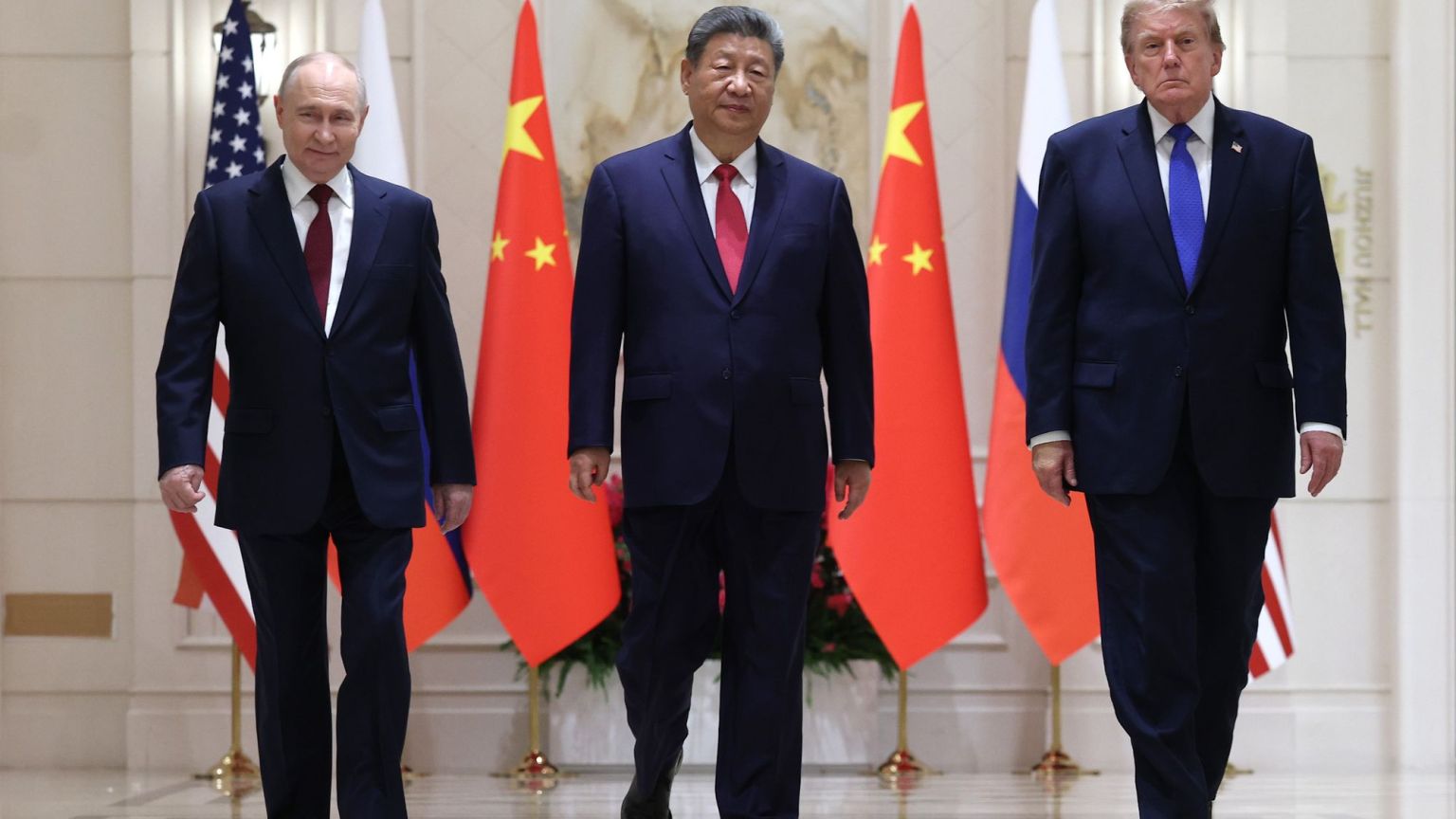
This week’s Asia-Pacific Economic Cooperation (APEC) meeting in Shenzhen, China provided the backdrop for a trilateral summit between the leaders of China, Russia and the US. Presidents Xi Jinping, Vladimir Putin and Donald Trump all attempted to play the role of would-be Masters of the Universe. As a BBC commentator noted, the summit was ‘high on spectacle, short on substance’.
But then mega-summits are rarely about substance. They are designed to send out a message about the global power of those invited – and, in the case of this summit, the relative lack of global power of those not invited.
Western media have already made much of the optics of the APEC summit. There have been reams of commentary on Trump warmly referring to Putin as ‘my friend’, and on Xi breaking with Chinese diplomatic protocol to personally greet Trump on the tarmac at Shenzhen Bao’an International Airport. These diplomatic displays of bonhomie showed that all three key players had a common interest – namely, creating the impression that they were formidable statesmen capable of making consequential decisions about the future of the world.
The summit itself only lasted for 80 minutes. Yet what was important was not what was said, but that it happened at all. Fifty years from now, historians may note that this was China’s coming-out party. As the host, Xi took top billing in this carefully staged performance. It highlighted China’s status as a global superpower. According to a report in The Times, ‘The official pictures showed President Xi in the middle, in the dominant position, and in subordinate places to the right and left sat Putin and Trump. The symbolism was unmistakable.’ The central, even dominant role assumed by Xi highlighted the unmistakable shift in global power towards China.
For his part, Trump was pictured nodding off during Xi’s speech. But then the US president was not there to listen but to perform. Indeed, after the Republican Party’s disaster in the midterm elections, Trump was clearly delighted to swap the domestic stage for the international one. It was a chance to burnish his image as a global statesman. Throughout the summit, Trump repeatedly exaggerated the trilateral meeting’s significance. ‘We are making history’, he said.
For very different reasons, Putin was also delighted to be invited. The very fact that he was there at all showed that attempts to isolate him and Russia over the invasion of Ukraine have singularly failed. Moreover, Trump’s willingness to treat him as a friend rather than as an enemy suggests that America’s position on the war in Ukraine may soon undergo a dramatic reversal. It is worth noting that shortly after the summit, Trump instructed the European members of the so-called Coalition of the Willing to stop funding Ukraine.
That Europe had absolutely no presence in this summit underlined the continent’s geopolitical decline and the sorry state of the European Union as a global player. The EU must be getting used to being overlooked by the key global decision-makers – it was recently left out of the discussions between Russia, Ukraine and the US in Abu Dhabi. The EU’s failure to appoint an individual or a team who would talk and negotiate with Russia is not helping matters.

While the big boys got on with their mega-summit in China, European leaders met in Berlin for yet another meeting of the Coalition of the Willing. Ukrainian president Volodymyr Zelensky and UK prime minister Andy Burnham were also in attendance. No doubt those present were motivated by an awareness that Europe is struggling to gain a voice in global diplomacy.
Future historians studying the Shenzhen summit will no doubt note the crisis of statesmanship haunting the West. Trump’s erratic and unserious diplomacy is bad enough, but matters are far worse when it comes to the leaders of Europe. They are happy to go to Kyiv for photo-ops next to Zelensky. But when it comes to seizing the initiative and playing a decisive role in the resolution of the war between Russia and Ukraine, they are nowhere to be seen. Despite constantly being humiliated by Trump, Europe’s leaders are still clearly unwilling and incapable of doing anything without the approval of Washington.
Europe is in real danger of being reduced to an insignificant role in world affairs. To reverse this trajectory, we need to confront Europe’s crisis of leadership. And that means developing a strategic vision to assist European nations in finding their place in the world.
Frank Furedi is president of the Freedom and Sovereignty Initiative Europe.
You’ve hit your monthly free article limit.
Support spiked and get unlimited access.
spiked is even better on the app
Read, watch and listen to spiked wherever you are. Our brand-new app brings everything together, with ad-free reading, audio articles and offline access.
Become a spiked supporter to unlock exclusive app access, unlimited articles, bonus podcasts, discounts and special events.
Monthly support makes the biggest difference. Thank you.



Comments
Want to join the conversation?
Only spiked supporters and patrons, who donate regularly to us, can comment on our articles.