The dystopia of a world without growth
The UN-backed, expert-led roadmap to a post-growth society is a recipe for immiseration.
Want unlimited, ad-free access? Become a spiked supporter.
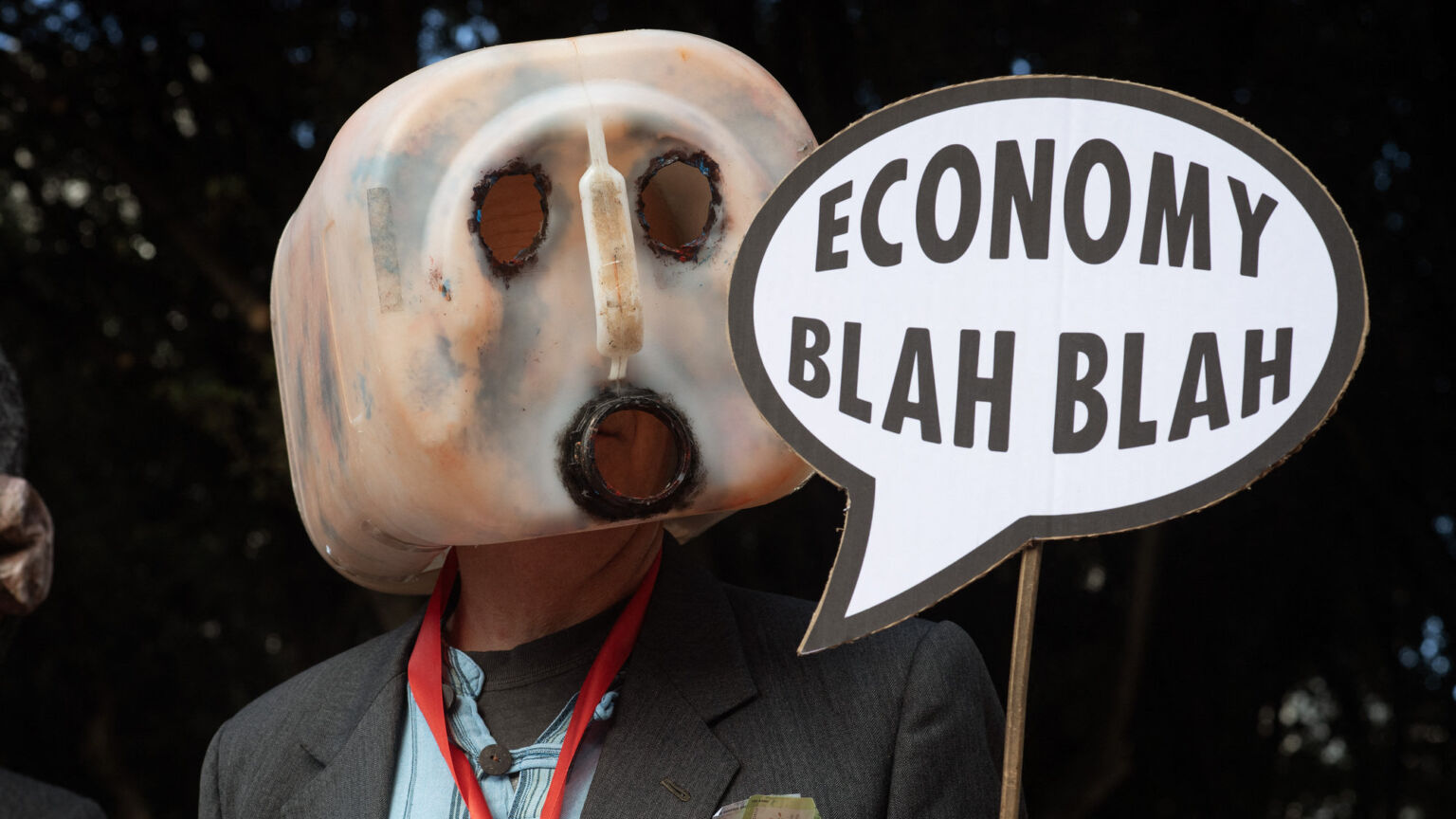
UN agencies, academics and other policymakers have launched an alternative to what they call the ‘doomed strategy’ of economic growth. In a piece published simultaneously in Le Monde, the Guardian and El País, the authors claim that the ‘real question today is not whether growth continues, but what kind of economies we are building, who they serve and whether they allow everyone to live in dignity within planetary boundaries’. Signatories to this ‘roadmap for eradicating poverty beyond growth’ include Olivier De Schutter, Joseph Stiglitz, Jayati Ghosh, Thomas Piketty, Kate Raworth and Jason Hickel.
Their ‘roadmap’ is typical of much contemporary growth-critical writing – it is wistful, authoritative and extremely vague about how the post-growth future can be realised.
The notion of a post-growth economy can appear dotty. Yet it embodies the influential ‘progressive’ frame of mind that upholds the need for abstinence on the part of the general populace. These particular economists are among today’s best-known growth sceptics – a splendid term coined by spiked regular Daniel Ben-Ami to encompass the increasingly celebrated medley of ‘degrowthers’, ‘anti-growthers’ and ‘agrowthers’ (‘a’ is for agnostic). Predicated on the notion that humanity has breached, or will imminently breach, nature’s limits, their message is that human societies have to start curbing their economic and material development.
These growth sceptics are the modern-day representatives of a long-established type of ‘progressive’ – the collection of quirky dreamers that George Orwell mocked in The Road to Wigan Pier for their sandal-wearing, fruit-juice-drinking, pacifistic proclivities. Writing more recently, Paul Laity, an editor at the London Review of Books, summed up their ‘crankish’ outlook, calling it ‘woolly-headed naivety, moral superiority and worthy bohemianism’.
Today’s cohort shares the same well-meaning earnestness as previous generations, with their appeals for a fairer, less commercial and, all-in-all, happier world – a ‘beyond growth’ system where everyone can live in dignity. They also express the same nature-worship, condescension to the populace, and impracticability as their predecessors.
A big difference, however, is that today’s anti-development thinking is thoroughly mainstream. As Laity pointed out, it is ‘the cause rather than an eccentric distraction from it’. Indeed, the great irony today is that the Western elites growth-sceptics criticise have also all but given up on economic growth.
Politicians today, very much including Britain’s current government, often talk of wanting growth. But time and again, they act against it, from their instincts for more and more regulation to their pursuit of Net Zero. They are interested not in economic growth but in managing the status quo. Corporate leaders, too, seem more interested in their ESG (environmental, social and governance) and DEI goals, than in investing for sustained growth.
In contrast to the ‘progressives’ of the past, today’s advocates for a morally ‘better’ economy do so from an even more entitled position. Benefitting from the outputs of other people’s labour, from the dwellings in which they live to the laptops on which they write their anti-growth diatribes, they repudiate further development. They seem to imagine that everyone else on the planet can enjoy the same levels of material prosperity, without mining additional metals and minerals, constructing new homes, hospitals and factories, and producing more of the staples of middle-class life in the developed nations.
They seem to think all that’s required for human flourishing is to make everyone regenerate, recycle and redistribute. As the prefix ‘re-’ implies, this means going back to what has already been produced, without the additional resources that come from their despised economic growth. The world economy can supposedly provide for everybody if it functions as a mix of repair shop and a charity shop.
Those championing the roadmap to a post-growth society claim they ‘have done the maths’ for how this works. But they fail to show their workings. Instead, they insist what needs to be done is to legally guarantee universal basic services and universal minimum incomes. Not only is it a terrible idea to universalise the West’s handout culture, destroying incentives to work and people’s capacity for self-reliance. They also fail to disclose the fairy-tale sums showing how taxing existing wealth and just printing money – ‘purposeful public money creation’, they call it – can fund this global guarantee.
One of the roadmap signatories, Oxford University economist Kate Raworth, has gone further than most of her colleagues in setting out the what and the how. Pretentiously described by George Monbiot as ‘the John Maynard Keynes of the 21st century’, her ‘doughnut economics’ model has been welcomed by her fellow travellers as ‘redefining economics’. Regardless of the hyperbole, her approach does have the merit of trying to illuminate how society could cope without the nitty-gritty of economic development. Assessing a few of her model’s particulars helps expose the delusions of her and the other ‘woolly-heads’.
In her doughnut thesis – it’s an American ring-style one – she doesn’t focus on the hole in the middle representing ‘deprivation and poverty’, but on the pair of concentric rings. The inner side of the ring represents the ‘social foundation’ floor that meets everybody’s basic needs. These include food, housing, energy, clean water, sanitation, income, healthcare and education. The outer side of the doughnut ring is the ceiling marking the ecological limits of the planet.

The area between the two represents her ideal – the place where humanity should strive to live and can thrive. She calls this ‘a safe and just space for all’, in which we are no longer ‘addicted to growth’, and instead rely on redistribution and regeneration. An economy that is able to meet everyone’s basic needs, but without destroying the planet. A happy sweet spot.
The core flaw in this growth-less nirvana is that meeting those ‘basic needs’ is impossible without producing new wealth; that is, without economic growth. Raworth’s own methodology shows that stopping the global economy from expanding further condemns much of the world’s population – in richer countries, as well as in a larger number of poorer ones – to inadequate lives, if not impoverishment.
Although her definition has been refined over the years, the iteration of the inner doughnut included in Raworth’s bestselling book, Doughnut Economics (2017), derives from the UN’s Sustainable Development Goals (SDGs). SDGs are not really about helping poorer nations of the world develop ‘sustainably’ to reach something like first-world living conditions. They focus just as much on ‘progressive’ objectives, such as subjective well-being, phasing out fossil fuels, cutting obesity, recycling waste and reducing smoking.
How many countries have already achieved those SDG targets? You might think of the world’s 40 advanced industrialised nations, and perhaps some of those fast-growing emerging economies over recent decades. But the UN’s answer is a big fat zero.
Not one country reaches all the UN’s SDGs. Finland is the closest, scoring 87 per cent overall. It is let down by its low ratings for ‘climate action’, ‘sustainable cities and communities’, ‘responsible consumption and production’, and, bizarrely, ‘zero hunger’. Surely the UN is wrong that hunger and malnutrition stalk this nation known for its happy and prosperous people, its saunas and Lapland sleigh rides? But for the UN, ‘major challenges remain’ in Finland meeting ‘zero hunger’. That’s because, by the UN’s virtuous standards, Finnish people are too obese, don’t eat enough vegetables, and use too much nitrogen fertiliser to produce their crops.
Raworth’s latest assessment of her own modified doughnut targets also acknowledges a significant ‘social shortfall’, impacting about 35 per cent of the global population. By her own thesis, the world remains well outside her doughnut wonderland. Even if we were less demanding than the UN’s or Raworth’s definitions of basic needs, humanity requires a lot more production of pretty much everything to get there.
For illustration, let’s say Britain’s average income per person (using 2024 data) of about $53,000 is sufficient to achieve its people’s basic needs – note the UN places Britain eleventh in the SDG ranks, with a score of 82 per cent. For the world’s 8.2 billion people to reach Britain’s modest (and inadequate) average level of living would require a global annual output of about $435 trillion.
Yet, the latest World Bank estimate of global output sits at $111 trillion. Just to get everybody into Raworth’s doughnut area of ‘thriving instead of growing’, the world would need to be producing about four times as much as today. That is impossible to achieve without a gargantuan growth in the production of homes, food, clothing, machinery, energy, appliances, means of transportation and so much more. So, according to one of the most thought-through growth-sceptical models, we still need a lot more global economic growth to secure everyone’s basic social needs. Raworth herself even admits that the average share of the population in overall social shortfall within the poorest 40 per cent of countries was about three in five, and for the middle 40 per cent, three in 10.
The paradox is that despite these findings using one of their own lauded models, Raworth and her fellow signatories stick with their pious beliefs. Undaunted, they hold to their belief that economic growth is bound to be a human and ecological disaster. This shows that, for them, preventing ecological damage takes priority over meeting everyone’s even basic requirements.
Despite their talk about human dignity, their starting point is not what people need, but what they think the planet needs. This marks a shift from the earlier phase of environmental concern in the 1960s and 1970s that emphasised the ecological limits to growth: resource depletion, pollution and over-population. Now the demand is for human self-restraint to avoid ecological harm.
The roadmap signatories counsel humans to put limits on growth, claiming that ‘droughts, megafires, floods and heatwaves remind us that our economies are pushing the planet beyond its limits’. They bemoan what they see as the destructive consequences of development. Yet they take its achievements for granted.
The signatories aren’t offering an alternative economic strategy for humanity, but a dreamland that aligns with their virtuous conceits. Their roadmap is really a drawn-out rejection of the cultural, social, political and economic gains of modernity.
This also points to the contemporary appeal of growth scepticism. It resonates with the broader anti-Enlightenment culture of fatalism, pessimism and defeatism. People, especially many younger people, have been socialised into this culture of low expectations. So much so that few now believe we can find creative and technological solutions to our problems.
For those genuinely concerned about human dignity, there is a practical alternative to any growth-critical roadmap. We need to promote the aspiration, the ability and the expectation of ever-rising living standards and more productive work, while figuring out how to create the opportunities for this. That implies not just a growing economy, but one that can grow an awful lot faster than it has been recently doing.
Phil Mullan is the author of Beyond Confrontation: Globalists, Nationalists and Their Discontents.
You’ve hit your monthly free article limit.
Support spiked and get unlimited access.
Support spiked and get unlimited access
spiked is funded by readers like you. Only 0.1% of regular readers currently support us. If just 1% did, we could grow our team and step up the fight for free speech and democracy.
Become a spiked supporter and enjoy unlimited, ad-free access, bonus content and exclusive events – while helping to keep independent journalism alive.
Monthly support makes the biggest difference. Thank you.





Comments
Want to join the conversation?
Only spiked supporters and patrons, who donate regularly to us, can comment on our articles.