Net Zero is reversing the Industrial Revolution
Denby Pottery survived the Napoleonic Wars and the Great Depression. But it couldn’t withstand Ed Miliband.
Want unlimited, ad-free access? Become a spiked supporter.
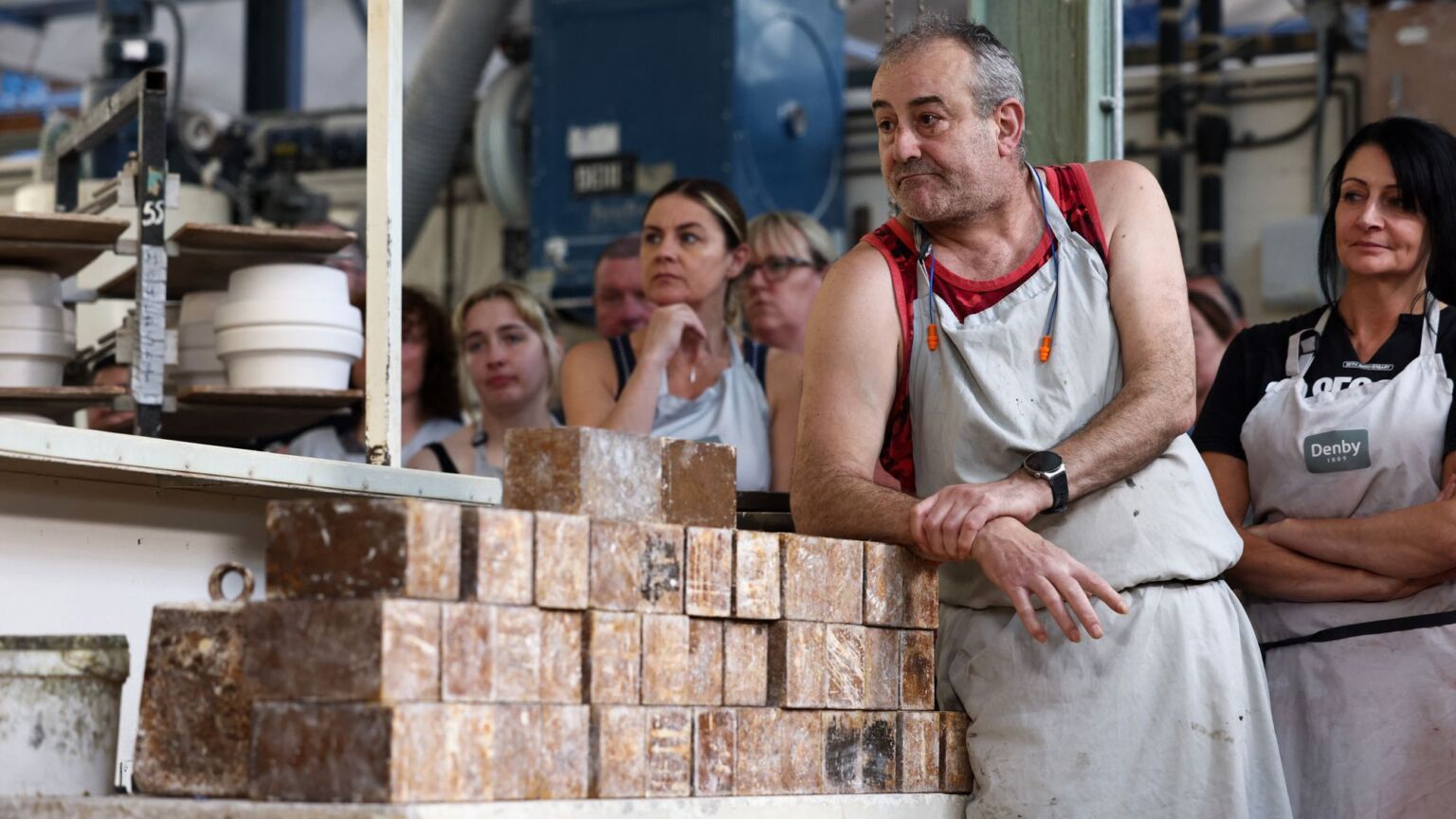
Denby Pottery has survived more than its fair share of economic turmoil in its 217-year existence. But nothing it seems on the scale of the industry-destroying policies of the current Labour government. This week, the famed Derbyshire company closed its doors for the final time, citing soaring energy and labour costs. Around 600 workers have lost their jobs.
The pottery firm took its name from the village where, in 1809, it first began turning local clay into stoneware bottles, before expanding to homewares. It went on to furnish dining tables in Britain and across the world for 10 generations. But, in June, work at its kilns ceased. No doubt weak consumer demand for upmarket housewares was partly to blame. Clearly, too, chancellor Rachel Reeves’ hikes in the national insurance taxes haven’t helped. Yet make no mistake: the real culprit in all of this is energy secretary Ed Miliband.
In March, when administrators were appointed for the floundering company, Denby was perfectly clear what the problem was – ‘soaring industrial energy costs’. This is an insurmountable problem for a ceramics business because, to get a finished product, kilns must run at a temperature of about 1,200 degrees Celsius for hours at a stretch. And it’s here that Westminster’s depressing ignorance of science, combined with its dogmatic loyalty to Net Zero, has taken its toll.
Denby isn’t the first British victim of Net Zero. In November, hundreds of jobs were lost when ExxonMobil closed the Fife Ethylene Plant in Scotland. In 2024, 2,000 jobs vanished when the Port Talbot steelworks in Wales closed its last two blast furnaces to meet decarbonisation targets. Later that year, Vauxhall shut its 120-year-old van factory in Bedfordshire, shedding more than 1,000 jobs. Only a last-ditch intervention by the government prevented British Steel’s Scunthorpe plant – and its 2,700 employees – from facing the same fate.
These tales of economic devastation have one thing in common: Net Zero. It has led to Britain having the highest industrial energy prices in the developed world, and made it all but impossible to make or produce anything.
We can expect many other of Britain’s famed potteries to go the way of Denby. According to Rob Flello, CEO of industry body Ceramics UK, for kilns to reach the same temperatures with electricity as they do with gas is four or five times more expensive. Now, as with steelmaking, those of an environmentalist persuasion talk up new electrical technologies as an alternative to heat supplied by gas. In principle, future technologies, including low-carbon ones, are always worth exploring. But with ceramics, electric methods of heating will not supplant gas ones for years.
Britain’s Trade Union Congress has published a very balanced report about decarbonising high-temperature ceramics production through electrification. It notes that while electric kilns may make for better glazes, their components degrade rapidly and do not distribute heat as uniformly as gas. To retrofit existing kilns is a big, expensive hassle, and to scale up electrical heating technologies and power supply for industrial purposes will be no easy business, either.

So why does the government dogmatically insist that electrification is the way to go for UK ceramics factories? After all, Miliband himself states that 30 per cent of UK power generation is still based on gas. His figure is debatable, but clearly full decarbonisation of British ceramics factories is decades away.
Oblivious to all this, Miliband, the messiah of Net Zero, demands that industry abandon the cheap gas it currently depends on for some of the dearest electricity on Earth. Worse, a byzantine system of energy-relief schemes for business, first introduced by the previous Conservative government and now made still more complicated by Labour, only softens costs for firms that rely on electricity, not gas. A summary of the reliefs contains not a single mention of gas.
Looking forward, a relief system for gas-intensive industries could prevent future bankruptcies like that of Denby. Moreover, future UK governments should celebrate ‘heritage’ manufacturing for its design merits. That is not nostalgia – it is entirely in the UK’s interests. Denby outlets in America, China and South Korea are still operating.
It isn’t just Labour that is to blame for Denby’s closure. Tory bigwig Tom Tugendhat has claimed that ‘energy policies that have pushed prices higher in search of a carbon ambition at home’ are the culprit at Denby. This is rich, given that, in 2022 he (along with other candidates for the leadership of the Conservative Party) made an unreserved commitment to uphold Net Zero.

What makes Denby’s closure all the more galling isn’t only the jobs that have now vanished. We have lost something of British history, too. In 2024, it was reported that Denby Pottery Village welcomed 300,000 visitors a year.
This is the cost of Net Zero. Thousands of jobs and livelihoods lost. Factories that were once the lifeblood of a community decommissioned. And the memory of all of the remarkable things our nation once produced, vanishing without a trace.
James Woudhuysen is visiting professor of forecasting and innovation at London South Bank University. Follow him on X: @jameswoudhuysen.

spiked summit 2026
10am-5pm, Saturday 27 June
Emmanuel Centre, London, SW1P 3DW
With Lionel Shriver, Brendan O'Neill, Katharine Birbalsingh, Toby Young, Allison Pearson, Paul Embery, Tom Slater, Andrew Doyle, Fiyaz Mughal and more
Become a spiked supporter to get a discounted ticket
£80 or £50 for supporters
You’ve hit your monthly free article limit.
Support spiked and get unlimited access.
Support spiked and get unlimited access
spiked is funded by readers like you. Only 0.1% of regular readers currently support us. If just 1% did, we could grow our team and step up the fight for free speech and democracy.
Become a spiked supporter and enjoy unlimited, ad-free access, bonus content and exclusive events – while helping to keep independent journalism alive.
Monthly support makes the biggest difference. Thank you.







Comments
Want to join the conversation?
Only spiked supporters and patrons, who donate regularly to us, can comment on our articles.