Christianity is being criminalised as hate speech
A pastor’s conviction for preaching the gospel in a ‘buffer zone’ is a chilling sign of our intolerant times.
Want unlimited, ad-free access? Become a spiked supporter.
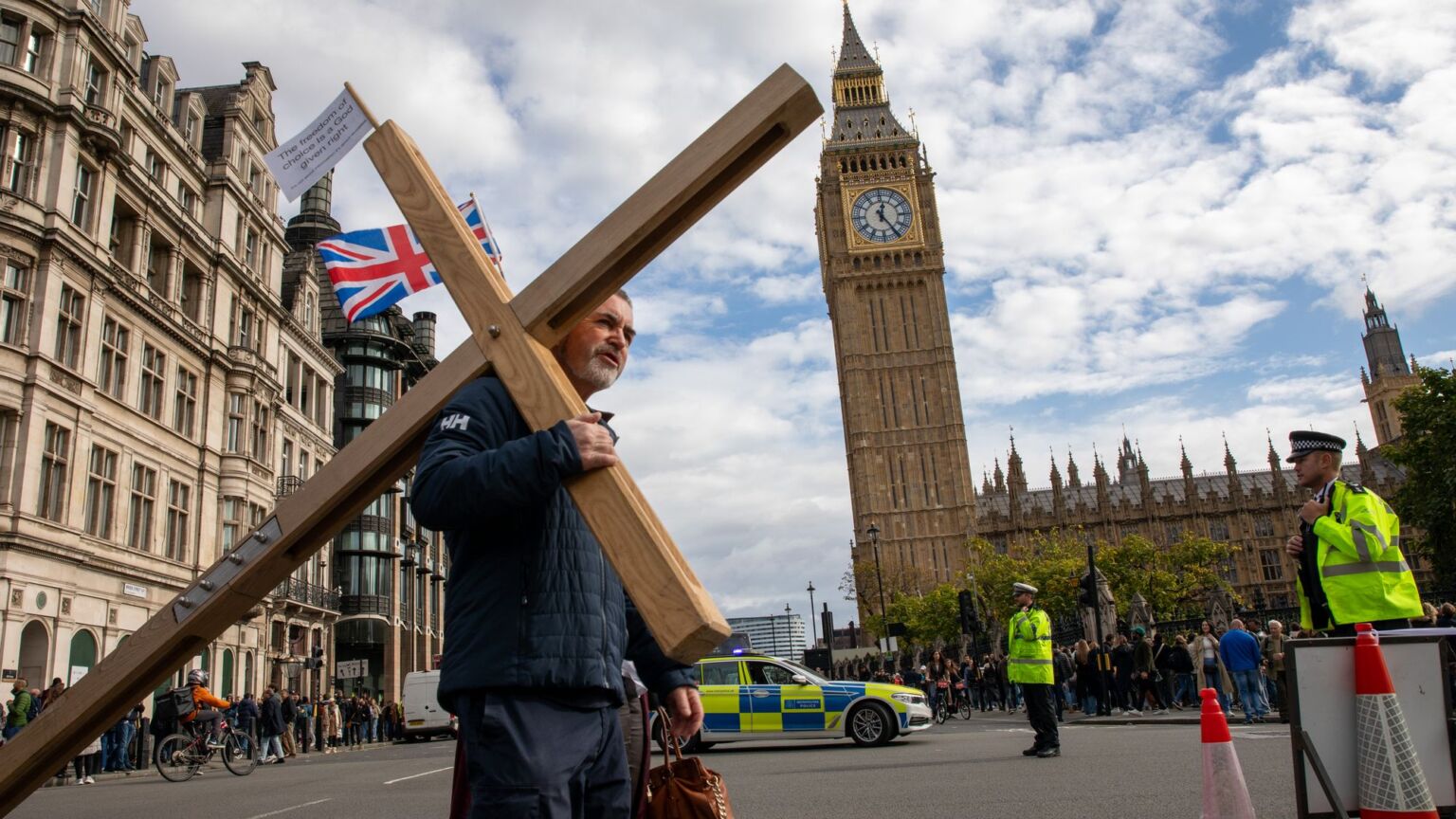
Few can deny the extent to which Christianity has shaped the United Kingdom. For centuries, we had an established church, a Christian monarch, and laws and institutions steeped in biblical language and moral assumptions. But as that culture gave way to pluralism, expressions of the Christian faith have seldom been offered the same protections other beliefs have.
Consider the growing number of free-speech rows involving street preachers in London. In recent years, several preachers have been stopped, questioned and even arrested under the Public Order Act. In most cases, the charges don’t stick – but the process itself is punishment enough. It sends the message that certain views rooted in Christianity are now considered inappropriate for the public square.
This shift is exemplified by the case of school chaplain Bernard Randall, who in 2025 was dismissed from his job. Randall was also referred to the government’s counter-extremism programme, Prevent. The referral concerned the content of his assemblies, in which the reverend had presented time-honoured Christian beliefs to the students. In one sermon, he had told the children that it was okay to question and debate LGBT teaching. Whatever one may think of such views, the fact that they can now earn you a referral to counter-terrorism forces is astonishing.
Though British law claims to protect freedom of religion, Randall’s case and others’ reveal a pattern of state behaviour that is increasingly uneasy with Christian expression. The conviction of Clive Johnston – a 78-year-old retired pastor from Northern Ireland – is one of the more egregious examples of this. Earlier this month, Johnston was found guilty of breaching an abortion clinic buffer zone and failing to comply with a police order to leave. He was cautioned after preaching the words of John 3:16 near a hospital in Coleraine. Though his sermon did not mention abortion even once, focussing entirely on the gospel, he was accused of ‘influencing’ those within the buffer zone. He is appealing the conviction.
Let us be clear about what this means. A man is facing criminal penalties for saying publicly that ‘God so loved the world’. Not as part of a protest or as a targeted intervention, but as an act of ordinary Christian witness – a common practice in Northern Ireland, which has some of the highest rates of Christian practice in Western Europe. If Randall’s case had been chilling, Johnston’s represents something far more definitive: the formal criminalisation of religious speech. The Bible, in effect, has been found guilty.
Supporters of buffer-zone laws will argue that they protect women seeking abortions from genuine harassment. This is a legitimate aim. But laws must be judged not only by their intentions, but also by their application. And here, the application has drifted far beyond anything that could reasonably be described as ‘preventing harm’. With ‘influence’ being such an elastic concept, buffer-zone laws have inadvertently granted the state a remarkable power: to decide which ideas may be expressed in which places, and which may not.
What makes this discomfort with Christian principles particularly striking is how out of step it is with broader cultural trends. Far from fading into irrelevance, Christianity – and religion more broadly – is experiencing a notable resurgence among younger generations. Across the UK, Bible sales have increased by 130 per cent since 2019. Churches across the nation have noted an uptick in young attendees. In an age of anxiety and fragmentation, many are turning back to the very traditions that the state seems most wary of.
It has always been the case that the more institutions attempt to sideline religious expression, the more compelling it is to those searching for something solid and enduring. But this is not an argument for complacency. A society in which people must rediscover faith in spite of state censorship is not one that can be truly called a liberal democracy.
Clive Johnston’s conviction shows, in stark terms, where the current trajectory leads: to a country where quoting scripture can be construed as a criminal act. That is not the United Kingdom most people recognise. Nor, I suspect, is it the United Kingdom most people – especially the younger generation – want to live in.
Carla Lockhart is MP for Upper Bann.
spiked summit 2026
10am-5pm, Saturday 27 June
Emmanuel Centre, London, SW1P 3DW
With Lionel Shriver, Brendan O'Neill, Katharine Birbalsingh, Toby Young, Allison Pearson, Paul Embery, Tom Slater, Andrew Doyle, Fiyaz Mughal and more
Become a spiked supporter to get a discounted ticket
£80 or £50 for supporters
You’ve hit your monthly free article limit.
Support spiked and get unlimited access.
Support spiked and get unlimited access
spiked is funded by readers like you. Only 0.1% of regular readers currently support us. If just 1% did, we could grow our team and step up the fight for free speech and democracy.
Become a spiked supporter and enjoy unlimited, ad-free access, bonus content and exclusive events – while helping to keep independent journalism alive.
Monthly support makes the biggest difference. Thank you.
Comments
Want to join the conversation?
Only spiked supporters and patrons, who donate regularly to us, can comment on our articles.