Safetyism has made society terrified of disagreement
Protecting people from challenging or dissenting views is doing us real harm.
Want unlimited, ad-free access? Become a spiked supporter.
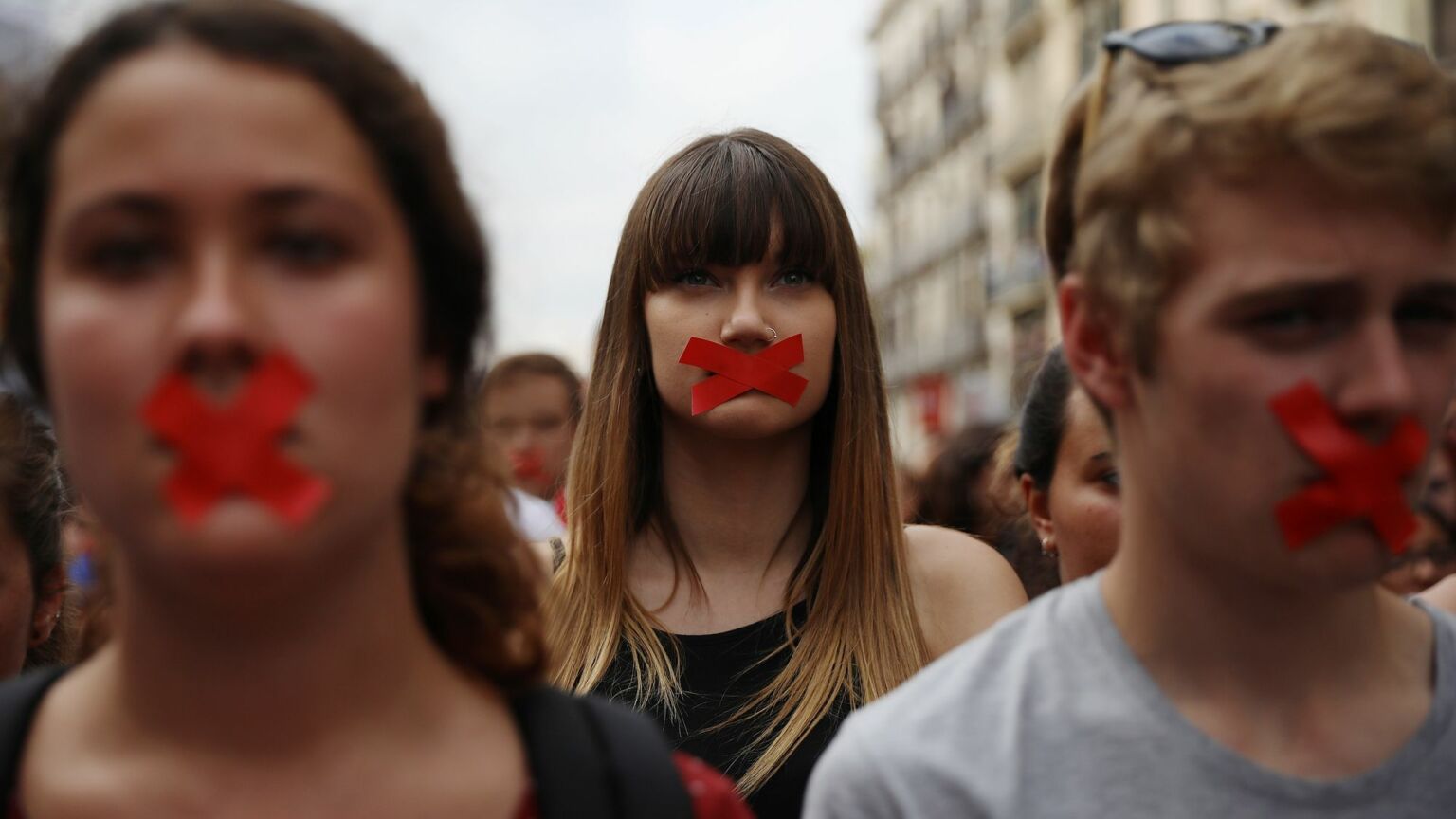
As ‘safe spaces’ on Western university campuses continue to multiply, it has become clear that institutions designed to defend free thought are now breeding grounds for illiberal conformism. Higher education no longer trains students to grapple with dissent. It teaches them to avoid intellectual conflict at all costs.
This conformism has not been limited to the lecture hall. It has spread outwards into companies, the media space and public life. A 2024 survey of faculty members across 55 major US colleges, carried out by the Foundation for Individual Rights and Expression (FIRE), suggests that this process is already well advanced. FIRE reports that 42 per cent of American university faculty say they self-censor during classroom discussions, and 27 per cent do not feel free to speak openly about sensitive topics. FIRE notes that the level of self-censorship recorded in the US is roughly four times higher than during the McCarthy era.
It gets worse. According to FIRE, around 1,700 academics were targeted by sanction campaigns between 2000 and 2024. This has resulted in the dismissal or removal of 225 academics from their institutions. It’s clearly a problem in the UK, too, exemplified by the cases of Kathleen Stock and Jo Phoenix. Stock was forced to leave the University of Sussex in 2021 after facing ostracism, harassment, intimidation by masked protesters and internal pressure for her dismissal – all because she holds gender-critical views. Phoenix, a fellow gender critic, was forced out of the Open University that same year, after being harassed by her colleagues and by OU management in relation to her beliefs.
The irony of this safety-obsessed culture at university is that it doesn’t, in practice, protect anyone. On the contrary, it weakens society and entrenches social fragility by teaching people to anticipate penalties for ‘wrongthink’. In such a climate, any form of debate begins to look like an unnecessary risk.
This reflects Jonathan Haidt and Greg Lukianoff’s notion of ‘safetyism’ – the idea, that is, that the discomfort caused by nonconformity should be treated as trauma. This logic is then reinforced by what the psychologist Nick Haslam has called ‘concept creep’. This involves the semantic expansion of terms such as ‘bullying’, ‘harm’ and ‘abuse’ until they come to include all manner of small, everyday behaviours. Once that shift takes hold, disagreement is redefined as violence, and censorship becomes a morally justified form of protection.
Additionally, and in contrast to the intentions of safe-space ideology, data from the US Centres for Disease Control and Prevention (CDC) and campaign group, the Heterodox Academy, point to an explosion of anxiety and depression among young people. Excessive protection hasn’t helped. Instead, it has eroded mental resilience and real-world capability.
Amid all this, a great deal has been made of the value of ‘inclusivity’. But what we now call inclusivity has collapsed into a tendency to surround oneself only with like-minded people, building a group cohesive enough to expel the heretic. It functions as any rigid orthodoxy does. The virtue of the group depends on enforced unanimity. Inclusion in its true form (the tolerance of plurality of identities and perspectives) cannot possibly exist here.

The antidote to all of this cannot merely be a case of policy change. It will require a cultural and social shift. In societies dominated by emotional reasoning, where feeling becomes believing, the real act of rebellion lies in testing one’s convictions against contrary evidence. It is therefore imperative that we return to teaching people not what to think, but how to think.
To reject the idea that disagreement is traumatic is to restore dignity to intellectual debate. Free speech, however it manifests, is worth nothing if we do not grant it the right to unsettle us.
Stefano Gujon is a political-science graduate and independent analyst of political theory and social dynamics.
spiked summit 2026 – SOLD OUT
Saturday 27 June 2026
10am-6pm, Saturday 27 June
Emmanuel Centre, London, SW1P 3DW
With Lionel Shriver, Brendan O’Neill, Katharine Birbalsingh, Toby Young, Allison Pearson, Paul Embery, Tom Slater, Andrew Doyle, Fiyaz Mughal and more
The spiked summit has now SOLD OUT. To join the waitlist, email:
[email protected]
£80 or £50 for supporters
You’ve hit your monthly free article limit.
Support spiked and get unlimited access.
Support spiked and get unlimited access
spiked is funded by readers like you. Only 0.1% of regular readers currently support us. If just 1% did, we could grow our team and step up the fight for free speech and democracy.
Become a spiked supporter and enjoy unlimited, ad-free access, bonus content and exclusive events – while helping to keep independent journalism alive.
Monthly support makes the biggest difference. Thank you.




Comments
Want to join the conversation?
Only spiked supporters and patrons, who donate regularly to us, can comment on our articles.