Why Labour can’t let go of Europe
The EU is aloof, decrepit and hostile to democracy – just like the modern, globalist Labour Party.

Read our latest coverage of the French riots here – paywall-free all of this week..
If anyone had any lingering doubts that the Labour Party had become a delusional, self-seeking and ideologically bankrupt corpse, then the events of the past fortnight ought to have dispelled any final misgivings. The fact that Britain’s governing party is using the issue of the European Union is grimly apposite, because that similarly decrepit and aloof institution is the last remaining thing that binds the factions of a body that has lost its reason for existing.
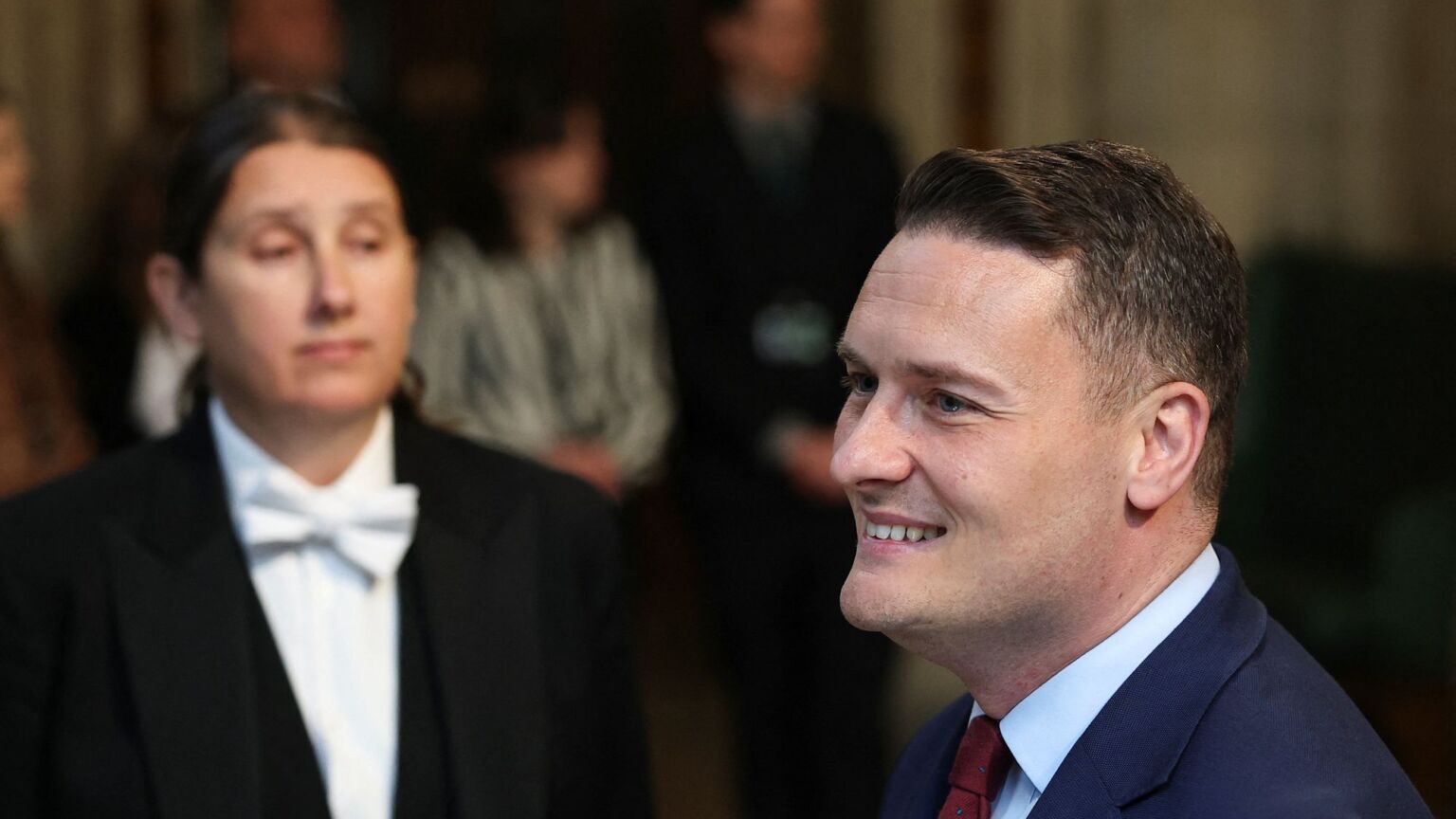
We all knew the calamitous showing at the 7 May local elections would precipitate a challenge to Keir Starmer’s leadership. Yet not all of us foresaw that the entity which would bring the party together in the ensuing struggle for power would be the EU. Former health secretary Wes Streeting wasted no time after resigning from Starmer’s cabinet before calling for Britain to abandon Brexit and rejoin the EU. In hindsight, this shouldn’t have surprised us.
Even if some of the contenders cynically jink and waver on the issue when it’s convenient – witness Andy Burnham’s backtracking on his previous statements on reversing Brexit – they are all keen to display their pro-federalist credentials because they know this is all Labour has got left. The EU is the last remaining force that unites a hollowed-out party that now believes in nothing except its own survival.
Labour has adopted the blue and gold standard of that modern-day Holy Roman Empire for much the same reason Irish Republicans have become morbidly fixated with Palestine. Just as they have abandoned their ideal of a united Ireland to pursue instead an ersatz cause over which they have no influence, the Labour Party, having given up on the British working class, has found its own substitute raison d’être, one more amenable to its refined, globalist tastes.
Labour stopped being a party for the workers some years ago, to become instead a patrician charity for the workless and workshy. That much was signalled in the 2019 General Election, when the ‘Red Wall’ turned blue, and it was confirmed once again this month. It’s now a party for affluent, cosmopolitan lifestyle-leftists and a lumpenproletariat electoral bloc hooked on welfare. Each partner is locked in a squalid symbiotic relationship. The former accrues the warm glow of benevolence by handing over other people’s money to the latter, to those who might otherwise work, but who now don’t, thanks to the hope-destroying munificence of their paymasters.
Meanwhile, it’s working people of all ranks who are obliged to pay for this seedy embrace. It’s the country which suffers under the weight of the consequent high taxation, borrowing, debt and welfare budget, all of which are pushing the British state towards bankruptcy. This is why ‘working people’ now, for the most part, actively hate the Labour Party.
Not only has Labour largely given up on the working class, there is also a palpable sense that it and the cloistered class who support it find the working class repellent. That much was made clear in 2010 when the then Labour prime minister, Gordon Brown, labelled a Rochdale pensioner a ‘bigot’ for raising concerns about immigration. We saw it once more last week when the current prime minister accused those behind the Unite the Kingdom march of ‘peddling hatred and division, plain and simple’.

They still don’t get it. They still think rallying round the flag of a bullying and vindictive foreign body will provide them a lifeline. They still don’t understand that they’ve lost the working class, and that the more they fixate on this moribund anachronism, the sooner they will guarantee their own oblivion.
Suicidal empathy is all too human
It’s not often that a phrase enters the lexicon before the book that spawned it is actually published. I doubt people spoke about the ‘invisible hand’, ‘Big Brother’ or ‘the selfish gene’ before Adam Smith, George Orwell and Richard Dawkins had devised the phrases. But the Canadian academic Gad Saad, the man responsible for that already well-known phrase ‘suicidal empathy’, has already achieved that rare feat. What with the release in Britain next month of his book by that name, we will finally know what precisely he means by the coinage.
Most people who are familiar with Saad’s previous work will know what it signifies, and I suspect it’s caught on because we intuitively recognise it as a chief symptom of the hyper-liberal mindset. It’s already commonly understood to mean policies or behaviour that, motivated so mindlessly and fanatically by the desire to be or seem compassionate, reward immoral or harmful behaviour and actively make life worse for those doling out uncalculated benevolence.
You probably will have read news reports in recent years that fit this criterion. And some people would say that over-indulgent governmental policies regarding immigration, Islam or DEI policies in the emergency services would be classed as examples of ‘suicidal empathy’ – policies in which the desire to express compassion has actively made life more dangerous and deadly for everyone.

‘Suicidal empathy is a civilisation malady that has entered every nook and cranny of our lives’, wrote Saad in an article for the New York Post last week, and I’m sure he’s right. It’s certainly become an epidemic.
It’s just that it’s not new. Acts or policies motivated by delusional compassion have always been a feature of mankind’s history, especially in cultures in which showing empathy gains you kudos, improves your social standing and ultimately improves your chances of finding a mate.
Likewise, that similar phenomenon of virtue-signalling may have been one of classic hallmarks of wokery, but there have always been ostentatiously caring types who go to any lengths to demonstrate how compassionate they are, in order to further their own egotistical, selfish ends.
‘Suicidal empathy’ is merely the diametric opposite of the ‘invisible hand’, that other eternal phenomenon by which behaviour driven by honest self-interest actually improves society’s lot in the end.
Obesity isn’t a ‘disease’
You may have seen a recent television advert proclaiming that ‘obesity is a disease’. Apparently, the World Health Organisation also agrees. Yet I suspect those behind this campaign have taken inspiration from Alcoholics Anonymous, which tells those who attend its meetings that alcoholism is a ‘disease’.
Yet neither alcoholism nor obesity is itself a disease, only the cause of diseases. Both can be terrible, deadly conditions with many underlying causes, some genetic and physical, but mostly being emotional in origin. Overwhelmingly, people who eat or drink too much do so because they are desperately unhappy. This means that such conditions can be addressed therapeutically, or through self-reflection and willpower.
Telling people the lie that obesity is a ‘disease’ is not going to help. It will only entrench a passive approach to life that is part of their problem.
Patrick West is a columnist for spiked and author of Get Over Yourself: Nietzsche For Our Times (Societas, 2017). Follow him on X: @patrickxwest.
spiked summit 2026 – SOLD OUT
Saturday 27 June 2026
10am-6pm, Saturday 27 June
Emmanuel Centre, London, SW1P 3DW
With Lionel Shriver, Brendan O’Neill, Katharine Birbalsingh, Toby Young, Allison Pearson, Paul Embery, Tom Slater, Andrew Doyle, Fiyaz Mughal and more
The spiked summit has now SOLD OUT. To join the waitlist, email:
[email protected]
£80 or £50 for supporters
You’ve hit your monthly free article limit.
Support spiked and get unlimited access.
Support spiked and get unlimited access
spiked is funded by readers like you. Only 0.1% of regular readers currently support us. If just 1% did, we could grow our team and step up the fight for free speech and democracy.
Become a spiked supporter and enjoy unlimited, ad-free access, bonus content and exclusive events – while helping to keep independent journalism alive.
Monthly support makes the biggest difference. Thank you.







Comments
Want to join the conversation?
Only spiked supporters and patrons, who donate regularly to us, can comment on our articles.