The Trump-Xi summit was a battle of two waning superpowers
America and China are more dependent on one another than ever before.
Read our latest coverage of the French riots here – paywall-free all of this week..
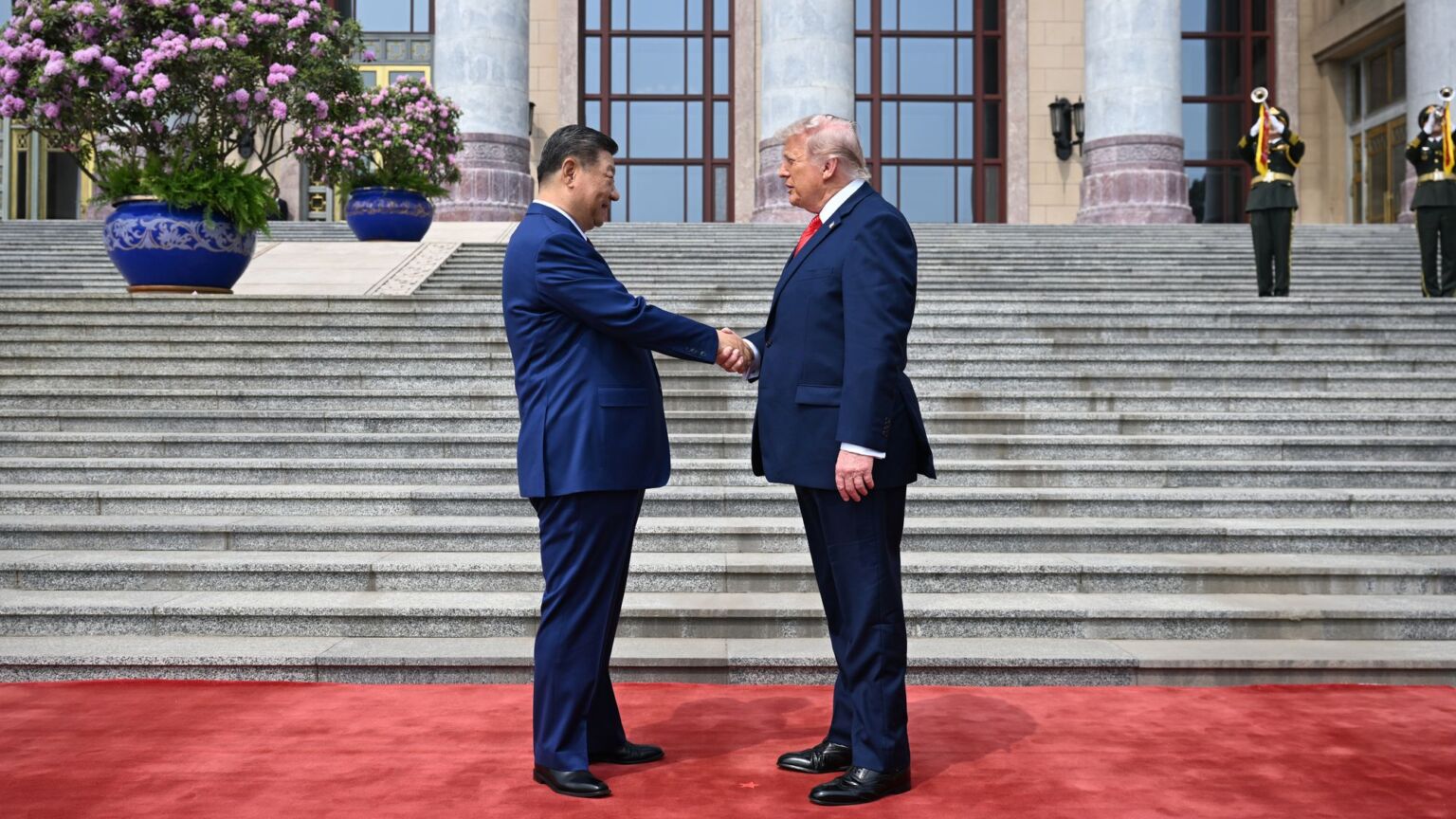
US president Donald Trump met Chinese Communist Party (CCP) leader Xi Jinping for a two-day summit in Beijing this week. Accompanied by Elon Musk, the CEOs of Apple, Boeing and top American financiers, Trump had stressed that the conversation would be about trade ‘more than anything else’ before the conference began. Hopes were high for US exports of farm products – especially soybeans – plus exports of Nvidia chips designed for Artificial Intelligence (AI). China’s own export to Mexico of precursors for the drug fentanyl, still devastating the US, was also thought to be high on Trump’s agenda.
So how did Xi open the discussions? Not with soybeans. Instead, China’s president bluntly insisted that Taiwan remained the most important issue for China. Some said Trump ‘froze’ when confronted in public with a question on Taiwan; certainly, the White House readout of the talks made no mention of the thorny subject.
Many Western commentators were determined to view Trump and America as the losers in the negotiations, even before they had begun, owing to the current stalemate in Iran. A Washington Post podcast agreed that the US had already lost the conflict, while the New York Times said the summit underscored the ‘strategic setbacks’ Trump had met ‘as he struggles for a way to end the Iran war’. A columnist on The Times also divined, Xi ‘smells bombast… masking weakness’ on the part of The Donald.
Indeed, Trump Derangement Syndrome (TDS) spread as far as the Hong Kong-based South China Morning Post, where one commentator discovered that the president’s general ‘bravado of maximum pressure masks a deepening domestic vulnerability’ – over fragmented supply chains, inflation and plummeting approval ratings at home. Over Iran, too, there had been ‘a sharp decline in US global standing’.
Well, perhaps. Yet two things are forgotten among all this.
First, the scale of integration between the US and Chinese economies – in two-way trade and two-way foreign direct investment – is enormous. That does not rule out war between members of what Trump calls the ‘G2’ – indeed, it ensures that, leaving aside today’s high-tech weapons, any war will be several orders of magnitude more catastrophic even than the First World War, which was itself preceded by significant globalisation. However, for the moment, Washington needs Beijing to keep buying up its debt in the form of treasury bonds, just as Beijing needs America to keep buying its exports. Compromises in formal negotiations are therefore no surprise – even though, behind all the diplomacy, real-life manoeuvres on both sides are becoming much more aggressive.
Make no mistake, both countries are competing in a military arms race. This year, China has released footage of prototype sixth-generation stealth fighters, and America has test-fired a Tomahawk cruise missile from a Typhon launcher in the Philippines. Both sides have been upping their nuclear arsenals for some time.
Lawfare, too, is beginning to play a bigger role in this strategic competition. Beijing prepared for the summit laws to counter US sanctions, ordering Chinese and foreign companies not to comply with measures taken by Washington against five Chinese oil refiners, and other companies accused of trading with Iran. Meanwhile, America’s Multilateral Alignment of Technology Controls on Hardware (MATCH) Act has pressured allies of the US to enforce Washington’s controls on the export of semiconductor manufacturing equipment to China.
Nonetheless, in typical Trump fashion, the American president has wasted no time in chalking up the summit as a success. He claims China has agreed to greater investment in US farms, limited the export of precursors to fentanyl, and sealed a Chinese order for 200 Boeing jets. On Iran, Trump said that there was consensus on the need to bar Tehran from acquiring nuclear weapons, and to reopen shipping lanes in the Strait of Hormuz. On top of soybeans and beef, there is also a chance that, to replace Iranian oil, the US will sell more of its own oil to China.
Coverage of the conflict has oscillated between extreme views. Of course, while those afflicted by TDS exaggerated America’s economic and political woes, others (optimistically) asserted that China was on the verge of collapse. One oddball tried to persuade us that the Chinese Communist Party ‘is facing a perfect storm of problems at home’. Another reported its impotence in the Gulf, the difficulties it faces both in equalling US military power and in ‘establishing an alliance of authoritarian states’ with Iran, Russia and North Korea. The ‘collapse in Beijing’s global standing’, he wrote, ‘is not confined to the Iran issue’. As ever, Western opinion presented two options: America in decline and China’s imminent combustion.
The more sober truth is that America is in long-term decline, but it has proved more resilient than critics allow. But China too now encounters unmistakable problems. The US is growing, but saddled with burgeoning debt – and China also has trouble brewing in that domain. Of course, Trump faces domestic dissent – but so, in a very different form, does the CCP. China has long had too much housing built, is heavily indebted and is hurtling towards a demographic cliff.
Of course, there is no direct symmetry between the two contenders. Yet, as Xi underlined, the greatest potential asymmetry remains Taiwan. Though there were fears that Trump would lower arms sales to Taipei, US secretary of state Marco Rubio said that there had been no change in the US position of studied ambivalence on the island. Once again, however, diplomacy does not tell the full story.

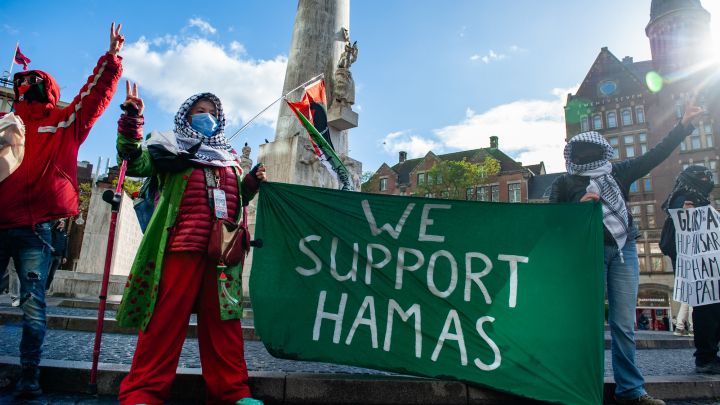
As Hamas has unfortunately shown us, in today’s world, ideology remains a more potent motivating force than economics. For the Chinese Communist Party, reunification with Taiwan is a sacred duty. Those of us concerned with preserving what’s left of democracy around the world should never forget that.
James Woudhuysen is visiting professor of forecasting and innovation at London South Bank University. Follow him on X: @jameswoudhuysen.
spiked summit 2026 – SOLD OUT
Saturday 27 June 2026
10am-6pm, Saturday 27 June
Emmanuel Centre, London, SW1P 3DW
With Lionel Shriver, Brendan O’Neill, Katharine Birbalsingh, Toby Young, Allison Pearson, Paul Embery, Tom Slater, Andrew Doyle, Fiyaz Mughal and more
The spiked summit has now SOLD OUT. To join the waitlist, email:
[email protected]
£80 or £50 for supporters
You’ve hit your monthly free article limit.
Support spiked and get unlimited access.
Support spiked and get unlimited access
spiked is funded by readers like you. Only 0.1% of regular readers currently support us. If just 1% did, we could grow our team and step up the fight for free speech and democracy.
Become a spiked supporter and enjoy unlimited, ad-free access, bonus content and exclusive events – while helping to keep independent journalism alive.
Monthly support makes the biggest difference. Thank you.

Comments
Want to join the conversation?
Only spiked supporters and patrons, who donate regularly to us, can comment on our articles.