What the hell is a ‘MMIWG2SLGBTQQIA+’ person?
Canadian identity politics has jumped the shark.
Want unlimited, ad-free access? Become a spiked supporter.
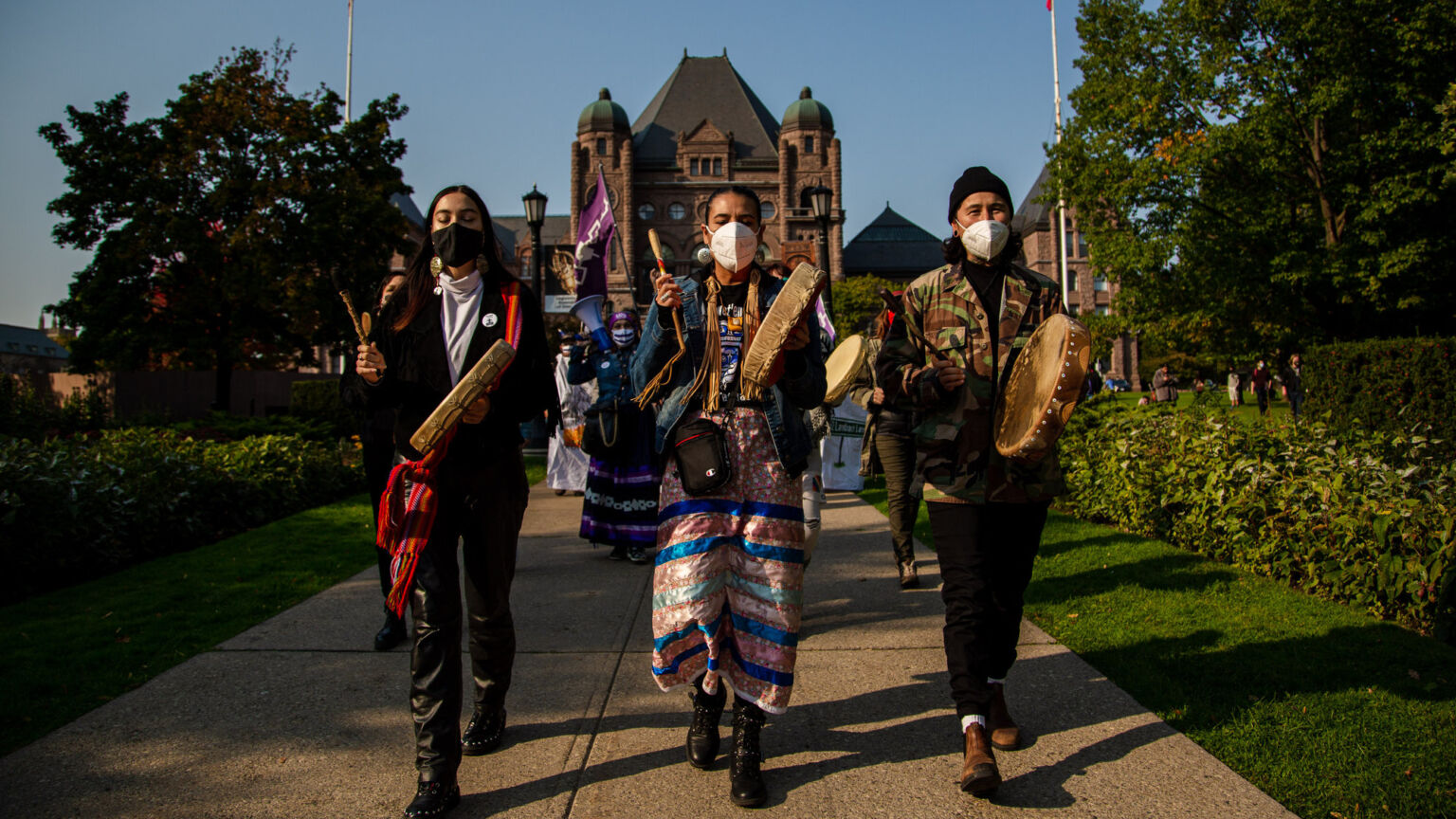
‘MMIWG2SLGBTQQIA+’… Canadian MP Leah Gazan used this 16-letter acronym in a press conference at the beginning of April. Her statement went viral, meeting immediate confusion and ridicule. Many observers remarked that the string of characters resembled a scrambled wi-fi password. She couldn’t be serious, could she?
But she was. Gazan, a member of the ultra-woke New Democratic Party, was criticising recent budget cuts that would supposedly strip seven billion Canadian dollars in funding from Indigenous Services Canada and Crown-Indigenous Relations, the two government departments with responsibility for policies related to indigenous Canadians. ‘[The Canadian government] provided zero to deal with the ongoing genocide of MMIWG2SLGBTQQIA+’, Gazan said, quivering with indignation. Officially, this impenetrable acronym stands for: Missing and Murdered Indigenous Women, Girls, and Two‑Spirit (a term that is used by some First Nations to describe people who embody both masculine and feminine spirits), Lesbian, Gay, Bisexual, Transgender, Queer, Questioning, Intersex and Asexual people. I hope that clears things up for you.
It may all seem like a joke – the very definition of woke madness. Unsurprisingly, Gazan was widely mocked. But there is a serious issue behind this indecipherable maze of letters.
The kind of language deployed by governments nowadays is growing ever more distant from the way ordinary people express themselves. Public institutions across the West now use increasingly specialised terminology. Plain speech has been replaced by administrative and technical language. This pattern appears in HR departments, university offices and legislative settings. The language of identity politics, in particular, is growing increasingly detailed and arcane. And as this terminology becomes more mind-bending, shared understanding with the general public evaporates. As official speech requires specialised knowledge to understand, the audience shrinks to a small circle of activists.
Public institutions are under great pressure from activists to signal ‘inclusion’ at every turn, no matter how ridiculous they end up sounding to the general public. Listing every possible category of human being protects against claims of bias or oversight – but, over time, this turns administrative language into a form of procedural compliance, draining it of any real meaning. Each new letter or category ticks an extra box but makes the message harder for everyone else to follow.
For an administrator, a 16-letter acronym is a success because it is exhaustive. The fact that it’s also impossible to understand is actually a virtue, as it becomes a means of expressing virtue and moral superiority. This is the same mindset that has given us terms like ‘birthing person’ (mother), ‘Latinx’ (a Latino person) and a ‘justice-involved individual’ (convicted criminal), words which are practically never used by the groups they refer to.
Gazan reacted to the mockery her comments provoked in the only way establishment elites know how – namely, by calling her critics ‘bigots’. This defensiveness isn’t only arrogant and incorrect – it strengthens the barrier between herself and the people she is supposedly trying to connect with. Those who find the language confusing are often excluded from the conversation. Understandably, they then zone out. The result is a situation where the state is only talking to itself and a small coterie of activists.
Gazan maintains that those mocking her use of ‘MMIWG2SLGBTQQIA+’ are distracting from the real issue of federal cuts to indigenous services. But the viral reaction to her press conference is proof that her use of jargon was the real distraction here.
If so-called progressives really valued ‘inclusion’ anything like as much as they claim, they would use plain and clear language that doesn’t alienate the public.
Yuan Goh is a writer on politics and culture based in Massachusetts. His work has appeared in the Federalist, DC Journal and Quadrant.
spiked summit 2026 – SOLD OUT
Saturday 27 June 2026
10am-6pm, Saturday 27 June
Emmanuel Centre, London, SW1P 3DW
With Lionel Shriver, Brendan O’Neill, Katharine Birbalsingh, Toby Young, Allison Pearson, Paul Embery, Tom Slater, Andrew Doyle, Fiyaz Mughal and more
The spiked summit has now SOLD OUT. To join the waitlist, email:
[email protected]
£80 or £50 for supporters
You’ve hit your monthly free article limit.
Support spiked and get unlimited access.
Support spiked and get unlimited access
spiked is funded by readers like you. Only 0.1% of regular readers currently support us. If just 1% did, we could grow our team and step up the fight for free speech and democracy.
Become a spiked supporter and enjoy unlimited, ad-free access, bonus content and exclusive events – while helping to keep independent journalism alive.
Monthly support makes the biggest difference. Thank you.
Comments
Want to join the conversation?
Only spiked supporters and patrons, who donate regularly to us, can comment on our articles.