How climate monomania destroyed the British economy
Politicians of all stripes have put achieving Net Zero above securing cheap and plentiful energy.
Read our latest coverage of the French riots here – paywall-free all of this week..
Like Russia’s invasion of Ukraine in 2022, the war in Iran has exposed the folly of Britain’s energy and climate policy.
Since 2008, we have been sold a utopian dream of the benefits of green energy. In July 2009, Ed Miliband, then the secretary of state for energy and climate change, said decarbonisation would ‘create a more secure, more prosperous low-carbon Britain’. In 2010, new prime minister David Cameron said he wanted the ‘greenest government ever’ so that we might ‘have our share of the industries of the future’. In 2015, Lib Dem MP Ed Davey said that renewables were central to our ‘global leadership on climate change’. In 2019, prime minister Theresa May, who put Net Zero into law that same year, said the UK was ‘leading the world on climate change’ and that others should ‘follow our example’.
That idealistic story is now unravelling. The UK not only has the highest industrial electricity prices in the developed world, but is actively deterring businesses such as OpenAI from investing here. Despite abundant offshore and onshore hydrocarbons, our dependence on imported gas has grown, and global annual carbon emissions continue to rise.
More than a mere policy failure, the UK’s green energy drive has been an ethical disaster. For more than two decades, we have failed to ask the vital question: what is energy policy for? Faced with a cross-party climate consensus, we never debated how decarbonisation should be weighed against other legitimate goods such as affordability, security, sovereignty, industrial depth and democratic consent. Instead, one objective was elevated above all the others. The trade-offs were brushed under the carpet.
Isaiah Berlin, one of the 20th century’s most important liberal political philosophers, offers a useful way of understanding what went wrong. In Does Political Theory Still Exist?, he argued that politics exists because a plurality of legitimate conceptions of the ‘good life’ can conflict. The alternative is monism: the belief that one supreme, unifying goal can take precedent over the rest. In that sort of system, with the goal of policymaking decided in advance, ‘the only unsolved problems will be more or less technical’, wrote Berlin.
For Berlin, a defender of value pluralism and political liberty, monism was the enemy of politics. He suggested that in more extreme cases, monism can drift towards crisis politics, where certain situations are cast as ‘critical emergencies’. And in a state of emergency, any means can be justified in the name of averting a putative disaster or threat. This serves as an apt description of contemporary British climate politics.
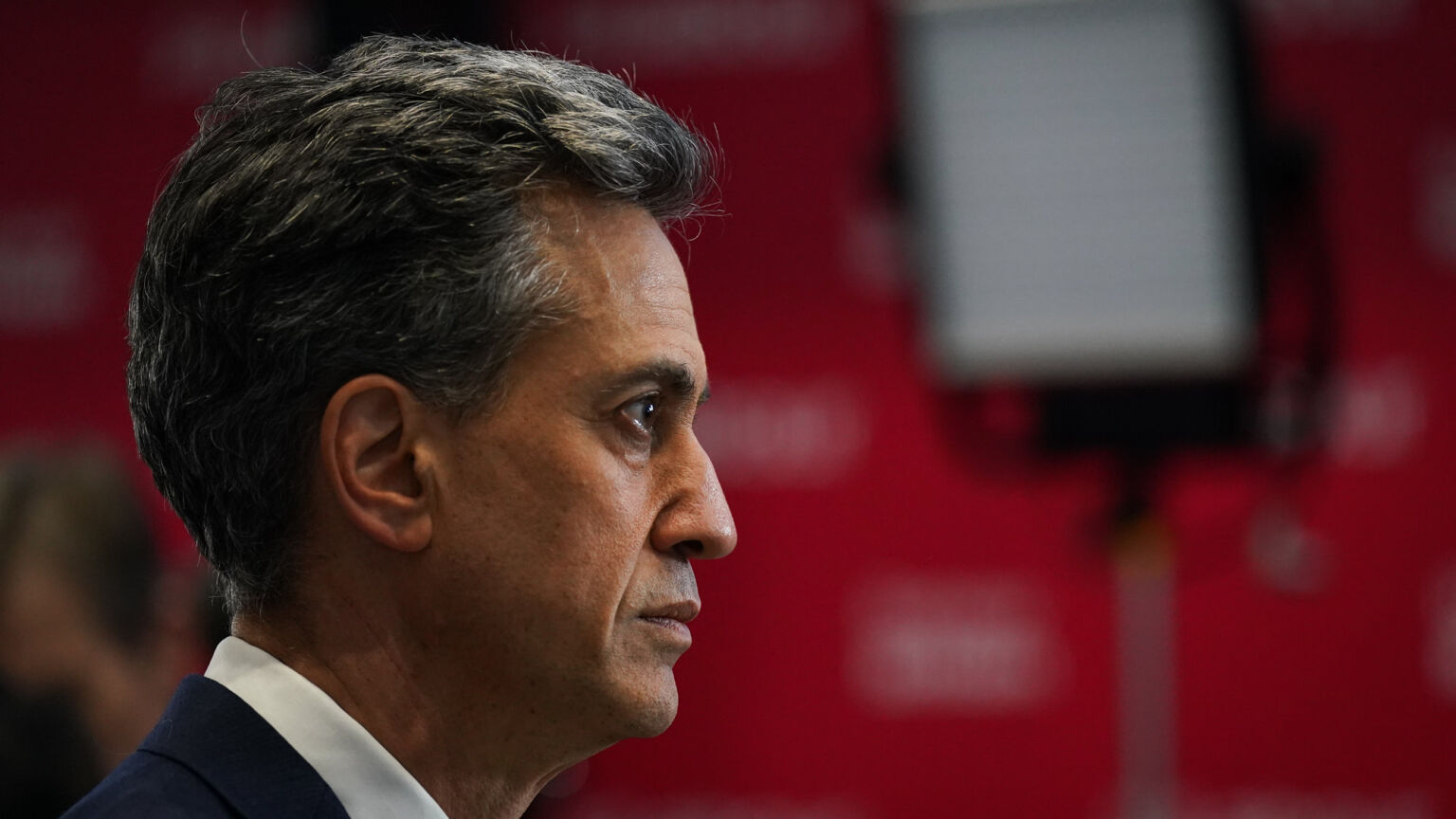
Indeed, no one has articulated this more clearly than Ed Miliband himself. In his 2022 post-pandemic manifesto, Go Big: 20 Bold Solutions to Fix Our World, Miliband set out his own monist logic. In his view, the ‘climate disaster’ is ‘the ultimate challenge for politics’. There is ‘no route to a renewed social contract that does not involve putting the climate threat front and centre’. The transition ‘demands we rethink and remake our societies’ and requires us to abandon our ‘300-year model of economic growth’ to do so. In a 2025 interview with The Rest Is Politics, Miliband dismissed sceptics as guilty of ‘defeatism’ and spoke in strikingly deterministic terms about Net Zero’s inevitability.

This is not ordinary policymaking. It is a totalising political vision in which every issue must be interpreted through a climate lens: jobs, fairness, housing, transport, ownership, industry, diet and more. All are made subordinate to the goal of decarbonisation. Worse still, this is not mere rhetoric. The Climate Change Act, the 2019 Net Zero amendment, carbon budgets and the influential role of the Climate Change Committee have turned decarbonisation from a policy goal into a statutory governing obligation. This shift has transformed the purpose of the British state itself, moving it away from maximising security and economic prosperity, and towards the long-term re-engineering of society in the service of a global emissions agenda.
Between 2010 and 2015, the coalition government reordered the system to favour intermittent renewables over firm power and domestic hydrocarbons. Rupert Darwall, a senior fellow at the National Centre for Energy Analytics and a long-time critic of Britain’s green agenda, shows how the coalition’s Electricity Market Reform plan and its so-called Contracts for Difference regime meant that the state supplanted the market in allocating capital ‘between different generating technologies’. The result was not merely more wind and solar, but also the premature phasing out of reliable coal and gas, greater dependence on imports (especially of liquefied natural gas) and a sharp rise in whole-system costs. Indeed, Net Zero policies are now adding about £17 billion a year to the cost of living – a figure which, in Andrew Montford’s analysis for Net Zero Watch, is heading towards £30 billion by 2035.
The consequences are impossible to hide. But the damage runs even deeper than bills or the risks of blackout. Rian Whitton, an analyst and leading industrial strategist, argues that high energy costs and decarbonisation policy have hollowed out the ‘foundational industrial economy’ on which hard national power depends, including steel, petrochemicals and ammonia production. He warns that our industrial base will ‘almost certainly have shrunk further by the time of the next General Election’. The prospect of finding Britain in a weaker industrial position after the outbreak of the Ukraine war, the largest land war in Europe since 1945, should terrify us all.
This is a real indictment of Net Zero and the cross-party consensus that protected it. Affordability has been subordinated and lied about, security treated as the preoccupation of cranks, and industrialisation viewed as a relic from a grubbier age. Britain’s mistake was not that it cared about climate change or the environment. We all do. It was that it allowed environmental concerns to colonise the entire field of politics. It is time to return to first principles and ask the questions that need asking – before it’s too late.

Maurice Cousins is campaign director for Net Zero Watch. Follow him on X: @MDC12345678.
spiked summit 2026 – SOLD OUT
Saturday 27 June 2026
10am-6pm, Saturday 27 June
Emmanuel Centre, London, SW1P 3DW
With Lionel Shriver, Brendan O’Neill, Katharine Birbalsingh, Toby Young, Allison Pearson, Paul Embery, Tom Slater, Andrew Doyle, Fiyaz Mughal and more
The spiked summit has now SOLD OUT. To join the waitlist, email:
[email protected]
£80 or £50 for supporters
You’ve hit your monthly free article limit.
Support spiked and get unlimited access.
Support spiked and get unlimited access
spiked is funded by readers like you. Only 0.1% of regular readers currently support us. If just 1% did, we could grow our team and step up the fight for free speech and democracy.
Become a spiked supporter and enjoy unlimited, ad-free access, bonus content and exclusive events – while helping to keep independent journalism alive.
Monthly support makes the biggest difference. Thank you.



Comments
Want to join the conversation?
Only spiked supporters and patrons, who donate regularly to us, can comment on our articles.