Tracey Emin: the art of self-exposure
From My Bed to her bronzes, Emin’s new retrospective lays bare the human condition.
Want unlimited, ad-free access? Become a spiked supporter.
Tracey Emin’s A Second Life exhibition recently opened at the Tate Modern in London. Running from 27 February to 31 August, this retrospective of her work unfolds like a confessional diary ripped open for the world. Spanning over 90 works across 40 years of her unflinching practice, it left me pondering the fragile threads that bind our humanity.
As I wandered through the Eyal Ofer galleries, I found myself confronting not just Emin’s art, but the very essence of vulnerability, guilt and the arduous path to personal sovereignty. In my three decades of going to exhibitions in this vein – beginning with the provocative Young British Artists’ Sensation in 1997 at the Royal Academy and the Tate’s 1999 Turner Prize show, where I first saw Emin’s infamous Bed – this stands as perhaps the most potent of them all. It is hard-edged, brutally honest and, in its quiet devastations, profoundly moving.
Emin, now Dame Tracey Emin CBE and professor of drawing at the Royal Academy, has evolved from the enfant terrible of the 1990s to a sage of self-examination. Yet her work retains that raw, unpolished urgency, as if each piece is a fresh wound. The exhibition charts this journey with meticulous care, beginning with her early provocations and culminating in recent bronzes and paintings that whisper of redemption.
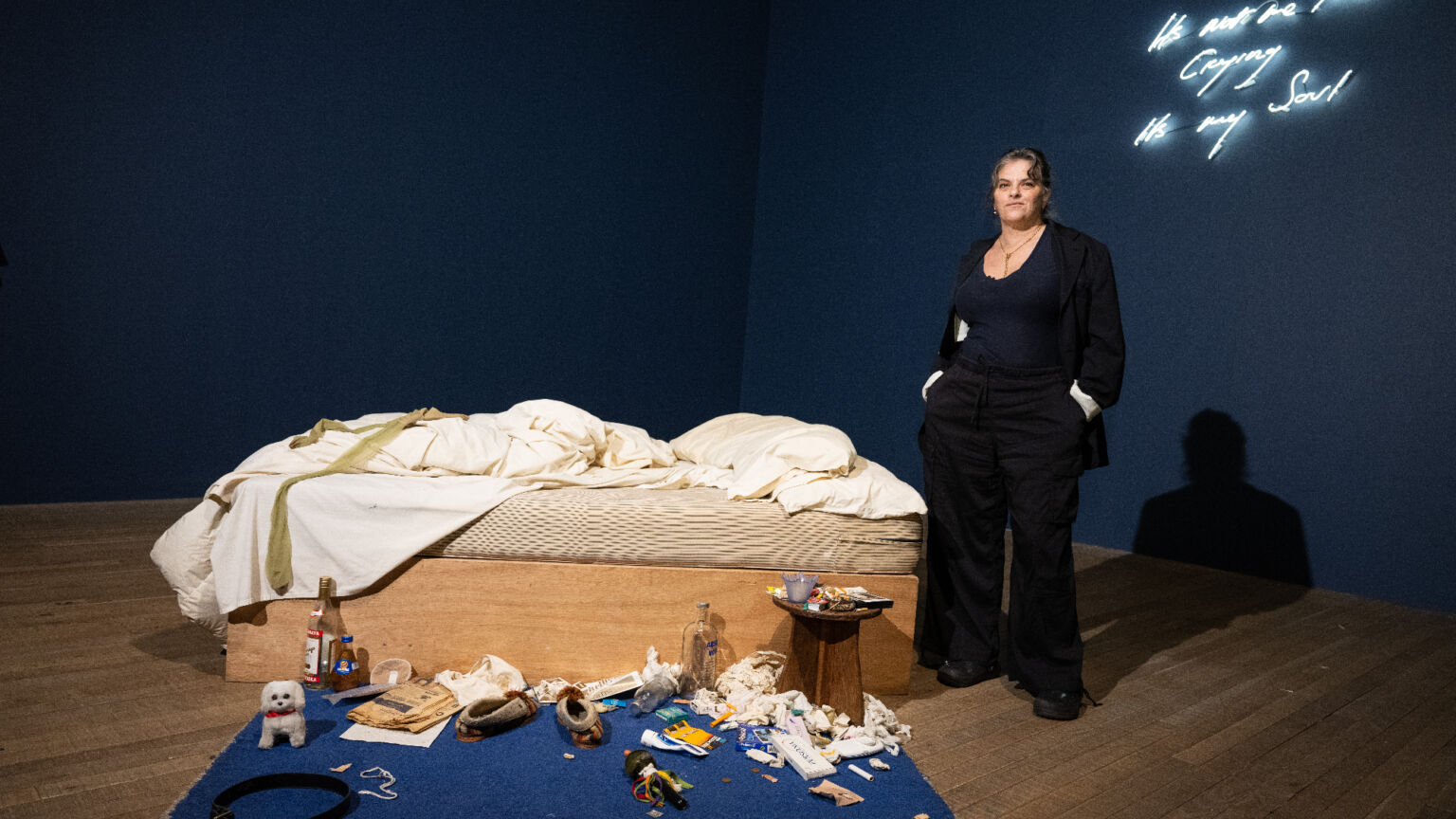
At the heart of the exhibition lies that same My Bed (1998), the infamous installation of stained sheets, discarded condoms and vodka that was nominated for the Turner Prize. A snapshot of despair from her Margate youth, it captures a young woman’s chaotic autonomy. It’s displayed here not as a relic but as a genesis point, inviting us to trace the decades-long arc from youthful rebellion to mature reflection. What makes it so striking is the gap Emin has bridged: from the hedonistic excesses of her twenties to the sober reckonings of illness, loss and moral accountability of her sixties. Her cancer diagnosis in 2020 and subsequent recovery infuse the later works with a haunting fragility, turning personal trauma into something more universal.
Technically, the show is a triumph. Emin’s command of media – painting, video, textiles, neons, writing, sculpture and installation – is on full display, each form serving her confessional ethos. The neons, like I Followed You To The End (2023), installed outside the museum, pulse with emotional electricity, their script-like handwriting evoking intimate letters never sent. Her bronzes, such as The Mother (2017), on loan from White Cube and echoing ancient fertility figures, bring a tactile weight, their surfaces pitted and imperfect, mirroring the scars of lived experience. Videos show raw monologues, while textiles – quilts stitched with accusations and apologies – hang like banners of unresolved guilt.
The curation, conceived in close collaboration with Emin, flows thematically rather than chronologically, grouping works around passion, pain and healing. This non-linear approach mirrors life’s messiness, forcing viewers to confront the cyclical nature of responsibility: how actions echo across years, demanding reckoning.
But it’s the emotional brutality that lingers. Emin uses the female body – her body – as a battlefield for exploring desire, abuse and agency. Works like Exorcism of the Last Painting I Ever Made (1996), a three-week performance recreated here through documentation, play out the artist’s exorcism of creative demons. Recent paintings, vast and visceral, depict nude figures in throes of ecstasy or agony, their forms dissolving into abstraction.
One room, dedicated to Emin’s writings and drawings, reveals the professor in her: delicate lines tracing regrets, responsibilities shirked or embraced. It’s here that the show’s power peaks, unapologetic in its demand for empathy. A female friend I accompanied to the exhibition was unaccustomed to such raw emotional exposure. She emerged from the Tate Modern almost devastated, her eyes reddening with tears. It’s too much, she said – like staring into someone’s soul without permission. Indeed, Emin doesn’t ask for permission; she insists on truth, challenging us to examine our own fragilities.
This isn’t art for the faint-hearted. It requires a strong stomach – not for gore, but for the psychological dissection of guilt and autonomy. Emin’s reflections on morality – abortion, relationships, self-destruction – probe the grey areas where personal choice meets societal judgment. In a world quick to cancel or commodify vulnerability, her work stands as a defiant assertion of the self. The honesty is deeply moving, performing a catharsis that heals as it hurts.
A Second Life is a must-see. It’s not escapism; it’s confrontation. For those willing to engage, it offers profound insight into the human condition – how we falter, forgive and forge ahead. Emin emerges as a profound philosopher of the personal. In these turbulent times, her exhibition reminds us that art’s true power lies in its ability to make us feel, question and ultimately reclaim our stories.
Gawain Towler is a commentator and an elected board member of Reform UK.
You’ve hit your monthly free article limit.
Support spiked and get unlimited access.
Support spiked and get unlimited access
spiked is funded by readers like you. Only 0.1% of regular readers currently support us. If just 1% did, we could grow our team and step up the fight for free speech and democracy.
Become a spiked supporter and enjoy unlimited, ad-free access, bonus content and exclusive events – while helping to keep independent journalism alive.
Monthly support makes the biggest difference. Thank you.

Comments
Want to join the conversation?
Only spiked supporters and patrons, who donate regularly to us, can comment on our articles.