Paul Ehrlich was catastrophically wrong
The co-author of The Population Bomb amplified the most apocalyptic tendencies of environmentalism – to disastrous effect.
Want unlimited, ad-free access? Become a spiked supporter.
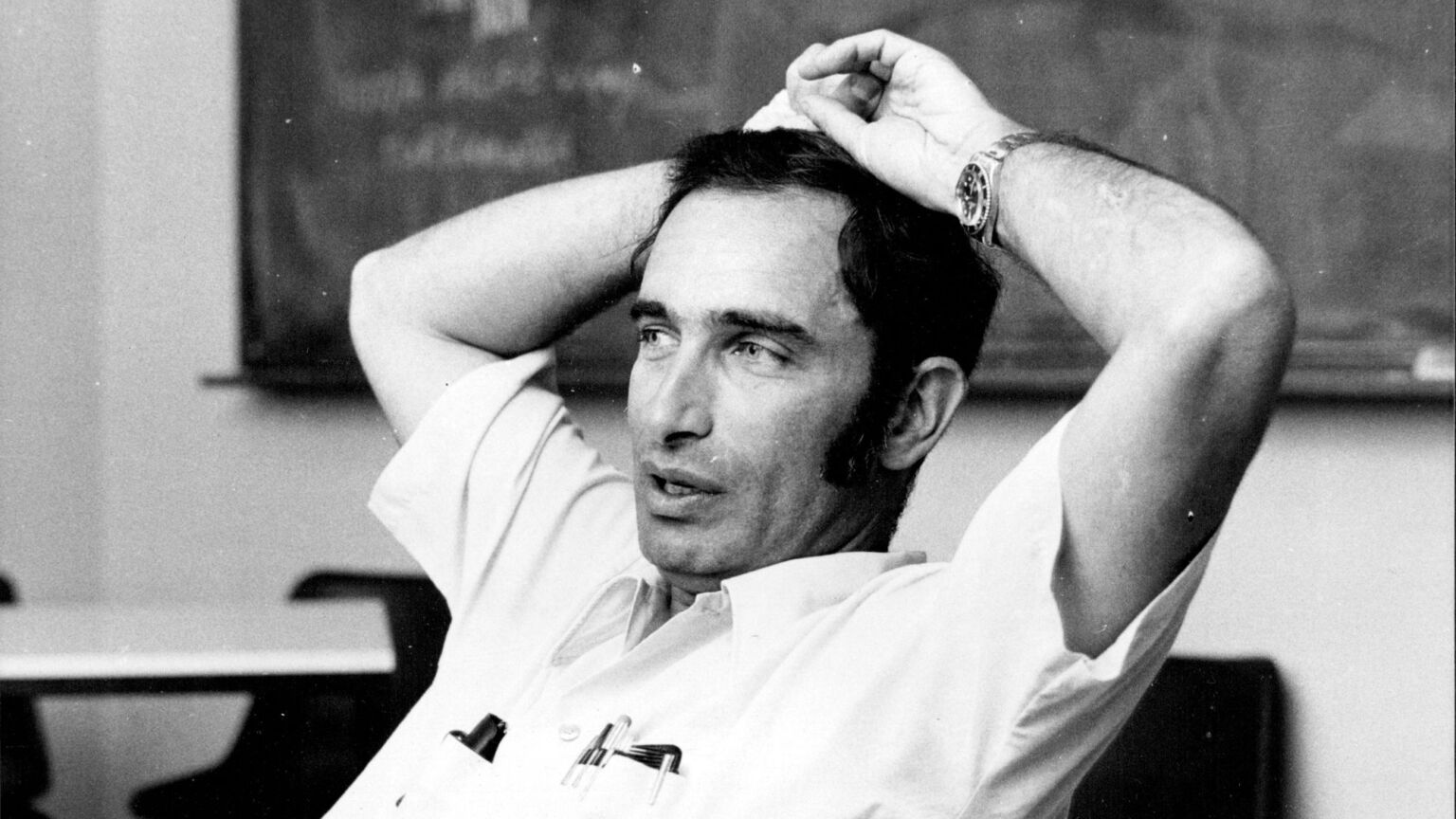
The death of Paul Ehrlich, at a decidedly selfish, resource-hogging 93, has elicited a resounding consensus on his legacy. He has been roundly condemned on both right and left as one of the most malign and unrepentant doom-mongers to sway public opinion and policy since the pre-war eugenics movement.
Initially an entomologist specialising in moths and butterflies, Ehrlich became famous during the late 1960s and early 1970s for trying to prevent the spread of what he saw as an altogether more troublesome species – his own, mankind.
Following the publication in 1968 of The Population Bomb, co-authored with his wife Anne, Ehrlich toured TV studios promoting an almost unforgivable assessment of our fate. Were we to obey the single most natural inclination of our and indeed any species – namely, copulation – we were doomed, he said. Men were told to sever their bloodlines at once, and ideally their vas deferens too.
This was not merely to save the planet, he argued. It was also to prevent man handing misery on to man, as population growth outstripped humanity’s ability to produce the food needed to feed itself. Indeed, on that front, it appeared to Ehrlich to be already too late. The Population Bomb began with this sombre knelling:
‘The battle to feed all of humanity is over. In the 1970s hundreds of millions of people will starve to death in spite of any crash programmes embarked upon now. At this late date, nothing can prevent a substantial increase in the world death rate…’
Even in 1968, a year of high-profile assassinations, riots at the Democratic National Convention in Chicago and cobbles being heaved up and thrown around in Paris by students demanding the impossible, this was perhaps the grimmest news of the year.
Environmental concern was nothing new in 1968, of course. The movement had perhaps been kick-started – if that isn’t too petrol-head a term – by Rachel Carson six years earlier, with Silent Spring. But Ehrlich proved singularly capable of amplifying environmentalism’s most millenarian tendencies. Among other media appearances, he featured on The Tonight Show with Johnny Carson more than 20 times in the 1970s and 1980s. And more to the point, he brought the focus back from biodiversity and the sixth great extinction to the prospect of not being able to feed our own children – children a feckless society seemed intent on spewing out into the world regardless, from India to America.

Yet somehow, feed them we did, even as the global population proceeded to double in size in the decades after the publication of The Population Bomb. Indeed, widespread famines have declined so emphatically during this period, as to seem to be actively trolling Ehrlich.
So why was he so wrong? It is important to understand that to a large degree, Ehrlich’s gloomy prognostications were nothing new. His most famous precursor was Reverend Thomas Malthus (1766-1834). Malthus was the classic Hedgehog, claiming to know One Big Thing: namely that, in conditions of growing prosperity, a linear, arithmetic growth (1,2,3,4…) in food production cannot keep pace with an exponential, geometric growth (1,2,4,8…) in population. All gains in food production are literally swallowed up.
Today, it is easy to laugh Malthus off as an Eeyore, but there were plenty of historical examples to support his overpopulation thesis in the pre-industrial age. Before birth control and female emancipation, growing prosperity and more food usually did mean more kids – and therefore more than could be fed. JM Keynes studied Malthus’s substantial correspondence with the more optimistic David Ricardo, and awarded the victory on points to the reverend.
But just as the later Ehrlich did, Malthus had failed to factor in technological innovation. This is an almost ubiquitous error, it seems, among pessimistic forecasters. In Matt Ridley’s excellent overview of human ingenuity, How Innovation Works, an entire chapter is given over to ‘the economics of innovation’. Ridley observes that ‘there is a curious hole at the heart of economic theory where the word “innovation” should be’. Innovation that, as Ridley readily concedes, does often arrive in just the nick of time.

The century of industrial revolution that followed the publication of Malthus’s An Essay on the Principle of Population in 1798 was certainly a bumpy ride for many involved. But by its end, Britain had enjoyed a roughly three-fold population increase, and no significant famines on its mainland.
Similarly, between the ongoing introduction of the Haber-Bosch process for extracting nitrogen from the air, and the harnessing of genetics and breeding programmes, the nation that Ehrlich foresaw being overwhelmed by Biblical catastrophe – India – proved capable of feeding more mouths, more workers, than had seemed possible.
Extrapolating demographic trends to predict coming disasters is generally a mug’s game. Dan Gardner has much fun at the expense of those, like Ehrlich, who talk ‘crystal balls’ in his survey, Future Babble. But to be more ruthlessly fair than I feel Ehrlich deserves, to have seen what he thought he could see and not speak out would indeed have been a dereliction. For that he can be forgiven.
What I find much harder to forgive was his proposed solution. He wanted vast social-engineering programmes to be launched, from teaching children that breeding was irresponsible to suggesting TV shows like The Waltons stop showing large healthy families getting along. If it came to it, he thought the government should sternly limit the number of children one might legally have, as strictly as it currently does spouses.
God knows how many lives he panicked and blighted as a result of his doom mongering and his miserable prescriptions. Whether in voluntary misguided restraint, or mass sterilisation campaigns, such as those launched in the mid 1970s by Indira Gandhi – rendered unforgettable for anyone who has read A Fine Balance by Rohinton Mistry. For this, and his refusal to ever acknowledge that he had been wildly and cruelly wrong, I am not inclined to forgive.
Today, Ehrlich’s prognostications are not just morally and factually wrong, they’re also absurd. Downstream of all the various downward pressures on the natural fertility of our species, we are increasingly staring down the barrel of demographic collapse.
Our relative childlessness is both sad and unsettling as a daily reality. Our prospects sometimes seem to me as grim in a fast-ageing population as they did to Ehrlich in a fast-growing population. I suppose if there is one pleasing moral to take from his story it is this – that, God willing, I am very wrong, too.
Simon Evans is a spiked columnist and stand-up comedian. Tickets for his tour, Staring at the Sun, are on sale here.
spiked summit 2026
10am-5pm, Saturday 27 June
Emmanuel Centre, London, SW1P 3DW
With Konstantin Kisin, Lionel Shriver, Brendan O'Neill, Katharine Birbalsingh, Toby Young, Allison Pearson, Tom Slater and more
Become a spiked supporter to get a discounted ticket
£80 or £50 for supporters
You’ve hit your monthly free article limit.
Support spiked and get unlimited access.
Support spiked and get unlimited access
spiked is funded by readers like you. Only 0.1% of regular readers currently support us. If just 1% did, we could grow our team and step up the fight for free speech and democracy.
Become a spiked supporter and enjoy unlimited, ad-free access, bonus content and exclusive events – while helping to keep independent journalism alive.
Monthly support makes the biggest difference. Thank you.







Comments
Want to join the conversation?
Only spiked supporters and patrons, who donate regularly to us, can comment on our articles.