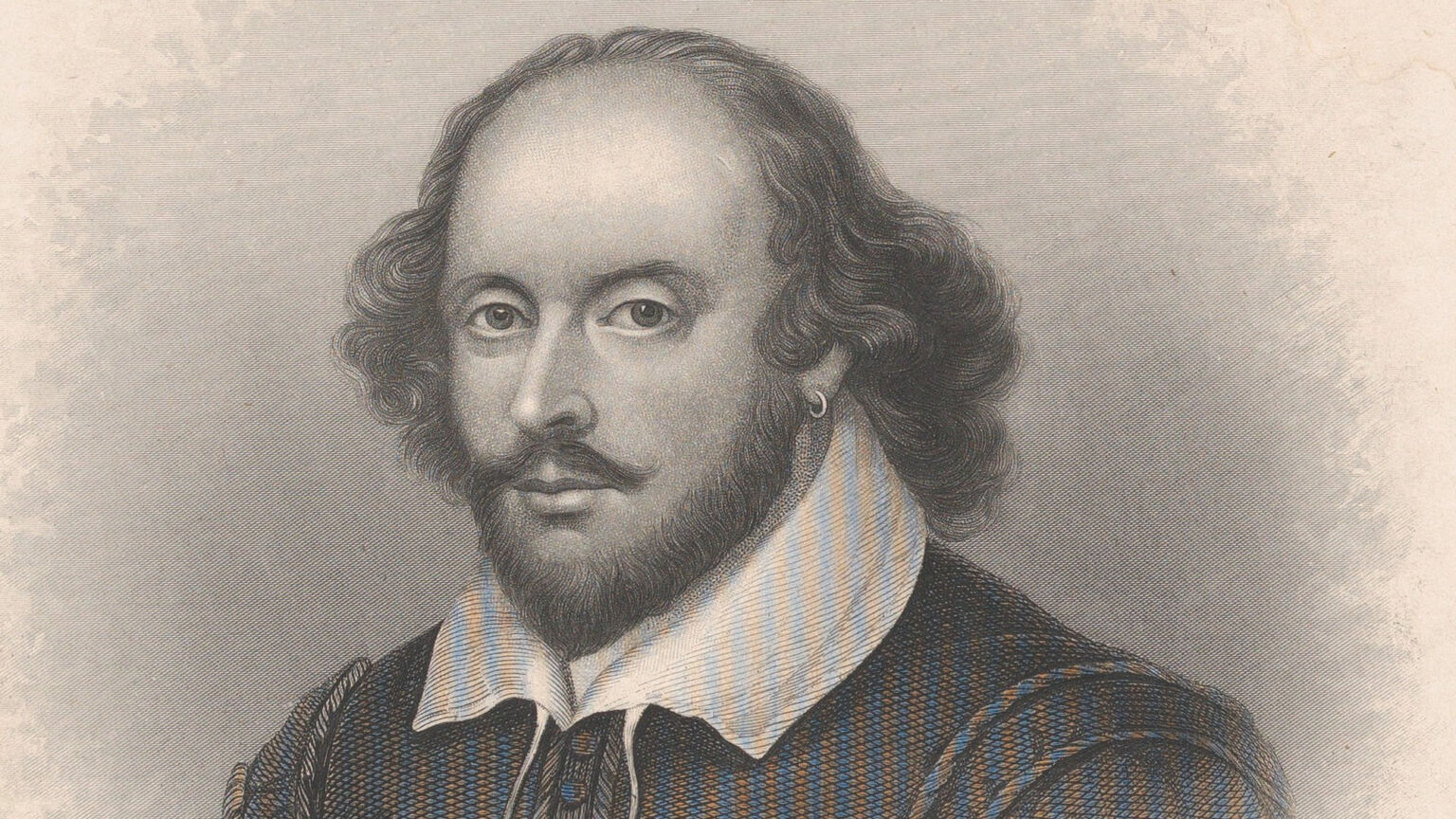
Stop trying to race-swap Shakespeare
I cannot believe it needs to be said but the Bard was not ‘a black woman’.
Want unlimited, ad-free access? Become a spiked supporter.
My reaction on reading headlines like ‘Shakespeare was a black woman’ is very much like that of Tom Hardy’s Mad Max on seeing a naked woman caged atop a tower in the middle of the desert: ‘That’s bait.’
You feel as though you’re being lured into a futile anti-woke tirade. Or, at least, you want to dismiss the idea out of hand – purely on the basis of rigid dogma, unexamined racial prejudice and male chauvinism. The reason being that only an Englishman could have produced work of such universal genius…
Now that would indeed be ridiculous. Women, and indeed people of various races, have produced a wealth of evidence to the contrary, albeit not so much in late-16th and early-17th-century England.
One could make a strong argument that, long before the first wave of organised feminism, the two greatest British novelists of the 19th century were women. Despite the success of Jane Austen only a few years earlier, the fact that poor Mary Ann Evans (better known as George Eliot) chose to change her name is still occasionally portrayed as an adaptation to patriarchal tyranny – even if it may have been a ruse to conceal her identity while she pursued an extra-marital affair. But exposing this misdemeanour is a footling ambition among serious literary scalp-hunters. It’s Shakespeare or bust.
The unhappy mule chosen to smuggle in the blasphemy that Shakespeare was a black woman is one Emilia Bassano. She was certainly an interesting figure, and one who rode what were treacherous waters for a talented woman at the time with considerable elan. She published what Wikipedia affirms was ‘the first book of substantial, original poetry written by an Englishwoman’. You’d think that might be enough. But no.
So, for the avoidance of doubt, let me say why I, and I suspect so many millions, find this kind of thing so tiresome. It is because efforts to undermine the few foundations of British pride and identity that have thus far resisted ‘decolonisation’ have to be named for what they are – aggressive and malevolent attempts to confuse and demoralise an already deracinated people.
It should be clarified that Bassano is not a new candidate for the ‘true’ creator of Hamlet, Falstaff and Lear. She has long been conjectured to be the ‘Dark Lady’ who Shakespeare wrote about in his sonnets, who plays second fiddle to the ‘Fair Youth’ in the 154-strong collection. Nearly 20 years ago, John Hudson decided to give this the kind of twist that it would demand were it to be a Netflix drama, and asserted that Bassano was the actual creative genius behind at least several of the Bard’s plays. You can just picture the montage of flashbacks – meaningful glances, discreetly passed manuscripts, borrowed signet rings pressed into hot wax – as it all begins to make sense to the puzzled library mole.

Now, on this precarious pole, feminist historian Irene Coslet has erected a new tent – namely that Shakespeare was ‘a black woman, Anglo-Venetian, of Moroccan descent, and covertly Jewish’. All of which makes poor Will look even more pale and stale than an unsold bacon wrap awaiting its fate as the shutters come down on another slow day in the Stratford-upon-Avon Greggs.
I am not going to attempt to go toe-to-toe with a feminist historian of two decades standing on the terms she has established for the debate. Anyone wishing to poke about in her cogitations will find a workable precis in her own essay for the LSE blog, published earlier this month. Good luck.
Suffice to say that Coslet acknowledges the importance of Shakespeare not merely as a dramatist, but also in having ‘shaped the thinking of many modern philosophers, including Freud and Marx’, which feels like a slur. She then begins to reference the old père des mensonges himself, Michel Foucault, a name that clangs a bell as ominous as any that warned Macbeth that the hour of regicide had come.
However, I do accept the subtitle to her LSE piece as pointing to a real issue: ‘Why authorship and representation matter.’ Because that might be the nagging doubt playing on many readers’ minds – why should I care?

The long-standing determination of various parties to demonstrate that Shakespeare was not the son of a lowly glove maker ranges from harmless parlour game to something considerably more pernicious. The general drift of it has been to suggest – with pained expressions of regretful patrician concern – that such an uneducated and unworldly rube simply could not have had the learning or the experience to peer so deeply into the hearts and minds of Caesar and Lear. Thus Edward de Vere, the Earl of Oxford, rose to become the poet manqué of choice.
This latest iteration – that the immortal verse was the work of an even more marginalised and erased archetype, not less – is exactly what we should expect in the present moment. But it is every bit as charged with bitterness, class hatred and snobbery as its predecessors. ‘How dare this individual, with so few opportunities presented to him, have done what none before or since has managed?’ The real author surely must have been, not an earl or a courtier this time, but a cruelly repressed soul, a victim of unenlightened social norms – and of men. She must have been the product of social forces, of material dialectics, and not simply a gift miraculous to a degree that looks suspiciously like the beneficence of God.
Shakespeare is the target for this sort of thing for obvious reasons, but nevertheless I think they are worth revisiting. He was not simply the greatest writer in the English language – in any language, in fact, when it becomes permissible to say so again – but by such a great height as to evoke the sublime. He is not the highest peak in a substantial range. He towers, from every angle, like the Matterhorn.
The only comparison I can think of in the arts is Beethoven. But even Beethoven had Bach, Mozart and Haydn on whom to build. Shakespeare erupts from the timeline like a kraken, his imaginative scope unmaking our minds. Forebears like Geoffrey Chaucer and Edmund Spenser are worthwhile subjects of study. But, if we are honest, they are mostly of interest to scholars – often young and resentful ones. Christopher Marlowe undoubtedly had immense and rightly lamented potential. But it was Shakespeare, in the words of Harold Bloom, who made us who we are. With his miraculous ability to make us self-aware, to overhear our own thoughts, motivations, inner struggles and desires, he invented the human.
This is then a source of pride – to me and millions of other Englishmen. Because yes, representation matters.
So no, we are not going to start slicing up and sharing out pieces of Shakespeare. I do not propose to start emphasising Frederick Douglass’s white father, or Bob Marley’s, or Barack Obama’s white mother (whose dreams he has yet to memorialise). I am happy for the Jews to have Spinoza back, after they rejected him, and Disraeli too, of course. And even for Alexandre Dumas’ quart of black blood to be cherished by readers who share it. Even works and ideas that are powerfully universal, that resonate for all humans, are the products nevertheless of individuals, who have the characteristics they have.
A notorious troll on X called Howling Mutant once quipped:
‘A black woman invented the telescope. You might disagree. You might even have some evidence to the contrary. But you have to ask yourself: is this really worth losing my job over? A black woman invented the telescope.’
But when it comes to Shakespeare, just this once, I am even willing to lose my job over it. He is ours. End of, as I expect he first said.
Simon Evans is a spiked columnist and stand-up comedian. Tickets for his tour, Have We Met?, are on sale here.
£1 a month for 3 months
You’ve hit your monthly free article limit.
Support spiked and get unlimited access.
Support spiked – £1 a month for 3 months
spiked is funded by readers like you. Only 0.1% of regular readers currently support us. If just 1% did, we could grow our team and step up the fight for free speech and democracy.
Become a spiked supporter and enjoy unlimited, ad-free access, bonus content and exclusive events – while helping to keep independent journalism alive.
———————————————————————————————————————————–
Exclusive January offer: join today for £1 a month for 3 months. Then £5 a month, cancel anytime.
———————————————————————————————————————————–
Monthly support makes the biggest difference. Thank you.





Comments
Want to join the conversation?
Only spiked supporters and patrons, who donate regularly to us, can comment on our articles.