Why Trump is wrong to sue the BBC
The US president’s litigiousness poses a serious threat to free speech.
Want unlimited, ad-free access? Become a spiked supporter.
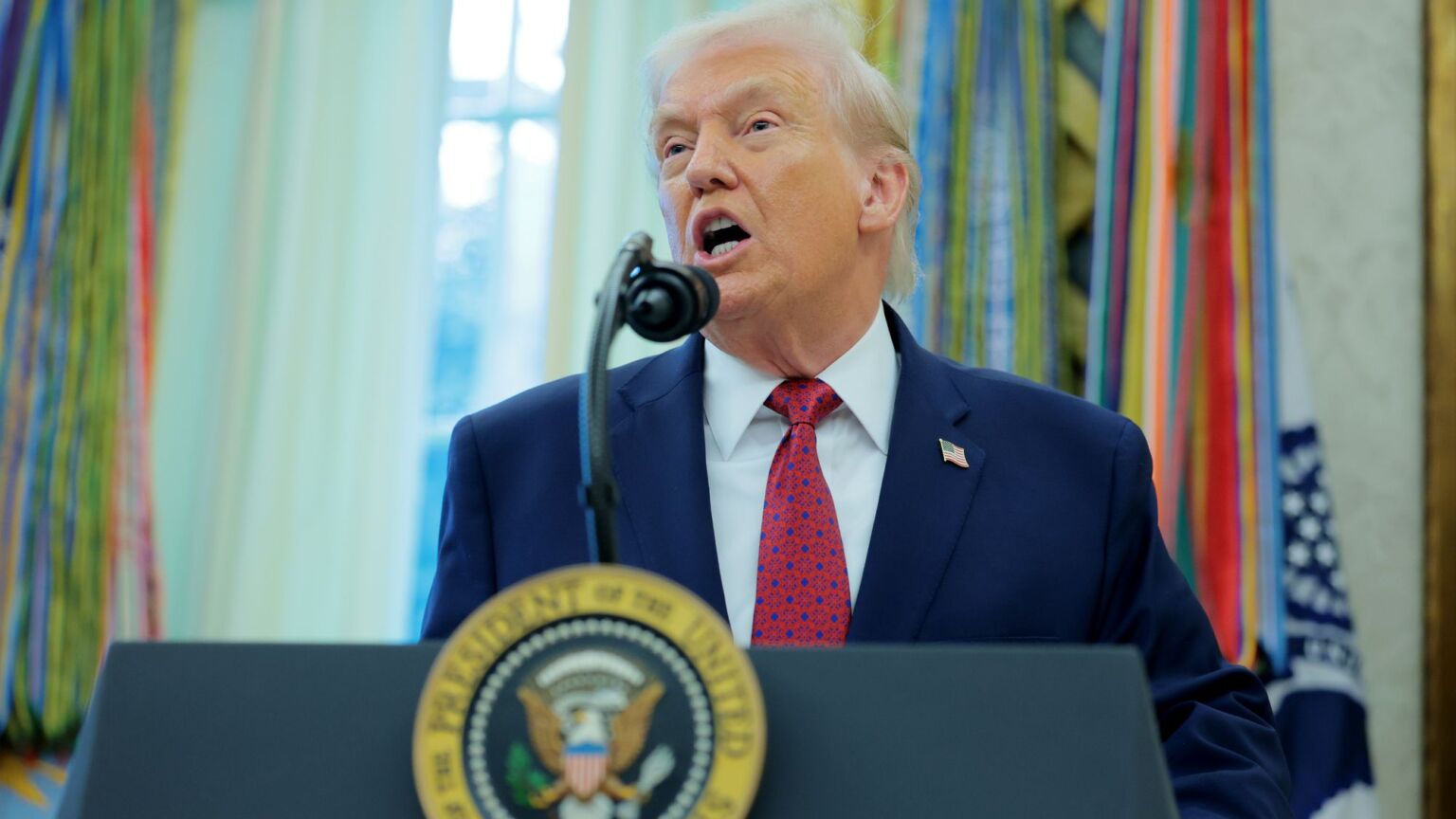
US president Donald Trump has filed a lawsuit against the BBC seeking $10 billion in damages. He says that he was defamed on the BBC’s flagship current-affairs show, Panorama. Given that the Beeb’s entire annual income is around £6 billion, and it does not hold anything close to that in liquid assets, Trump’s lawsuit could bankrupt the broadcaster almost two times over.
Trump alleges that the Panorama edition in question, which was broadcast ahead of the 2024 presidential election, edited together two pieces of footage from a speech by Trump on 6 January 2021 – the day of the riot on Capitol Hill. By splicing together two separate bits of the speech, Panorama made it look as if Trump had called for violent insurrection when he had not.
The BBC has already apologised to Trump for the edit, acknowledging that it ‘unintentionally created the impression’ that the US president had made a single continuous call for violent action ahead of the Capitol riot. BBC higher-ups called it an error of judgement. And the controversy has already led to the resignations of Tim Davie as director-general and Deborah Turness as CEO of BBC News.
The question of jurisdiction may be an issue for Trump. He is suing the Beeb from Florida and therefore needs to prove that audiences there saw the Panorama programme. Only then can he prove that it impacted him negatively. Hence the suit claims that the BBC has offices in Florida, transmits news through its website and ‘operates in the United States not as an abstract concept but in a constant manner’. It also points out that US citizens have access to certain episodes of Panorama via the international streaming platform, BritBox, jointly owned by the BBC and ITV.
The BBC has not formally responded yet, but it has indicated that it will fight the case. Media reports, not least on the BBC itself, have provided an outline of its position. It claims it does not have the rights to, and did not, distribute the Panorama programme on its US channels. The offending episode was indeed available online, on BBC iPlayer, but it was restricted to viewers in the UK. This certainly raises the question as to whether the programme could have meaningfully harmed Trump’s reputation in the US.
Even if Trump wins the case, there would be further obstacles to getting any money from the BBC. He would need to bring a separate case in the UK in order to enforce the judgement. It might be a tall order to persuade a British judge that he or she should bankrupt the state broadcaster to enforce the judgement of a US court.
The legal merits of the case matter, but the politics matter more. It is difficult to see how Trump could plausibly prove that the BBC has caused him reputational harm given he later won the 2024 election and remains one of the most electorally successful and recognisable political figures in the world. The sight of Trump suing the BBC cannot but look petty and vindictive.

More importantly, Trump’s constant use of litigation to attack his opponents poses a real risk to free speech. He reportedly has a $10 billion lawsuit outstanding against the Wall Street Journal over a story it published about Jeffrey Epstein’s infamous ‘birthday book’. Earlier this year, a judge dismissed his $15 billion defamation lawsuit against the New York Times. This is hardly the conduct of a president whose administration purports to believe in free speech.
Yet, while Trump’s free-speech-crushing litigiousness is a problem, so is the conduct of the BBC. The Panorama edit was a political intervention against Trump – it was designed to hurt him, at least among UK viewers. It is hard to see how splicing together two parts of a speech to effectively incriminate Trump could have been ‘unintentional’, particularly given that the same edit was used on more than one occasion by the BBC, including on Newsnight. If Trump was a normal private citizen in the UK and Panorama had done the same thing, a lawsuit in England would almost certainly succeed.
The BBC is now mired in an existential crisis – in part because of Donald Trump’s litigiousness, but also because of its own poor editorial standards and obvious political biases. Trump’s lawsuit should absolutely be criticised, but the BBC has no one to blame but itself for giving him the opportunity to launch it.
Luke Gittos is a spiked columnist and author. His most recent book is Human Rights – Illusory Freedom: Why We Should Repeal the Human Rights Act, which is published by Zero Books. Order it here.
£1 a month for 3 months
You’ve hit your monthly free article limit.
Support spiked and get unlimited access.
Support spiked – £1 a month for 3 months
spiked is funded by readers like you. Only 0.1% of regular readers currently support us. If just 1% did, we could grow our team and step up the fight for free speech and democracy.
Become a spiked supporter and enjoy unlimited, ad-free access, bonus content and exclusive events – while helping to keep independent journalism alive.
———————————————————————————————————————————–
Exclusive January offer: join today for £1 a month for 3 months. Then £5 a month, cancel anytime.
———————————————————————————————————————————–
Monthly support makes the biggest difference. Thank you.
Comments
Want to join the conversation?
Only spiked supporters and patrons, who donate regularly to us, can comment on our articles.