Roger Scruton’s leap of faith
God may be dead, but the search for transcendence lives on.
Want unlimited, ad-free access? Become a spiked supporter.
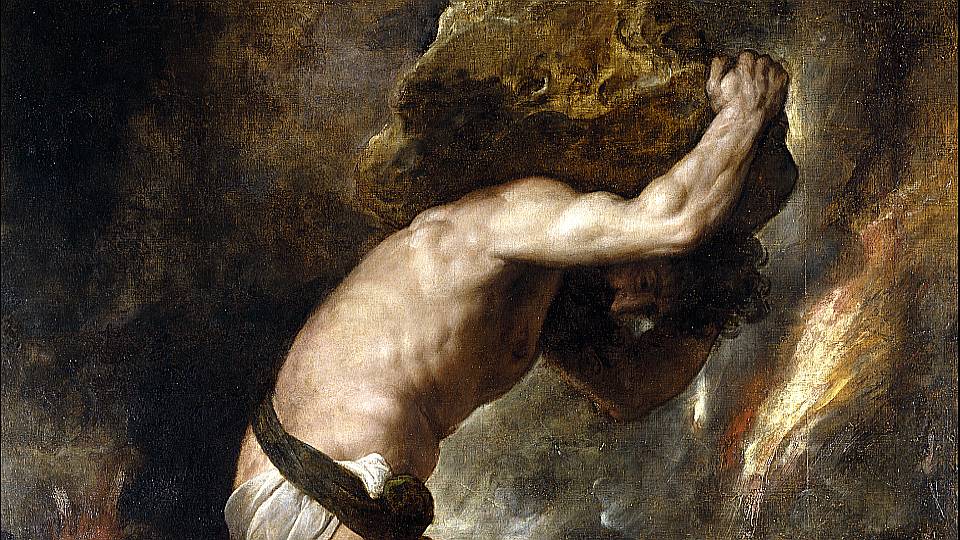
In The Myth of Sisyphus, Camus observed that he had ‘never seen anyone die for the ontological argument’. Galileo was right to recant, since the ‘truth was not worth the stake. Whether the Earth or the Sun revolves around the other is a matter of profound indifference.’ What does matter, Camus argued, is to find reasons for living. He explored what meaning life might have in the face of the fundamental antinomy of the human condition: that we are flickers of freedom in a dull, mechanical natural world; that we are unique possibilities and yet march only towards the certainty of our own mortality. Camus’s mythological hero can only find a measure of happiness when he realises the absurdity that arises from the human drive to understand crashing into the unreasonableness of the world, and, accepting his ineluctable fate, finds that there is enough to keep him going in the very struggle to live without hope.
Roger Scruton, in The Soul of the World, agrees that hope for an afterlife is an absurdity. There can be nothing following on from death, since things only follow on from each other as causes in the bounded ‘space-time continuum that is the world of nature’. He argues that an acceptance of death allows us to ‘see the world as making a place for us’. But while Camus’s transcendence of the human condition was based on an all-too-human revolt against, and scorn for, a world lacking in God, Scruton makes the case for a transcendence founded on ‘our works of love and sacrifice’ in a world that we make human by looking for God. He finds room for this hope for mankind precisely in faith, by which he means our refusal ‘to rest content with the contingency of nature’. When we cry out in extremis ‘Why?’, we reveal that we are looking for reasons that will let us understand why things are the way they are, why it is I suffer, why it is I love. We demonstrate – in our faith that there can be answers to existential questions such as these – that there are two ways of looking at the world, says Scruton: the ‘way of explanation’ and the ‘way of understanding’. The former looks for natural causes and universal laws in a world of facts, in the order of nature; the latter looks for reasons and meanings in a world of experience, in the order of the covenant.
Human beings can think about the world in both of these ways, says Scruton. Unlike animals, which ‘live immersed in nature’, humans have evolved from nature and now ‘stand forever at its edge’. With this unique perspective, we can think about the world in a way that transcends our genetic needs. Scruton returns frequently to the example of music to cast light on this cognitive dualism. If, listening to the opening theme of Beethoven’s Third Piano Concerto, we follow the way of explanation, then the concerto ‘consists of a series of pitched sounds, one after the other, each identified by a frequency’. But if we follow the way of understanding, then we can describe the concerto as ‘a kind of action in musical space’, in which a melody moves up from C, through E-flat, to G and then down again. These two accounts are incommensurable, yet they are both true. While the music depends upon the sounds, it is not reducible to them; while music is real, ‘it is perceivable only to those who are able to conceptualise and respond to sound in ways that have no part to play in the physical science of acoustics’, Scruton says. To put it another way, the sounds are not all there is. Not everything scientifically inexplicable is irrational – and nor is everything that is scientific necessarily rational or even reasonable, certainly from the point of view of practical reason and the question of how we should act.
The American composer Aaron Copland argued that ‘the ideal listener is both inside and outside the music at the same moment… a subjective and objective attitude is implied in both creating and listening to music’. Scruton also sees the ‘I’ that stands for our self-consciousness as ‘poised between freedom and mechanism, subject and object’, suspended between nothingness and being. As music exists in a different way to sound, so ‘I’ exist in another way to that of my brain and body. If we allow the truth of this, then we shift the argument about God on from whether or not we can find proof of His existence. After all, when science makes an account of the world, it cannot give an account of what it is like to be me. But from my first-person perspective, I know, without having to check, that my shoulder aches. I don’t carry out any kind of medical examination to know that, and I cannot be wrong about it. My shoulder aches only for me. This epistemological privilege amounts to an ability to know things about myself on the basis of no evidence whatsoever. Is God, then, perhaps a person like me?
This relationship of self-consciousness, in which I can say to myself, ‘Angus, what do you think about this?’, is the basis for the way in which I can also ask you what you think about it. It has the structure of an I-you relationship. When I find myself in my thinking about myself, I also find that you are a necessary part of that finding: I cannot be anything unless you recognise it. As Sartre put it: ‘The intimate discovery of myself is at the same time the revelation of the other as a freedom which confronts mine.’
Try as I might, I can never pin down just what it is to be me. Wherever it is that ‘I’ stand, I stand forever on the edge of things. As do you. And because ‘I’ requires ‘You’, then it follows that I am always looking for you, trying to attain to that infinite horizon which is your perspective, your uniqueness. Scruton calls this the ‘overreaching intentionality of interpersonal attitudes’, but we might as well call it love. After all, it is when I am in love that I try to reach beyond – or through – your face, your lips, your eyes, so as to grasp you. The you that is present in your face but at the same time not there, not identical with it. This overreaching is also what we do when we reason – and it is to be found in the exercise of our freedom. Scruton argues that ‘I-you intentionality projects itself beyond the boundary of the natural world’, and, ‘in doing so, it uncovers our religious need’.
Such a religious frame of mind, Scruton continues, amounts to a ‘reaching out from subject to subject; it searches for a relation that is close, intimate, and personal, with a being who is present in this world though not of this world; and in this reaching out, there is a movement towards sacrifice, in which both self and other might give themselves completely and thereby achieve a reconciliation that lies beyond the reach of ordinary human dialogue’. We experience this searching in love, and we hear it in music. Thus, the atheists’ argument that they can find no evidence of God’s existence is as insufficient as attempting to explain love in terms of reproduction or music in terms of vibration. After all, God may only reveal Himself to those who love Him. Or maybe God is simply not to be found in the universe that He created. Or Maybe God is like the number one: ‘outside space and time… [with] no causal role to play in the physical world.’ But if this is true, and it is the central question of Scruton’s book, then we cannot expect to encounter God anymore than we can expect to meet the number one. But how, then, is it possible for God to ‘be a real presence in the life of His earthly worshippers’? And how is it possible for us to be in love?

Scruton makes an appeal to religion, the arts, erotic love, friendship and familial ties: all spheres which rely upon that overreaching intentionality which allows us to catch sight of the ‘other person in the I’. It also allows us the possibility of morality, that is, of treating others as people and not as things, as fellow subjects and not objects. Yet Scruton acknowledges the pressing need for this ‘care of the soul’ precisely because it is ‘vanishing from our world today’. We live in a world of contracts rather than obligations; a world where parents are condemned as a jilting generation rather than honoured; a world in which human relationships are being steadily pornified; a world in which the humanities are studied – if they are studied at all – as a means to well-paid job; a world in which there are those who would dismiss the humanities entirely in favour of a natural science of man. What grounds are there for thinking that Scruton’s call for due care of the soul will be listened to?
Scruton is correct that great art and music address ‘us from beyond the borders of the natural world’. But who is listening? And how many still have the courage to discriminate between good music and bad music? When it comes to the sacred rituals of religion, it is not enough to choose to believe in them; you have to be born into them. Who today is born into religion? There is a danger in Scruton’s argument of simply confronting the ongoing despoliation and desecration of the world with the assertion that the sacred persists. No doubt we need society – the order of the covenant – and no doubt it requires non-natural foundations. But it is precisely these that have been eroded. Where can we find a solid foundation for the sacred?
Camus, at the end of The Myth of Sisyphus, finally gives us an image of Sisyphus himself: ‘convinced of the wholly human origin of all that is human, a blind man eager to see who knows that the night has no end, he is still on the go. The rock is still rolling.’ There are echoes of Sartre’s position that ‘one need not hope in order to undertake one’s work’. One should do what one can because one is ‘nothing else but the sum of [one’s] actions.’ Now Sartre defended his position as a realistic optimism – one acts without hope and, in so doing, self-surpasses, transcends oneself. Man is able to exist through the pursuit of transcendent aims. Sartrean ‘optimism’ consists in a belief that man can find himself again and neither can nor needs to be saved from himself – even by God, if God existed. Sartre did not believe He did.
Scruton stands in this line of thought, which is particularly welcome given the overpowering sense of fatalism and cultural pessimism which permeates so much thinking today. There is a crying need for the sort of attitude that understands that everything rests on human subjectivity, indeed, that there is nothing outside human subjectivity. These are desperate times, after all. The authority of Western high culture is shot to pieces; and the authority of the church is such that it stays afloat only because there is still some ballast of belief or principle left to throw overboard. To where can we turn but to voluntarism?

In this sense, maybe Camus was right to cast us as stone-rollers simply because it is our duty to roll stones with commitment and authenticity. There is no need for any further explanation: we must do our duty because it is our duty, regardless of any consequences. The more we demonstrate our courage, perseverance, obedience, love and loyalty simply because we choose to be brave, simply because we choose – on no basis whatsoever – not to be cowards, then that is better for you and me. So far, so good; but which battles are to be fought? What duty should I follow? Orders, after all, are not always to be obeyed.
I see two grounds for optimism over and above the limits of existential humanism. The first is that strange things happen. In the order of nature, there is never anything new under the sun; but in the order of humankind, there is novelty, there is creation and there is destruction. We are born and we die; we are beginners and enders. The birth of a human child is miracle enough, and in that sacred moment the existence of another order in which we see the unique created from the everyday is revealed. The second is that it is precisely the existence of that different order of being which means, as Scruton usefully reminds us, we are always asking ‘why?’ It was in the searching for reasons and for the causes of things that human history began to be written. Even if there is no final ultimate cause to be found on the way of understanding (nor on the way of explanation), we will continue to look for one, and, in that sense, there is much in being human that presupposes, and relies upon, our looking for God.
Angus Kennedy is convenor of The Academy. His new book, Being Cultured: In Defence of Discrimination, is published by Imprint Academic. (Order this book from Amazon (UK).)
The Soul of the World, by Roger Scruton, is published by Princeton University Press. (Buy this book from Amazon(UK).)
You’ve hit your monthly free article limit.
Support spiked and get unlimited access.
Support spiked and get unlimited access
spiked is funded by readers like you. Only 0.1% of regular readers currently support us. If just 1% did, we could grow our team and step up the fight for free speech and democracy.
Become a spiked supporter and enjoy unlimited, ad-free access, bonus content and exclusive events – while helping to keep independent journalism alive.
Monthly support makes the biggest difference. Thank you.




Comments
Want to join the conversation?
Only spiked supporters and patrons, who donate regularly to us, can comment on our articles.