The strange death of Cockney London
A street battle between rival Bangladeshi factions revealed the extraordinary transformation of the East End.
Want unlimited, ad-free access? Become a spiked supporter.
It’s always a little strange when your hometown makes the national news. In the 1980s, Romford occasionally got a mention because it was home to Steve Davis’s snooker club during his reign as world champion. In the 1990s, it became the butt of comedians’ jokes, apparently because it was populated by Essex girls called Sharon and Tracy, whose footwear of choice was the white stiletto. It even featured in Underworld’s 1990s dance track, ‘Born Slippy’.
Last week, however, Romford made the news for a very different reason. It was the site of a street battle between supporters of rival Bangladeshi political factions, the National Citizen Party and the Awami League. Although subsequent reports established that the real trouble kicked off a mile or so up the road, in Chadwell Heath, it seems that the bitter political divisions of the Indian subcontinent have found their way on to the streets of east London.
This depressing scene raised many questions. How has a medieval market town with centuries of history, including once being part of the ancient Royal Manor of Havering, become a host to imported political antagonisms? Why have Britain’s streets become an extension of the political battlegrounds of Dhaka?
The answer, at least in part, lies in the extraordinary demographic changes that have taken place across east London and continue to ripple eastwards into Essex. How people interpret those changes often depends on their politics. It may also depend on their age.
I left Romford in my early 20s and moved to Stratford. I can still remember what I told my parents before moving back to the East End they had left before I was born: ‘In Romford everyone’s white, everyone’s English – it’s so boring!’ I also remember older relatives asking: ‘Why do you want to go and live up there? It’s full of foreigners now.’ I thought they were unenlightened racists. It’s funny what 30 years can do to your perspective.
Like many families now living in Essex, mine originated in east London. My maternal grandfather came from Stepney. My grandmother was born and brought up on the Isle of Dogs, then a working-class neighbourhood of dockers, factory workers and their families. The world they inhabited, with its distinctive character and sense of community, has been transformed by the redevelopment of the docklands into Canary Wharf, with its glass towers, offices and luxury apartments. The Qatar Investment Authority, Qatar’s sovereign wealth fund, owns 50 per cent of the holding company behind Canary Wharf Group.
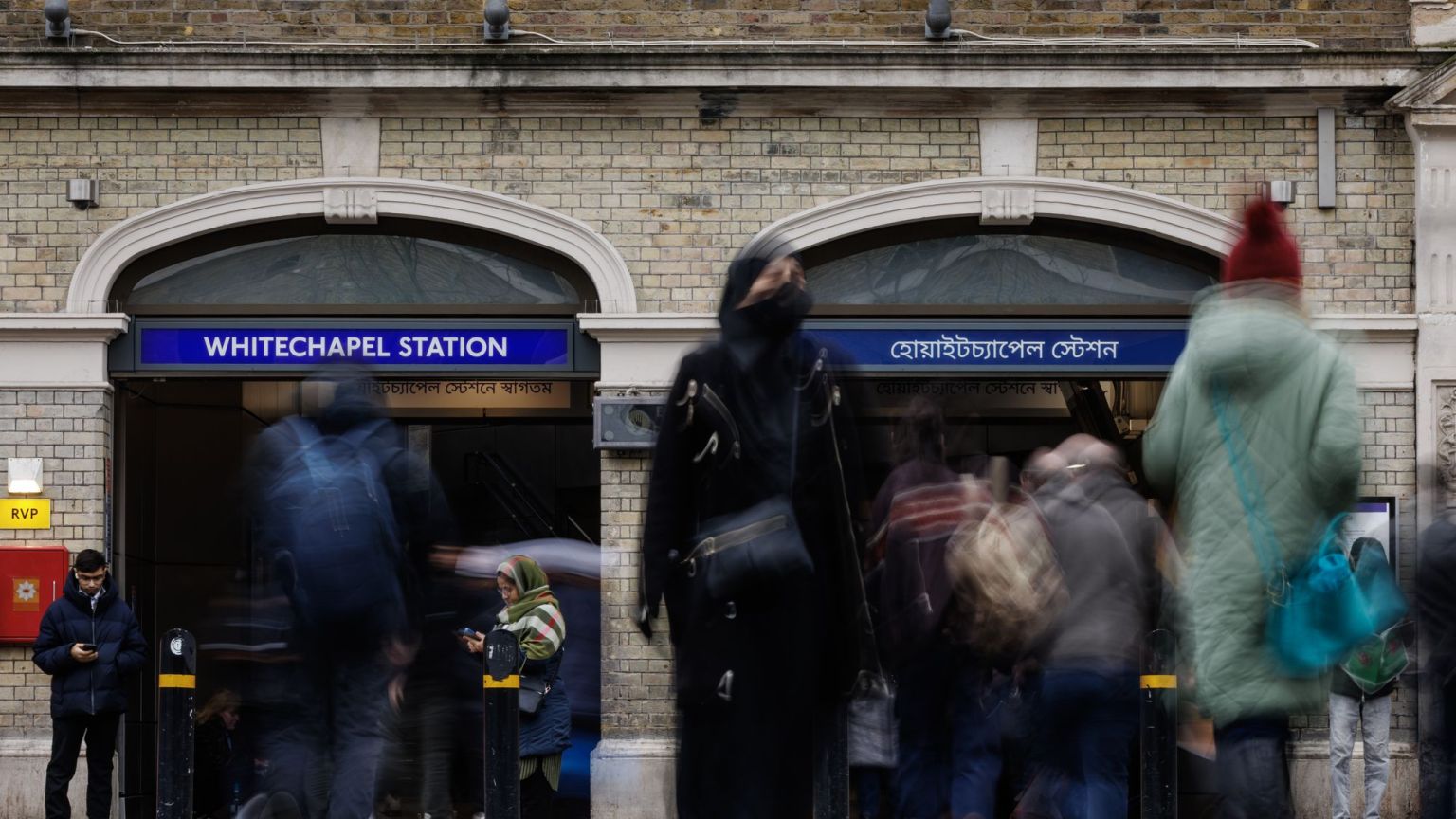
The East End’s demographic transformation has been remarkable. In the 2021 UK Census, just 15.7 per cent of Whitechapel residents identified as white British. In Stratford, the figure was 20.3 per cent. In Ilford, it was just seven per cent.

And the Cockneys’ movement eastwards continues. Take Dagenham. Shortly before my grandmother died in 2014, she told me that, on the street she had moved to in 1977, she was now the only person who spoke English.
If something resembling this happened to an established population elsewhere in the world, there would be no shortage of people describing it as displacement or cultural erasure. Here, however, the movement of Cockneys is often dismissed as ‘white flight’. Notice the emphasis: the people who leave become the problem, rather than the extraordinary changes taking place around them.
For many on the liberal left, simply raising questions about demographic change is enough to invite accusations of racism. But imagine a traditional Spanish town in which successive waves of British immigration had made the local population a minority. Would Spanish residents be entitled to express concern about the disappearance of their language, customs and traditional way of life? Or would British liberals tell them that demographic change was a myth, that their concerns were xenophobic, and that they should simply celebrate the diversity of their new neighbourhood?
Of course not. The right to cultural continuity appears to be universal – except, it seems, when it comes to Britain’s own working-class communities.
Cockneys were once as much a part of London’s identity as the black cab, the pie-and-mash shop and the East End pub. Their accent, humour, traditions and neighbourhood loyalties were shaped over generations by working-class Londoners. They were not simply a collection of local stereotypes – they were a living community with a history and a sense of belonging. So where have they gone?

Many are in Romford, Dagenham, Harold Hill, Brentwood and further into Essex. Their parents and grandparents lived in Whitechapel, Poplar, Bow, Stratford and Ilford. Their children and grandchildren have ‘moved out’.
Some families left because they wanted a bigger house, a garden or what they saw as a better life beyond the capital. Others were priced out or found that the neighbourhoods they knew had changed beyond recognition. As immigration increased, new arrivals often settled in inner London’s cheaper neighbourhoods. These processes overlapped and reinforced one another, profoundly changing the character of working-class London.
And it hasn’t stopped. I now live in Brentwood, where the changes are increasingly visible. People who have lived here for years talk about the town changing around them; some are already discussing moving further east. Meanwhile, Romford increasingly reminds me of the Stratford I moved to in the 1990s.
That is why the description ‘white flight’ is inadequate. It suggests a collection of individuals independently deciding to move somewhere better, rather than a profound transformation of the communities into which they were born and from which many felt they had to leave. Perhaps we need a different phrase for this story: the Cockney diaspora.
New arrivals often settle where housing is cheaper and work is more accessible. Poorer, working-class neighbourhoods can therefore experience rapid demographic change while wealthier areas remain comparatively insulated. Yet some of the most enthusiastic defenders of high immigration live in comfortable, predominantly white middle-class communities, far removed from the pressures experienced in the parts of London and Essex that have changed most dramatically.
This is the uncomfortable class dimension of the immigration debate. The people who make the strongest case for liberal immigration policies are not necessarily those who experience their most immediate consequences. For some, diversity is an abstract principle to be championed from a comfortable distance. For working-class communities, it is a lived experience, often involving profound changes to the places they have called home for generations.
Perhaps those who dismiss such concerns should listen a little more carefully. The Cockneys have not vanished. But their world has been transformed – and their diaspora is still moving eastwards.
Geoff Bagwell is a freelance writer.
You’ve hit your monthly free article limit.
Support spiked and get unlimited access.
spiked is even better on the app
Read, watch and listen to spiked wherever you are. Our brand-new app brings everything together, with ad-free reading, audio articles and offline access.
Become a spiked supporter to unlock exclusive app access, unlimited articles, bonus podcasts, discounts and special events.
Monthly support makes the biggest difference. Thank you.








Comments
Want to join the conversation?
Only spiked supporters and patrons, who donate regularly to us, can comment on our articles.