Burnham’s backing of the Chagos deal is a major unforced error
There is no legal, moral or political case for giving up these vital islands and paying Mauritius for the pleasure.

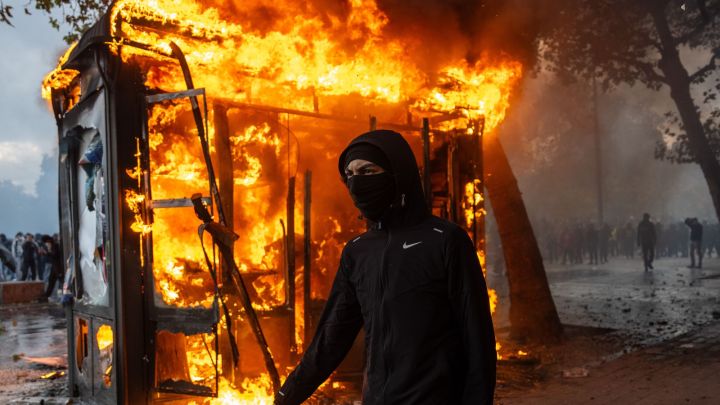
Read our latest coverage of the French riots here – paywall-free all of this week..
The Labour government’s indication that it intends to continue with the deal to hand over the Chagos Islands to Mauritius may prove to be Andy Burnham’s first major unforced error.
Perhaps Foreign Office mandarins and advisers such as Jonathan Powell have convinced Burnham that he has no choice under international law but to go ahead with the deal. Accepting such advice without question would be a serious political misjudgement – for which Burnham would only have himself to blame.
The government argues that the deal, negotiated under Keir Starmer, resolves a long-running dispute that could lead to the UK being put under a legal obligation to cede sovereignty of the islands, on terms decided by Mauritius. As such, they argue that the deal will give long-term reassurances about the continued presence of the critical US-UK military base on Diego Garcia, the largest of the Chagos Islands.
What they don’t tell you is that the case against the deal is far stronger. From a moral point of view, it is shameful that the UK has failed to take into account the opposition of UK-based Chagossians to the deal. The strategic case is also questionable. It is not just that Donald Trump has, even if inconsistently, indicated his unhappiness with the deal. US and UK experts have also argued that giving up sovereignty to Mauritius, a nation subject to a high level of Chinese influence, risks the long-term security of Diego Garcia.
Perhaps most importantly, there is substantial disagreement among respected legal experts about the UK’s obligations. Some argue that no international court has jurisdiction to impose a binding ruling on the UK about Chagos without the UK’s consent. In other words, going ahead with the deal is fundamentally a political choice rather than the legal necessity the government has made it out to be.
And it is the political case against the deal that is so overwhelming. Ceding the sovereignty of Chagos may be a marginal issue for British voters. That the UK will pay for the privilege is definitely not. The government’s preferred measure of the cost is the net present value of £3.4 billion. However, the cash payments are projected to come to £34.7 billion over the lifetime of the agreement, a number that is likely to attract the most public attention.
Choosing to give away billions in taxpayers’ money when there is no clear obligation to do so is an issue that hits home with the British public. The revelation that much of the money will come out of the hard-pressed defence budget makes the issue political dynamite.
Paying Mauritius billions to give away UK territory at the expense of our armed forces will be an easy message for political opponents to get across. And presumably the Conservatives and Reform UK will use every opportunity to hammer that message home. Conservative MP Tom Tugendhat’s appointment as shadow foreign secretary is significant in this respect, given how outspoken he has previously been in opposing the deal.
But the biggest problem for Burnham will not be the opposition parties, but his own MPs. Many of them are clearly unhappy with the deal and, even if they are not, are still uncomfortable defending it publicly.
Andy Burnham may have been badly advised over Chagos. But, in the end, it is his decision whether to follow that advice. Over the next few months, Labour backbenchers will have many difficult decisions to defend – including on welfare reform, the early release of prisoners and whether more licences are granted to drill North Sea oil. They will rightly question why they are being forced to defend the PM over a decision he had no need to take.
If Andy Burnham goes ahead with the deal to hand over sovereignty of the Chagos Islands to Mauritius, the political costs may prove much harder to recover than the financial ones. He should abandon the deal without a second thought.
David Paton is Professor of Industrial Economics at Nottingham University Business School. He posts on X as @CricketWyvern.
You’ve hit your monthly free article limit.
Support spiked and get unlimited access.
Support spiked and get unlimited access
spiked is funded by readers like you. Only 0.1% of regular readers currently support us. If just 1% did, we could grow our team and step up the fight for free speech and democracy.
Become a spiked supporter and enjoy unlimited, ad-free access, bonus content and exclusive events – while helping to keep independent journalism alive.
Monthly support makes the biggest difference. Thank you.



Comments
Want to join the conversation?
Only spiked supporters and patrons, who donate regularly to us, can comment on our articles.