Why are trade unions undermining women’s workplace rights?
Unions spend more time defending ‘trans brothers and sisters’ than the interests of female members.
Want unlimited, ad-free access? Become a spiked supporter.
Since women first joined the fire service in the 1970s, they’ve fought an ongoing battle for single-sex facilities – including showers – in stations built for all-male crews.
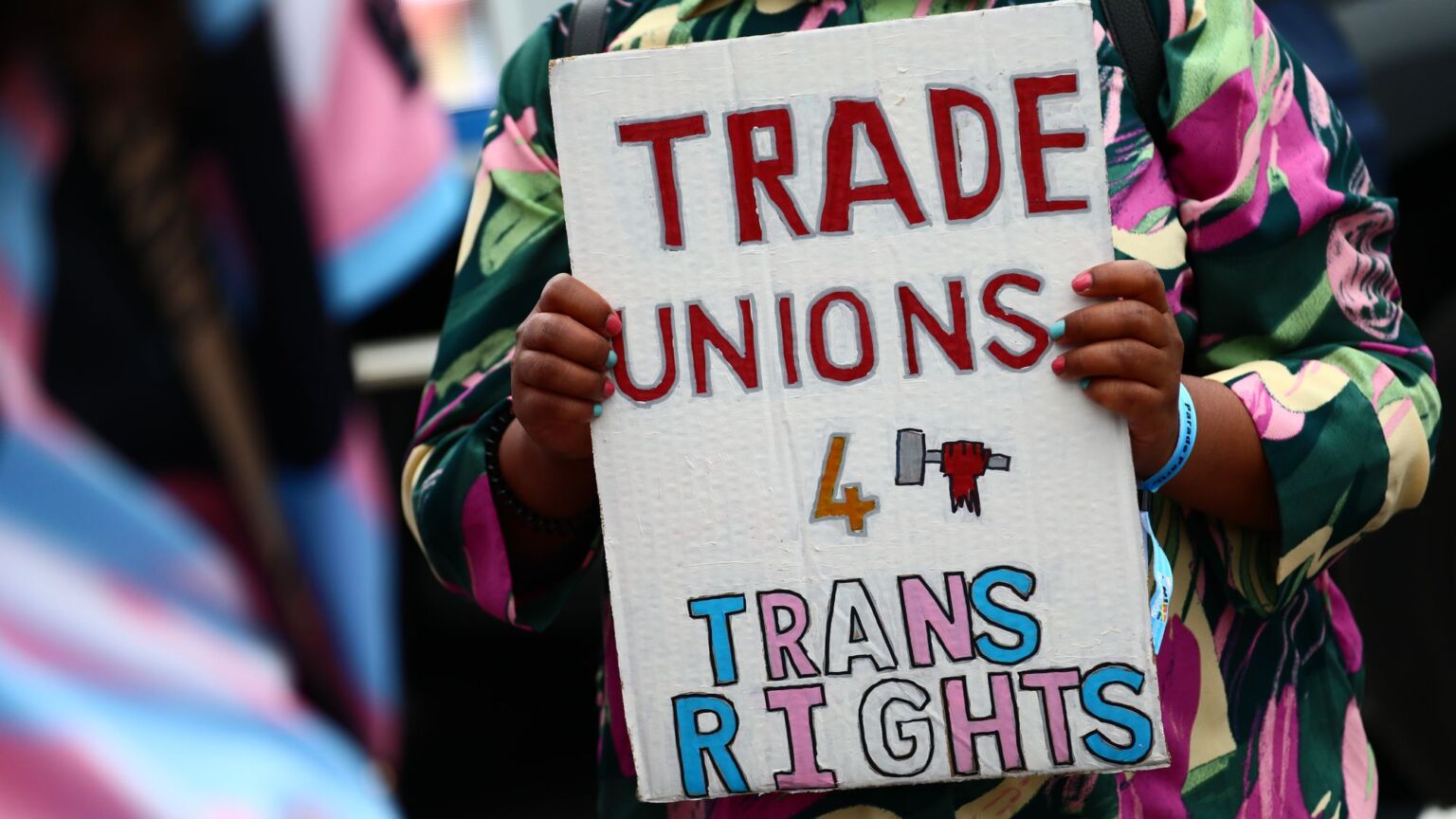
So it’s hardly surprising that the Fire Brigades Union’s (FBU) response to the updated guidance from the Equality and Human Rights Commission (EHRC) on single-sex facilities has attracted backlash. In a statement published on social media, the FBU said it stands ‘firmly in solidarity with trans, nonbinary and gender-diverse members’ and spoke of their right to access facilities ‘without fear’ and with ‘respect and dignity’ at work. There was no mention of female firefighters, and the FBU was not alone.
Unison – the UK’s largest trade union – announced its intention to oppose the EHRC guidance. The Universities and Colleges Union (UCU) published a statement that said it would continue to ‘fight for the rights of trans and nonbinary people’. So that’s three trade union statements on a landmark ruling about women’s rights to privacy, dignity and single-sex spaces – and women are not mentioned in any of them.
Perhaps the most extraordinary thing is how under the radar this seems to be. So why aren’t union members protesting publicly against this? Why aren’t they leaving in droves? I suspect they simply don’t know that this is happening.
After all, most trade-union members are not political activists. They are customers who think they’re buying an employment-protection policy – a bit like breakdown cover for their car. They join a trade union because they want protection if something goes wrong at work. And someone to represent them if they’re disciplined, treated unfairly or facing redundancy. Yet, unlike car insurance, there are no comparison websites helping people weigh up the relative merits of the National Association of Schoolmasters Union of Women Teachers vs the National Education Union – or Unison vs the GMB.
Most don’t spend hours researching competing unions and comparing policy positions. They join a particular union because a colleague recommends it. Or because it offers a good deal to newly qualified staff. Or simply because it’s the union that’s already established in their workplace.
In other words, it’s a consumer choice rather than a political one. Which means many members are completely unaware they’re supporting one of the most powerful political campaigning movements in Britain. And that their subscriptions don’t just fund workplace representation – they also fund lobbying, political campaigns, conference motions, public statements and interventions on some of the most contentious social issues of our time.

When challenged on controversial positions – like ‘trans rights’ – trade unions will often say that this is what members have voted for. Technically, that’s true. Policies are passed through democratic structures. Leaders are elected. Conferences vote on motions.
But this defence assumes a level of member engagement that simply doesn’t exist. The reality is that most union members never attend conferences. They don’t submit motions. They don’t stand for election. Many don’t vote in internal ballots. Most couldn’t even tell you what policies their union adopted last year.
Take Unison, which has around 1.3million members, the majority of them women. Its current general secretary, Andrea Egan, was elected with just 58,579 votes – around 4.2 per cent of eligible voters. Which means many women will be unaware that their current union leader is actively campaigning against their sex-based rights.
That doesn’t mean the election was illegitimate. All members were invited to participate. But only a small number did. It’s not that the other members don’t care, but they have other priorities. Which makes it a pretty good business model for unions, allowing a relatively small number of highly engaged activists to shape policy – using funds from a much larger membership.
This is a bit embarrassing to admit, but despite being a National Union of Journalists (NUJ) member for around 25 years, until I sat down to write this article, I had no idea whether it had issued a statement on the EHRC guidance. It hadn’t.
What I did find, however, was a report from last year’s Trades Union Congress LGBT+ Conference celebrating motions on ‘trans solidarity’ and highlighting speeches condemning the Supreme Court ruling, and expressing support for trans and non-binary people.
The report also highlighted contributions from NUJ delegates, who described trans and nonbinary people as having been ‘stripped of their rights’, ‘vilified and marginalised’, and called for solidarity with ‘trans and nonbinary comrades’ – much of which I disagree with, but since I had been so busy getting on with my job, I hadn’t even known that this had been said in my name.
How many women will never discover that the trade union they’ve paid thousands of pounds into – thinking they were buying employment protection – was also funding campaigns to remove their hard-won rights? Including their right not to be forced to share changing rooms or showers with men at work? These campaigns focus, almost exclusively, on the interests and rights of men.
The real question isn’t whether trade unions should be allowed to campaign. It’s whether members understand what they are actually paying for.
Janet Murray is a freelance journalist and director of SEEN in Journalism.
spiked summit 2026 – SOLD OUT
Saturday 27 June 2026
10am-6pm, Saturday 27 June
Emmanuel Centre, London, SW1P 3DW
With Lionel Shriver, Brendan O’Neill, Katharine Birbalsingh, Toby Young, Allison Pearson, Paul Embery, Tom Slater, Andrew Doyle, Fiyaz Mughal and more
The spiked summit has now SOLD OUT. To join the waitlist, email:
[email protected]
£80 or £50 for supporters
You’ve hit your monthly free article limit.
Support spiked and get unlimited access.
Support spiked and get unlimited access
spiked is funded by readers like you. Only 0.1% of regular readers currently support us. If just 1% did, we could grow our team and step up the fight for free speech and democracy.
Become a spiked supporter and enjoy unlimited, ad-free access, bonus content and exclusive events – while helping to keep independent journalism alive.
Monthly support makes the biggest difference. Thank you.




Comments
Want to join the conversation?
Only spiked supporters and patrons, who donate regularly to us, can comment on our articles.