Tony Blair’s last-ditch attempt to save the technocratic order
The former PM’s overpraised essay refuses to reckon with the chasm between elites and the masses.
Want unlimited, ad-free access? Become a spiked supporter.
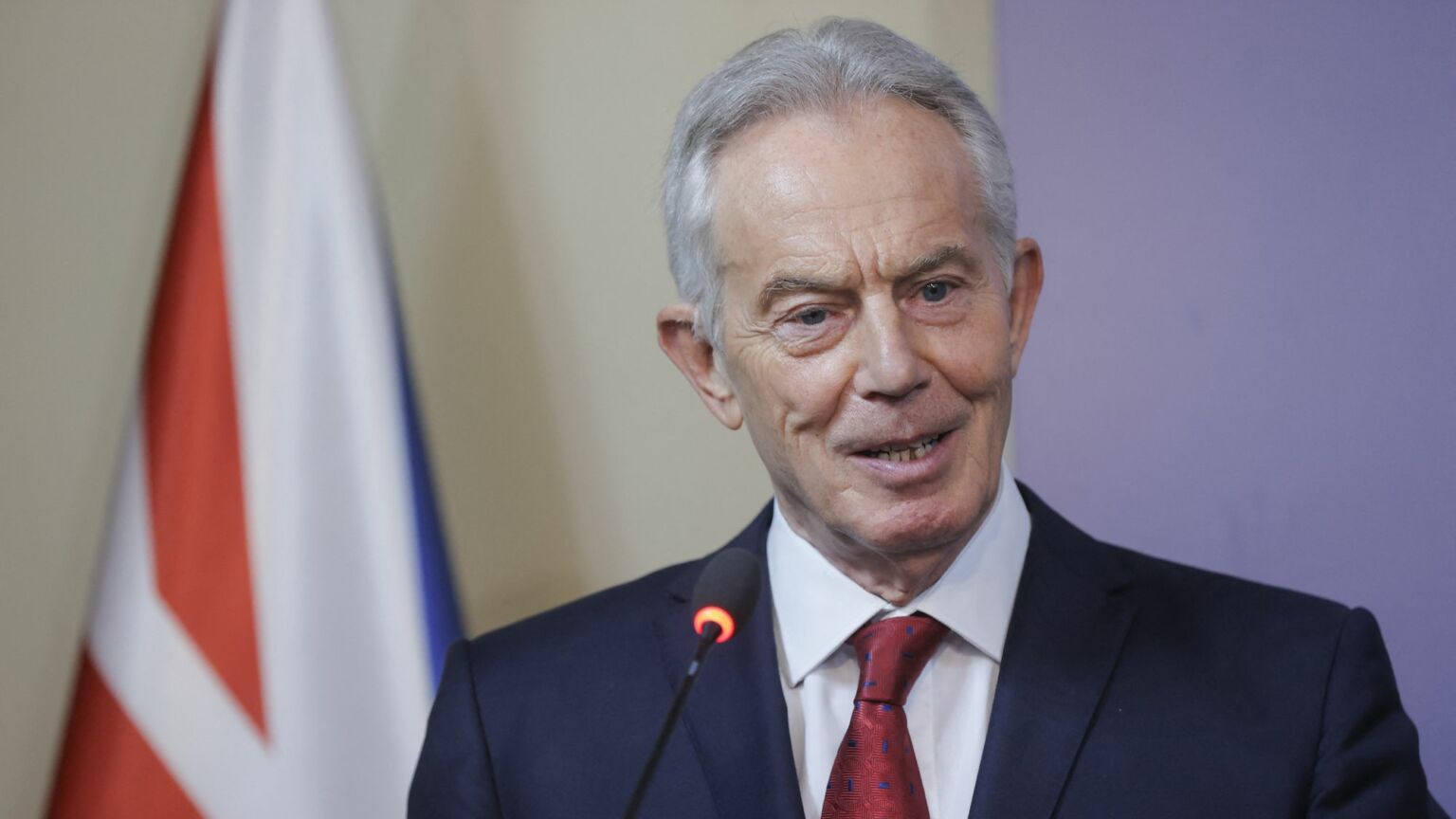
Tony Blair certainly has a sense of timing. Just as the Labour Party enters a long march into the least-exciting leadership contest in recent memory, the former UK prime minister arrives with a wide-ranging and widely praised essay on the state of the nation.
His essay is the purest expression of the technocratic spirit – the very form of politics that has, right across the world, taken such a battering in recent years. It is also the most desperate expression of that spirit – prepared to cede much ideological ground in the desire to hold on to power.
This is not to say that Blair refuses to recognise many important truths. He understands that Labour’s victory in 2024 was not one of enthusiasm, that voters are angry with a system they see as totally failed, and that the ideological projects of mass migration and environmentalism have to be jettisoned by any party keen on winning and keeping power.
At the heart of Blair’s essay is an attempt to develop the concept of ‘radical centrism’. Blair considers his centrism ‘radical’ because ‘the centre should never be the place of managing the status quo’. Indeed, Blair recognises how far the status quo has failed, and takes this to mean that ‘radical’ solutions are required – on welfare, migration, the EU and more.
Of course, this is Tony Blair, the ultimate architect of contemporary managerialist Britain, and so his idea of radicalism is rather unlike what you and I might think of as radical. Indeed, Blair manages to present technocracy itself – government by experts – as the most radical thing imaginable. In one of the typically clunky but rather telling phrases of the essay, he says that where ‘the correct answer requires radical change, the centre should be the radical changemaker’. For Blair, the emphasis is always on ‘correct answer’ rather than on ‘radical change’.
But what are the ‘correct’ and ‘radical’ answers that Blair has to offer? They are a mixture of the mundane, the too little too late, and the impossible. The essay abounds with the recondite obsessions of the international set that patronise Blair’s Institute for Global Change, such as digital ID and artificial intelligence. Where he concedes ground, it is too little too late, as shown by his volte-face on Net Zero. And his most incendiary proposal – doing ‘whatever it takes’ to deal with small boats – is impossible without taking on the human-rights framework of the European Court of Human Rights, whose decisions Blair made the UK subject to when his government passed the Human Rights Act in 1998.
But for all the ‘radicalism’ of Blair’s prescriptions, there is a more profound failure to understand the root cause of the issues he identifies. The problem with the political class is not just that it lacks convictions (or what Blair calls ‘ballast’) or lacks the technical insight to pursue the ‘correct policies’. No, the political class is structurally incapable of ‘good policies’ because of its alienation from and hatred of ordinary people.

No number of reports from the Institute for Global Change will change the fact that the political class is intractably resistant to the desires and aspirations of ordinary people. Blair is wrong when he says that the problem is policy rather than politics, because no amount of ‘policy’ can bridge the political chasm that exists between the ordinary voter and the average Labour-Tory politician.
Indeed, that this chasm exists is largely Blair’s doing. New Labour was, above all, a project of detaching the state from the control of ordinary people – the outsourcing of power once held by democratically elected politicians to quangos, NGOs and bureaucrats. It is therefore no surprise that Blair cannot understand that the problem is not that the political class have the ‘wrong’ policies, but that they refuse to implement the policies understood instinctively to be necessary by most ordinary people.
Blair says we need a ‘wholesale reconfiguration of government’. What he really means is just the managerial approach – one of ‘specialist technical skills’, ‘systemic change’ and ‘change management’ – that he introduced, preferably done by him.
This is the irony of even the most sensible of the centrists. No matter how much they come to accept the horrors wrought by mass immigration, climate alarmism or the endlessly expanding state, their ‘solutions’ will never amount to much. Because anything they try to do will inevitably be defeated by the very Blob they constructed.

There is one final irony to Blair’s diagnosis. He insists that the ‘centre ground’ is ‘where elections can be won’, and that the centre can be ‘radical’. But if the centre ground simply means what voters want, then this is much more radical than Blair would ever accept. Today’s actual centre ground is for deporting illegal migrants and tearing up the human-rights framework. It is for burning the NGO deep state to the ground. Today’s centre ground is not that of yesteryear. And this is true of political parties as well. Across Europe, the median voter is much closer to the parties derided as ‘far right’, whether that be Reform UK, the AfD in Germany, Vox in Spain or the National Rally in France.
There is indeed a radicalism brewing in politics, but it is the radicalism of ordinary people. Tony Blair’s vision, in contrast, is merely the last desperate gasp of a dying technocratic elite.
Jacob Reynolds is convening The Academy 2026: Hollow Leviathan: The State Against the Demos,which asks why the state became so disconnected from ordinary people, so incompetent, but at the same time so dangerously authoritarian. More info and tickets here.
spiked summit 2026 – SOLD OUT
Saturday 27 June 2026
10am-6pm, Saturday 27 June
Emmanuel Centre, London, SW1P 3DW
With Lionel Shriver, Brendan O’Neill, Katharine Birbalsingh, Toby Young, Allison Pearson, Paul Embery, Tom Slater, Andrew Doyle, Fiyaz Mughal and more
The spiked summit has now SOLD OUT. To join the waitlist, email:
[email protected]
£80 or £50 for supporters
You’ve hit your monthly free article limit.
Support spiked and get unlimited access.
Support spiked and get unlimited access
spiked is funded by readers like you. Only 0.1% of regular readers currently support us. If just 1% did, we could grow our team and step up the fight for free speech and democracy.
Become a spiked supporter and enjoy unlimited, ad-free access, bonus content and exclusive events – while helping to keep independent journalism alive.
Monthly support makes the biggest difference. Thank you.




Comments
Want to join the conversation?
Only spiked supporters and patrons, who donate regularly to us, can comment on our articles.