Anyone but Ed Miliband
The Net Zero secretary is the architect of Britain’s industrial decline. He must never become PM.

Want unlimited, ad-free access? Become a spiked supporter.
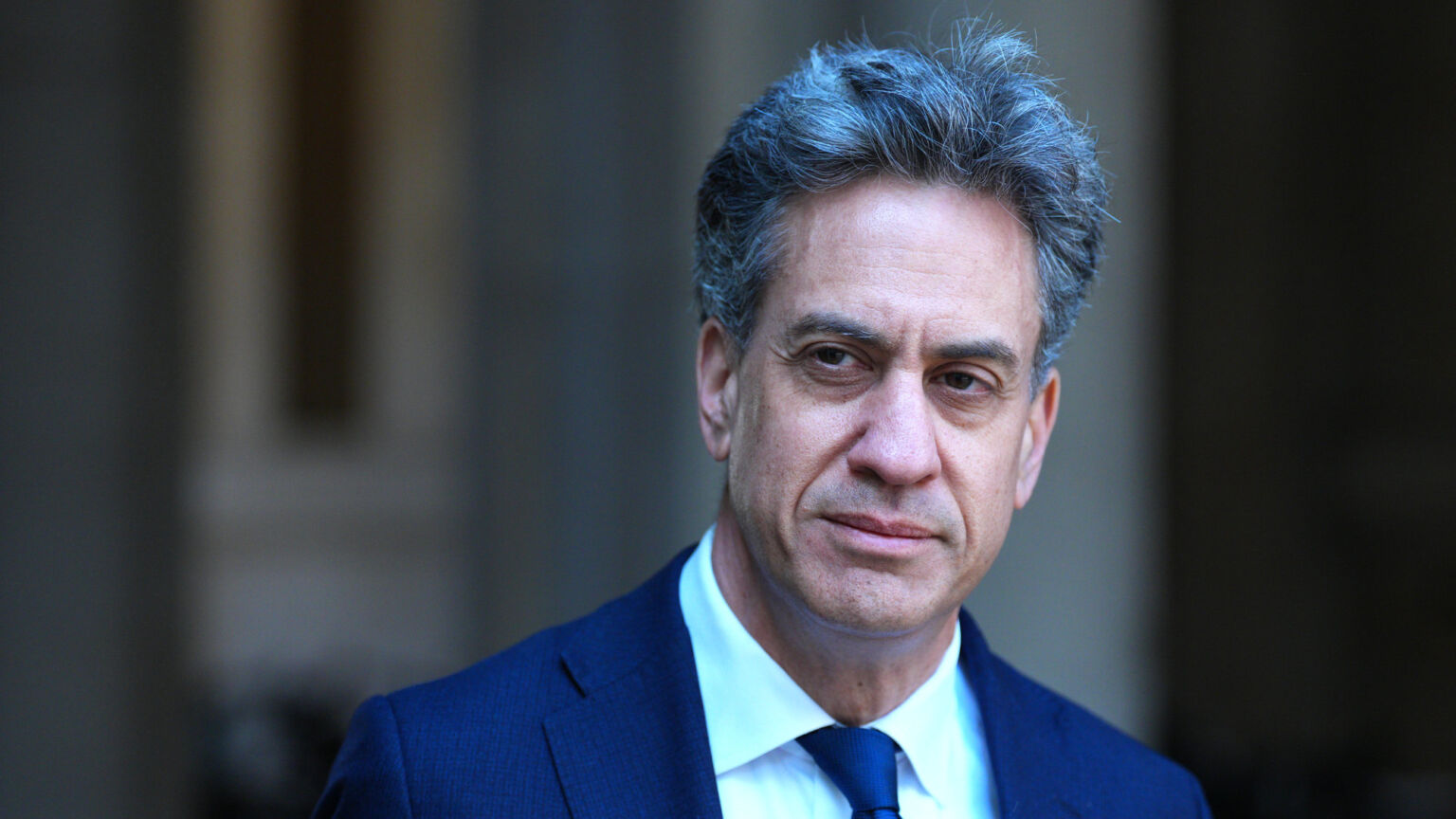
The ‘chaos with Ed Miliband’ that David Cameron once warned about could soon become a political reality in Britain. As far-fetched as it sounds, the Net Zero secretary and failed Labour leader is seriously being touted as a potential successor to Keir Starmer.
The Times reported last week that Miliband would be prepared to run for leader should health secretary Wes Streeting move to trigger an imminent leadership contest. If Andy Burnham, Greater Manchester mayor and the soft left’s king over the water, cannot get himself in parliament and on the ballot in time, then Miliband might be prepared to throw his own hat in the ring. Well, Wes Streeting’s big moment now appears to be imminent. Patrick Maguire and Aubrey Allegretti report in The Times that Streeting has told his allies he is preparing to resign as soon as tomorrow.
You might still think Miliband is a long shot, given how forcefully the public rejected him in the 2015 General Election. But this is the Labour Party we’re talking about – a party that has long ceased to have any connection with the masses or feel for public opinion. And so, as incredible as it may sound to those outside the Labour tribe, polls show that Miliband is the most popular minister in the current cabinet among Labour’s rank-and-file members, the very folk who may yet have the decisive say over who to anoint as our next prime minister. The liberal-left Independent sees Miliband as the top contender for the job. The New Statesman, Labour’s in-house magazine, has urged Ed to be installed in Downing Street, at least as a caretaker leader, while Burnham plots his way back to the Commons.
For those of us not in Labour la-la-land, a Miliband premiership is a terrifying prospect. After all, he is not merely a dreadful energy secretary. He is one of the main architects of Britain’s sky-high energy prices. And this makes him one of the leading causes of Britain’s industrial decline. Indeed, Miliband’s economic vandalism stretches right back to his time under Gordon Brown, as energy and climate change secretary between 2008 and 2010.
The Climate Change Act 2008, which Miliband stewarded through parliament, locked Britain into legally binding carbon-reduction targets with almost no democratic debate about what this would mean in practice – namely, higher energy bills for both consumers and industry, with catastrophic consequences.
The climate agenda initiated by Miliband led to an ever-growing dependence on intermittent renewable energy, which cannot keep the lights on when the wind stops blowing or the Sun stops shining. The more renewables in the energy system, the harder and costlier it becomes to match supply with demand. When turbines sit idle on still days, gas has to be procured at short notice and at inflated prices. When the wind is too strong, operators are paid – handsomely, at the consumer’s expense – to switch off.
By the time Miliband returned to government in 2024, the link between Net Zero and rising energy costs could no longer credibly be denied. But that hasn’t stopped him or given him pause for thought. In fact, not even the war in Iran, which has prompted one of the largest energy-supply shocks in modern history, has been able to dislodge Miliband’s dogmatic pursuit of energy austerity. His response to sky-high prices has been, characteristically, to push for more of what caused them.

Although Miliband talks a good game about ‘energy security’ and abundance through renewables, what decarbonising the grid means in practice is shrinking the supply of available energy. As one analysis by researchers at Peel Hunt found, the total electricity available in Britain has declined by roughly a fifth since the New Labour government first made climate change the organising principle of energy policy in the 2000s.
In the context of today’s Iran crisis, Miliband’s policies border on the suicidal. The North Sea still holds billions of barrels of extractable oil and gas. Lincolnshire sits atop a shale gas field large enough to supply the country for years. Yet the energy secretary has continued the punishing windfall tax on North Sea oil and gas, and – in an act of almost theatrical self-destruction – ordered concrete poured into Britain’s last fracking wells. Meanwhile, his so-called Energy Independence Bill, trailed in today’s King’s Speech, would formally ban any energy secretary from issuing new drilling licences. In other words, Miliband wants to make his energy transition – from cheap, reliable fossil fuels to expensive and unreliable renewables – permanent and irreversible.
The car industry, the steel industry, the chemicals industry – all are being crushed under the weight of Miliband’s diktats. The result is factory closures, job losses and hollowed-out communities. The green agenda is built on the suffering of the working class – the very people whom the Labour Party was set up to fight for.
Adam Smith once memorably reassured us that there is ‘a lot of ruin in a nation’ – that a nation as resilient as Britain can withstand years of mismanagement and crisis before reaching total collapse. I dare say, he failed to anticipate the phrase, ‘Prime Minister Ed Miliband’.

Fraser Myers is deputy editor at spiked and host of the spiked podcast. Follow him on X: @FraserMyers.
spiked summit 2026 – SOLD OUT
Saturday 27 June 2026
10am-6pm, Saturday 27 June
Emmanuel Centre, London, SW1P 3DW
With Lionel Shriver, Brendan O’Neill, Katharine Birbalsingh, Toby Young, Allison Pearson, Paul Embery, Tom Slater, Andrew Doyle, Fiyaz Mughal and more
The spiked summit has now SOLD OUT. To join the waitlist, email:
[email protected]
£80 or £50 for supporters
You’ve hit your monthly free article limit.
Support spiked and get unlimited access.
Support spiked and get unlimited access
spiked is funded by readers like you. Only 0.1% of regular readers currently support us. If just 1% did, we could grow our team and step up the fight for free speech and democracy.
Become a spiked supporter and enjoy unlimited, ad-free access, bonus content and exclusive events – while helping to keep independent journalism alive.
Monthly support makes the biggest difference. Thank you.






Comments
Want to join the conversation?
Only spiked supporters and patrons, who donate regularly to us, can comment on our articles.