What The Wizard of the Kremlin gets wrong about Russia
Jude Law and Paul Dano fail to convince as Putin and his Rasputin-like adviser.
Want unlimited, ad-free access? Become a spiked supporter.
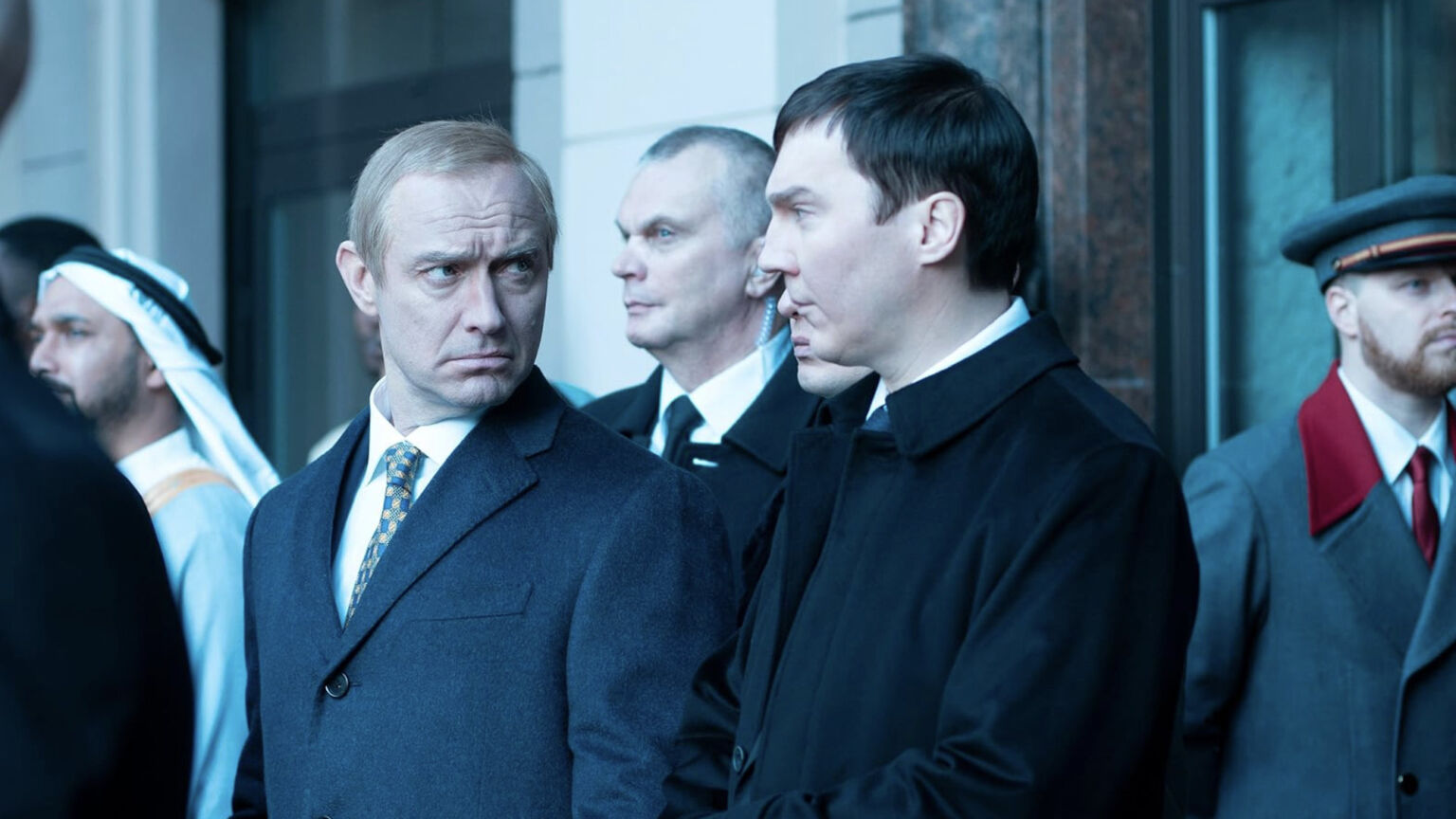
It has to be pure coincidence that a new flurry of Western speculation about Vladimir Putin’s hold on power in the Kremlin comes hard on the heels of the UK release of Olivier Assayas’s film, The Wizard of the Kremlin, a lightly fictionalised account of the 30 years in which Putin rose to become president and Russia’s ever more dominant leader. With Jude Law receiving high praise for his portrayal of Putin, the film is the latest example of the West’s grim fascination with the Russian leader and another attempt to penetrate what drives ‘the man without a face’, as he was described by one biographer, Masha Gessen.
Contrary to what might be assumed, the ‘wizard’ of the title is not Putin himself, who is referred to as the tsar, but his fictitious Svengali and strategist, the moon-faced Vadim Baranov, through whose eyes the action is seen. Baranov is evidently based on Vladislav Surkov, who served Putin in various advisory and executive roles until he left Russia in 2020 – maybe voluntarily, maybe not – and resumed, as per rumours, an incipient career as a fiction writer.
It should also be clarified that, while the film is based on a book, that book is not by Surkov. It is an international best-seller by the Francophone Swiss writer, Giuliano da Empoli, first published in France in 2022. As a long-time Putin-watcher, I must admit knowing nothing of the book until the film drew its first laudatory reviews at last year’s Venice International Film Festival. With many months to wait before the film’s UK release, I settled for the book instead.
Having now seen the film, I have to admit that reading the book first may have been a mistake, as the comparison – for me – does not favour the film, which lacks the subtlety, sense of place and linguistic elegance (even in translation) of the book. Indeed, my first impression of the (English-language) film was the absence of Russianness. It’s not only that most of the actors speak unaccented English, but also that the facial expressions and body language are mostly not what you would encounter in Russia. There is almost no sense of being in a Russian world, let alone in Putin’s world.
Granted, it is impossible to make any film on location in Russia right now, but Latvia may not have been the best choice of substitute. The Baltic states pride themselves on their non-Russianness. The film’s Kremlin and Red Square mock-ups look plasticky, the forests too tame to be Russian forests, and the architecture and interiors in many ways just wrong. I half wondered whether this dissonance between the ‘real’ Russia and this clumsy proxy was a deliberate choice, designed to accentuate what some see as the book’s satirical purpose, but it didn’t work for me. So, yes, I started out on the wrong footing, and things did not really improve from there.
The film’s episodic structure and script are largely faithful to the book’s narrative. And, always remembering both the book and the film are described as fiction, they are to a high degree historically accurate, selecting precisely the episodes that I would single out, if the goal were to sum up and distil the 30 years it covers. It moves from Mikhail Gorbachev’s ‘perestroika’ to Boris Yeltsin’s decrepitude and his completely manufactured election victory of 1996 to Putin’s accession to the presidency, when Yeltsin announced his departure on the eve of the Millennium.
We are given an equivocal (nudge, nudge, wink wink) account of the Moscow apartment bombings, a look at Putin’s callous response to the sinking of the Kursk submarine, and the risks he took to join Russian troops in Chechnya for New Year’s Eve. We see Putin forcing the oligarchs to choose between money and politics, his differences with and eventual spurning of wheeler-dealing Yeltsin-insider Boris Berezovsky, the persecution of energy magnate Mikhail Khodorkovsky (given his real name in the book, but the fictional name of Dmitri Sidorov, for some reason, in the film), Berezovsky’s plea to return to Russia, shown as reaching Putin after his death at his Berkshire mansion. There are also discussions about Russia’s annexation of Crimea, and we see Putin’s frustration at being treated, as he sees it, as someone on a par with the president of Finland (rather than, it is implied, the great power that is Russia).
There may be a little poetic licence in some of these sequences, but these are all episodes that belong in any account of Putin’s time in power. They also work well as self-contained chapters, which may be why it may have seemed that The Wizard of the Kremlin was a natural fit for a successful transfer to the screen.
If the backdrops and body language seem not to breathe Russia, Russians or the world of Putin, there is a similar credibility gap with the main characters. None – sorry, not even Jude Law – carry their roles with conviction. Surkov, the real-life Putin adviser seen as the model for Baranov, is often described as having a boyish appearance, and Paul Dano fits that image. But he seems largely lacking in the guile that Surkov’s designation as a latter-day Rasputin would require, and he is devoid of anything remotely wizard-like.
While Boris Berezovsky always seemed an alien while in exile in London, he seems almost an English gent in The Wizard of the Kremlin, as played by Will Keen. As for Putin, Law does his utmost in terms of facial and body contortions to ‘be’ Putin. But he tries too hard and is given too much to say. Putin projects his power as much with inscrutability as with words. It was clearly also hard for the nearly six-foot Law to replicate the diminutive Putin – however much he tried to scrunch himself up or sink into his chair. He was also given a vaguely demotic accent – that Putin’s Russian, for all its periodic descent into crudeness, does not have.
From this, it should not be concluded that Berezovsky and Putin cannot be depicted convincingly on screen or stage. Peter Morgan’s drama, Patriots, on the London stage in 2022, showed that it could be done, with Tom Hollander as Berezovsky and Will Allen, this time as Putin, using fictitious words and situations to project a higher truth about their relations. The Russia aspect was right, too.
This is also where da Empoli’s Wizard of the Kremlin succeeds in its original book form, allowing the reader’s imagination, or experience, to fill in the contexts that are too literally spelled out in the film. So, if you see the film, then please consider the book as well. It offers what seems to me as accurate an insight into the essence of Putin – a man of iron will with a keen awareness of power and no waster of words – as any contemporary historian or professional Putinologist has managed so far. It is also a pleasure to read.
Mary Dejevsky is a writer and broadcaster. She was Moscow correspondent for The Times between 1988 and 1992. She has also been a correspondent from Paris, Washington and China.
Watch the trailer for The Wizard of the Kremlin here:
spiked summit 2026 – SOLD OUT
Saturday 27 June 2026
10am-6pm, Saturday 27 June
Emmanuel Centre, London, SW1P 3DW
With Lionel Shriver, Brendan O’Neill, Katharine Birbalsingh, Toby Young, Allison Pearson, Paul Embery, Tom Slater, Andrew Doyle, Fiyaz Mughal and more
The spiked summit has now SOLD OUT. To join the waitlist, email:
[email protected]
£80 or £50 for supporters
You’ve hit your monthly free article limit.
Support spiked and get unlimited access.
Support spiked and get unlimited access
spiked is funded by readers like you. Only 0.1% of regular readers currently support us. If just 1% did, we could grow our team and step up the fight for free speech and democracy.
Become a spiked supporter and enjoy unlimited, ad-free access, bonus content and exclusive events – while helping to keep independent journalism alive.
Monthly support makes the biggest difference. Thank you.
Comments
Want to join the conversation?
Only spiked supporters and patrons, who donate regularly to us, can comment on our articles.