How the ‘be kind’ brigade taught us to hate one another
The ‘angry young women’ phenomenon is an inevitable outgrowth of woke identity politics.


Read our latest coverage of the French riots here – paywall-free all of this week..
Most people who have been paying attention will have realised by now that identity politics, which over the past 10 years reached unprecedented heights of fanaticism and compulsory observance, has had a devastating effect on race relations in the UK and throughout the West. Coercing people to label and perceive themselves on the basis of skin colour, to regard themselves as either oppressors or oppressed, has fostered division and resentment. The cumulative effect has been increased levels of racism and belligerent rancour all round, with everyone now seeing themselves as victims of prejudice.
The same thing has been taking place along the lines of sex. A narrative pushed in all arenas of society, that all men are oppressors and that masculinity is intrinsically problematic, that women are the eternal victims of ‘the patriarchy’ and that traditional feminine virtues of compassion and co-operation represent the norm and the remedy, has likewise sown discord. The emergence of ‘incels’ at the nastier end of the manosphere is the consequence of an unrelenting message sent out that men are a problem and no longer wanted.
Belatedly, it’s now becoming apparent to those of even a left-wing persuasion that identity politics has poisoned the minds of many and made society unhappier. As a much-discussed article in last week’s New Statesman has brought to grim light, a widespread hatred for the opposite sex is now being reciprocated by young women.
In her investigation on an emergent ‘femosphere’, Emily Lawford reports how women aged between 18 and 30 ‘feel much more negatively towards young men than young men feel about them’, and ‘while this “femosphere” spans a range of tones, much of it reinforces this hostility towards men’. In her interviews, Lawford came across a specific category and consistent target of this antipathy: straight white men.
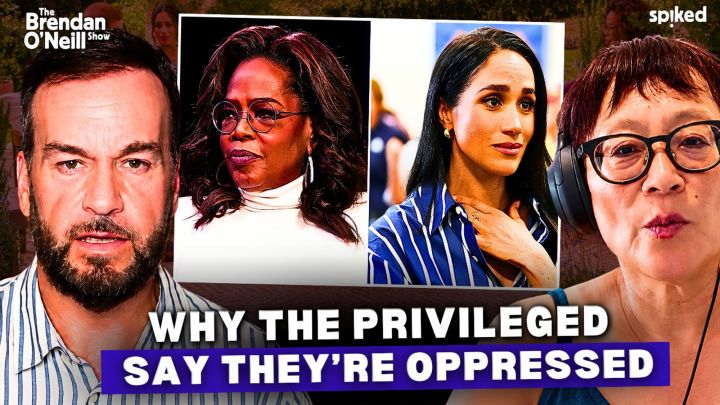
Surprisingly, perhaps, the greatest dislike for men and general discontent with life emerges not from working-class women or those from ethnic minority backgrounds, but from white and middle-class ‘privileged’ women. Yet that really should not surprise us at all. It is at university where white people are taught to feel miserable and guilty because of their skin colour. It is at university where young women are taught to blame ‘the patriarchy’ and ‘structural sexism’ for all their problems. And there is a certain type of entitled middle-class liberal who expects everything in life to be given to them on a plate. No wonder they are inclined to blame everyone but themselves for how unhappy they feel.
Lawford reports that ‘empathy’ is the virtue these young females value above all, contrasting it with the callousness and indifference they perceive in the men they encounter. ‘“Not caring” about the news was inconceivable to the women I met’, she writes.
How ironic it is that the doctrine of hyper-liberalism, which places at its core the need for compassion and the imperative to ‘be kind’, exhorting us to respect and recognise ‘the other’, has led us to a point at which everyone now hates each other.

Hungary exposed the elites’ contempt for democracy
There was something galling about Europe’s liberal-left elite falling over each other to give Hungary the proverbial pat on the head earlier this month, following its decision to oust EU bogeyman Viktor Orbán from power. It wasn’t merely the patronising way in which these technocratic minnows congratulated this historic and proud nation for voting the ‘right’ way. It was the brass neck of the people who themselves hold democracy in contempt.
The president of the European Commission, Ursula von der Leyen, was one of the first to issue her most hearty and most condescending best wishes, yet the commission she heads wasn’t put in power by a popular democratic mandate. Their members are appointed by EU member states. Unlike Viktor Orbán, Ursula von der Leyen can never be voted out of her position by the people of Europe.
British prime minister Keir Starmer also called the result a ‘historic moment, not only for Hungary, but for European democracy’. The nerve of the man. Starmer, like all those who have sought to overturn the national vote to leave the EU in 2016, continues to display his disregard for democracy. This will be seen with his scheme, to be announced at the King’s Speech next month, to align the UK with EU Single Market rules without a parliamentary vote.
‘Today Europe wins and European values win’, added Spain’s socialist prime minister, Pedro Sánchez. This is the same Sánchez who recently passed by decree, with the endorsement of his cabinet, a law that allows more than a million undocumented migrants and asylum seekers in the country to regularise their status, giving them temporary residence and the right to work. Not for the first time, Sánchez bypassed parliament in the knowledge that it was unlikely to approve the measure.
The three criteria for opposing Britain’s membership of the EU have always been democracy, accountability and parliamentary sovereignty. The elites throughout Europe still care little for any of these.
In praise of small talk
In an age of dogmatic literal-mindedness, in which individuals are still cancelled for uttering taboo words, as if they were eternally or inherently bad, it’s timely to be reminded that what we say is dependent on context and open to interpretation. Sometimes, simply speaking to each other is more significant than what is actually said.
A study carried out at the University of Michigan has revealed the importance of small talk, in which content plays a secondary role. After researchers asked 1,800 participants to rate how enjoyable they expected a conversation to be on seemingly mundane topics (such as cats, onions and vegan diets), those tested ‘reported enjoying them much more than they had predicted’. It concluded that what matters when it comes to human communication is not always what’s being said, but ‘enjoying a moment of connection’.
This finding echoes what the philosopher Ludwig Wittgenstein proposed: words don’t always represent meanings associated with ideas in the mind, and a word doesn’t represent some inalterable essence. Language is about communication. As Wittgenstein was fond of putting it: ‘Don’t ask for the meaning, ask for the use.’
We all intuitively know this when we greet people or bid them farewell. It’s not relevant what the word ‘Hello’ literally signifies, or whether it literally is a ‘Good evening’: it could be blowing a gale, or you could be in a foul mood. What matters is verbalising your recognition of your fellow human being. This is why, in exchanging trivialities with strangers about the weather, or grumbling with fellow commuters about the latest train strike, small talk matters.
Patrick West is a columnist for Spiked and author of Get Over Yourself: Nietzsche For Our Times (Societas, 2017). Contact him on X at @patrickxwest.
spiked summit 2026 – SOLD OUT
Saturday 27 June 2026
10am-6pm, Saturday 27 June
Emmanuel Centre, London, SW1P 3DW
With Lionel Shriver, Brendan O’Neill, Katharine Birbalsingh, Toby Young, Allison Pearson, Paul Embery, Tom Slater, Andrew Doyle, Fiyaz Mughal and more
The spiked summit has now SOLD OUT. To join the waitlist, email:
[email protected]
£80 or £50 for supporters
You’ve hit your monthly free article limit.
Support spiked and get unlimited access.
Support spiked and get unlimited access
spiked is funded by readers like you. Only 0.1% of regular readers currently support us. If just 1% did, we could grow our team and step up the fight for free speech and democracy.
Become a spiked supporter and enjoy unlimited, ad-free access, bonus content and exclusive events – while helping to keep independent journalism alive.
Monthly support makes the biggest difference. Thank you.






Comments
Want to join the conversation?
Only spiked supporters and patrons, who donate regularly to us, can comment on our articles.