The uglification of Britain
Our lives are being diminished by the charmless concrete jungles we inhabit.
Want unlimited, ad-free access? Become a spiked supporter.
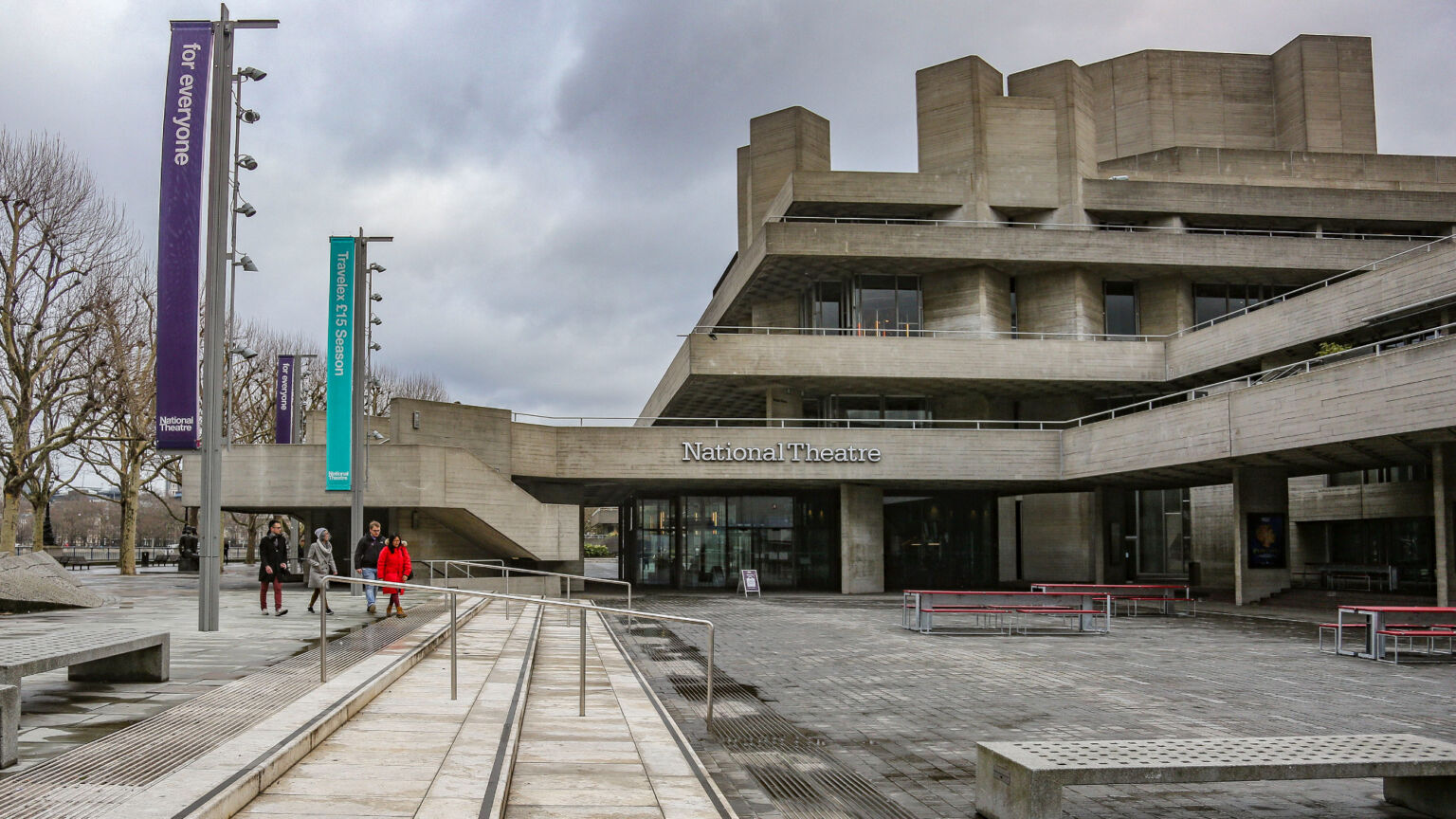
I live in Glasgow now, but I grew up in London. And I remember, as a teenager studying for my GCSE in drama, going to see Alun Armstrong’s barnstorming performance as Francisco Pizarro in Peter Shaffer’s The Royal Hunt of the Sun at the Royal National Theatre. It was a sumptuous affair, all vibrant, elegant staging and costumes, starkly contrasting with the dark themes inherent to Shaffer’s exquisitely harrowing narrative. But staring up at the National at 16 years old, I had a similar experience to thousands of people down the years looking up at the building, the gopping eyesore that it is.
‘Is this the best we can do?’, I wondered. We house the best of our national artistic endeavour in a multistorey carpark. And, if I had my way, not even our carparks would look like that.
These days, planners seem to promote ugliness as some kind of quasi-political message. Any British town will show it clearly enough: housing estates are poured in grey concrete, new towers go up that could be anywhere in the world, and ring roads – like the one encircling my own home in Glasgow – hem us in with an almost defiant lack of charm. It’s a truly soulless business, modern British urban planning, and has been since the middle of the 20th century.
These are not places designed to be loved. They don’t inspire numinous awe, like cathedrals of old; nor do they suggest elegant restraint, like a nice Georgian mews. They function, and we are increasingly told that that is enough.
I’ve come to think that ugly architecture and town planning aren’t neutral things – rather, they are symptoms of a spreading disease. We no longer assume that the environments we inhabit should uplift us, or delight us, or make us feel big, or make us feel small, or do anything other than contain us in concrete.
Architects and certain graduates will tell you of brutalism’s many benefits, of post-modernism’s philosophical elegance. But the desire for proportion, elegance, colour and harmony – for something that helps us to transcend the humdrum, rather than forcing us to give in to it – is not learned in privileged educational establishments. It’s inherent, a part of being human.
Our willingness as a society to provide beauty is waning. And when it disappears, it is the working classes who feel its absence most acutely. Ask anyone who grew up on a 20th-century council estate. It is ordinary people, stuck in modern housing, using those ugly carparks and civic buildings every day, who are left with the consequences of a political choice to uglify the human world.
Brutalism was no accident. It emerged through mid-20th-century planning regimes implemented by postwar governments, often influenced by left-leaning ideals. After the Second World War, many European governments were expanding the welfare state. We were doing so in Britain. There was a deep political commitment to provide mass housing, public institutions and civic infrastructure quickly and affordably. Fair enough – I applaud the postwar consensus as a moment of national pride.
But efficiency, uniformity and mass provision were social and economic priorities, not a recipe for something beautiful. Brutalism, with its exposed concrete, modular forms and minimal ornament, suits those goals. It was efficient, scalable and rejected what was seen as the decorative excess of earlier, class-bound architecture. Functional design could engineer a fairer society, they told us, and we’re still getting shafted by their sensibilities.
A similar pattern seems to have got its fingers into our broader culture, though this time perhaps led by tech bros and Silicon Valley types. Art and literature, and the magnificent inner worlds they mirror and enhance, are giving way to TikTok and all that rubbish. As a children’s author, I see this played out particularly harshly. Fewer children read for pleasure, and fewer families pass on the habit of sustained attention to language. I recently ran a creative writing workshop for a school. Many of the 11-year-olds that I was teaching had a reading age of six. Because reading, once a shining portal into other worlds, is increasingly shunned.
Something vital is lost as we lose the ability to delight in words and stories, to engage with philosophy and learn our histories. As with architecture, we are no longer uplifted, but are instead dragged down. And just as with architecture, the consequences are uneven. Some children, surrounded by books, will still find their way into that richer world. Others will not, through a lack of exposure, largely through their parents’ ambivalence.
These twin declines, intentionally uglier environments and less literary engagement, reflect a similar drift – a loss of confidence that ordinary life should be elevated. A well-built civic building and a well-turned sentence both signal care, intention and something beyond mere utility. They both brighten your day, and let’s not underestimate the importance of that. When we abandon any of it, we diminish.

Beauty, in all its forms, is not expendable. It is part of a life well lived. A society that stops offering it will soon forget how to recognise it, and, in time, stop demanding it altogether. It will be poorer for it.
If we house Shaffer’s work in a brutalist slab, we run the risk of undermining what Shaffer had to say for himself. We will stop being uplifted and challenged by great literature, theatre and art, and will instead be happy to slop around in online swill. This is surely not the world we want to live in, or pass on to our children.
James Dixon is a Glasgow-based novelist, poet and playwright.
You’ve hit your monthly free article limit.
Support spiked and get unlimited access.
Support spiked and get unlimited access
spiked is funded by readers like you. Only 0.1% of regular readers currently support us. If just 1% did, we could grow our team and step up the fight for free speech and democracy.
Become a spiked supporter and enjoy unlimited, ad-free access, bonus content and exclusive events – while helping to keep independent journalism alive.
Monthly support makes the biggest difference. Thank you.




Comments
Want to join the conversation?
Only spiked supporters and patrons, who donate regularly to us, can comment on our articles.