‘We’re told that all the West does is evil – and all our enemies do is good’
Melanie Phillips on how ‘progressives’ came to side with Islamist brutality.

Want unlimited, ad-free access? Become a spiked supporter.
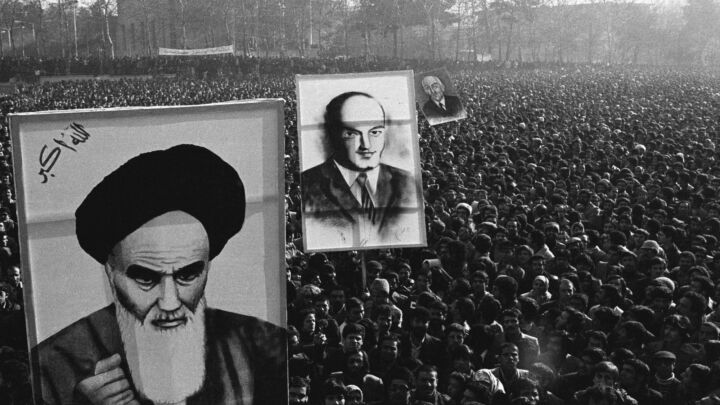
Flags of the Islamic Republic of Iran – a tyrannical Islamist dictatorship – are now a common sight on protest marches in the West. Even those ‘progressives’ who consider themselves anti-racist and anti-fascist have shown sympathy for a regime that kills its own civilians at home and sponsors armies of anti-Semites abroad. How did we reach this point? Can the West ever regain its sanity?
Melanie Phillips – Times columnist and author of the new book, Fighting the Hate: A Handbook for Jews Under Siege – returned to The Brendan O’Neill Show. What follows is an edited version of that conversation. You can watch the full thing here.
Brendan O’Neill: When Israelis hear about what’s going on in the UK – people on the left referring to the US-Iran conflict as an ‘unprovoked war’, for example – what do they make of it?
Melanie Phillips: People in Israel, if they think about Britain at all, are astounded. To be blunt, they think Britain is finished. People in America think Britain is finished. They think it has been Islamised, that it no longer has any idea of what it is or what it should defend. They think it is no longer prepared to stand up for itself or the wider West. It’s over. That’s how they see it, and they’re not entirely wrong.
You would have to be completely ignorant of what’s going on in the Middle East to think that this conflict with Iran is an unprovoked war. Or you would have to be so malevolently disposed towards Israel and America – which many people are – that nothing they do could be seen as anything other than wanton aggression. Both of these attitudes are clearly prevalent in Britain today.
O’Neill: An Al-Quds Day demonstration took place in London recently, where open support was expressed for the Islamic Republic. Did it shock you to see that in a Western capital?
Phillips: This has been going on for a long time. One can only begin to understand it by acknowledging what has happened in the education system over the past half-century. Several generations have grown up and been taught that the West is evil, racist, colonialist and oppressive, and that nothing it does is good. At the same time, they are taught that anything the developing world does – even if it is objectively bad – is somehow justified. This is the lens through which the world must be understood.
Even on 7 October 2023, while Israelis were still being slaughtered in southern Israel by a Hamas-led mob, there were already ecstatic celebrations going on in the West in anticipation of Israel’s downfall. That same madness has continued and is now applied to the conflict with Iran. If you have been following these developments, as I have, with concern about the erosion of the West’s moral clarity, you might not be surprised at this point – but it remains deeply shocking.
The narrative the West accepts has not been spun by the mainstream media alone, but by the entire international humanitarian establishment, from transnational courts like the International Criminal Court and the International Court of Justice to major NGOs. And if the moral framework of the West is shaped by institutions that invert good and evil, then everything becomes reversed. Good is seen as bad, and bad as good. Victims are portrayed as aggressors, and aggressors as victims. Justice is redefined as injustice.
O’Neill: On 7 October, Rama Duwaji – the wife of the future mayor of New York, Zohran Mamdani – was liking posts on Instagram that celebrated what was happening in Israel. What did you make of that story?
Phillips: It’s monstrous. Duwaji is monstrous. Mamdani is monstrous. He uses Jews to divide the Jewish community of New York – many of whom, I’m afraid to say, voted for him in great numbers. Whether they’re having buyer’s remorse now, I’m not sure.

I look at the behaviour of people in Britain and Australia and Canada, and you see the same contorted hatred of Jews. You think: what is going through their minds? Why do they hate Jews? Most of them have never met a Jew. They know nothing about Judaism. They know nothing about the Middle East or Israel. Yet they have been taught that this is what passes for conscience. They observe that their entire peer group thinks this, and a kind of mob hysteria takes over. I’ve read that something similar took hold among educated classes in the 1930s over Stalin. They thought Stalinism would bring about the brotherhood of man and a perfect society. They refused to hear about the millions being slaughtered, imprisoned and abused.
How does one account for this? How does one explain that so many in Germany supported Nazism? We can cite economic factors, the politics of the time, the aftermath of war – all valid reasons – but they don’t reach the heart of it. To me, this is very frightening. Despite living in what is supposed to be the most rational age ever known, we are witnessing a complete eclipse of reason. How can that be, when people are more educated than ever?
O’Neill: In Fighting the Hate, you give guidance on how to deal with this current wave of anti-Semitism. Why did you feel compelled to write it?
Phillips: First of all, more people are noticing the alarming rise in anti-Semitism in Britain and across the West – largely because we’re seeing record numbers of antisemitic attacks. But I think it’s wrong to frame this simply as ‘a rise’ in anti-Jewish sentiment. This is something unprecedented. This is the normalisation of hatred of Jews, Israel and Zionism, turning them into social and political pariahs.
I have watched what has been happening, especially since 7 October, with tremendous alarm. In my previous book, The Builder’s Stone, I analysed what I saw as the madness of the West: why it had turned on the Jews, why it actually needs Jews and Israel, and why it can only survive if it recognises that. I then visited Jewish communities in Australia, America and Britain to discuss the book. What I found in all of these communities was that Jews were completely poleaxed. They were almost paralysed by what they were experiencing.
These are not people like you and me who analyse global events constantly. These are ordinary people living their lives. Jews in Britain, America and Australia believed they were in countries where they were treated well, as equal citizens. They did not see themselves as having a problem. Then, suddenly – particularly in Australia, where the Jewish community had always felt very secure – they were confronted with something completely different. People they had known since childhood stopped speaking to them because of Palestine. People were asking them: ‘Why are you killing babies in Gaza?’ These are Western Jews being held responsible for what people perceive as Israel’s actions.
Israel itself was being defamed with false accusations about war crimes, yes, but these were individuals. They were dealing with the consequences in their daily lives – at work, at university, in social settings. I spoke to a businesswoman in Australia who told me about a time she was negotiating a deal. Everything was proceeding normally, and suddenly the person she was negotiating with asked: ‘Why are you killing babies?’ She didn’t know what to do. This was a contract that mattered financially. Should she challenge the accusation and risk losing the deal? Should she try to reason with the person? Should she ignore it? In the end, she let it go.
Again and again, I encountered Jews who were asking: ‘How should we respond?’ They don’t have the information. They don’t know the arguments. Even if they did, how do they defend themselves when confronted like that? How do they deal with friends, with colleagues? Most painful of all, how do you deal with a close family member who won’t speak to you any more?
I felt I had to try to help. People were desperate. They needed reassurance that they weren’t going mad, because they were being gaslit constantly. They needed to know they weren’t alone. Most of all, they needed practical guidance. Some people are naturally combative and others are not – so there is always a dilemma of how to respond when faced with anti-Semitism. Do you fight back, or do you prioritise your own security? There is no universal answer. But I try to outline the consequences of different choices.
I also stress that what people are facing is not uniform. The terrible accusations – genocide, apartheid, killing babies – are similar, but the people making them come from different perspectives. They may be left-wing activists, right-wing critics, confused liberals, irreconcilable liberals, friends, family members or colleagues. Each requires a different response.
Jews, of course, are at the sharp end, because it is directed at them – but anyone who wants to defend Jews, support Israel or more broadly defend Western civilisation faces the same problem. Often, they don’t have arguments ready because they haven’t thought about it in advance. I would hope that they, too, can learn from this book.
Melanie was speaking to Brendan O’Neill. Watch the full conversation below:
Buy Melanie’s book on Amazon now.
You’ve hit your monthly free article limit.
Support spiked and get unlimited access.
Support spiked and get unlimited access
spiked is funded by readers like you. Only 0.1% of regular readers currently support us. If just 1% did, we could grow our team and step up the fight for free speech and democracy.
Become a spiked supporter and enjoy unlimited, ad-free access, bonus content and exclusive events – while helping to keep independent journalism alive.
Monthly support makes the biggest difference. Thank you.



Comments
Want to join the conversation?
Only spiked supporters and patrons, who donate regularly to us, can comment on our articles.