We must resist the rule of the technocrats
The Covid era wasn’t an aberration – it simply confirmed how much we have surrendered of our democracy.
Want unlimited, ad-free access? Become a spiked supporter.
We all know how politics is meant to work in a democracy. Political parties put policy programmes before the electorate, people vote for those that best reflect their interests, and the victorious party implements them.
We also know this is not how things work out in practice. A party may be elected on a promise to improve public services, but once in power, discover there is insufficient ‘fiscal headroom’ to do so, thanks to the technocrats who actually call the shots. In other cases, a government might try to carry out the voters’ wishes for greater immigration controls – only to see its policies struck down in the courts because they contravene international human-rights laws.
Meanwhile, novel policies are regularly introduced not through popular demand, but on the basis of a supposed ‘expert consensus’. Your energy bills are too high? Tough luck, our Net Zero targets make extortionate electricity prices non-negotiable. Think you have the right to choose what you eat and drink? Think again, our sugar taxes are here to penalise you for making the wrong call.
Unsurprisingly, such policies are often disconnected from the everyday concerns of ordinary people struggling with housing costs or precarious work. Far from reflecting democratic opinion, they are the results of a consensus carefully manufactured among government agencies, academic researchers and campaigning NGOs.
From public-health policy to climate change, more and more issues are being removed from public control and handed to ostensibly neutral specialists. Though they may maintain a façade of democratic procedure, today’s Western societies are largely governed by an alliance between expert knowledge and managerial power. They would be more accurately described by the term ‘technocracy’.
Cast your mind back to the Covid-19 pandemic. This was not an aberration, but a revelation. As the disease began to spread, it fell to previously anonymous public-health functionaries to lay out the rules by which we would govern our lives. Advisory bodies known by acronyms like SAGE (in the UK), NPHET (Ireland), or CDC (America) became the most powerful arms of government, with journalists and the public hanging breathlessly on their every word. The true extent of the technocracy had been well and truly unmasked.
During that time, elected politicians were seemingly relegated to a secondary role. Their job was simply to approve, or very occasionally resist, the demands of the experts. Across much of the world, representative democracy largely ceased to function, with parliamentary meetings suspended or restricted. This too exposed where real power resides. Even post-pandemic, elected bodies increasingly resemble ornamental adjuncts to the administrative state.
It is depressing to think back on how much was taken as gospel during the lockdown era. Abstract metrics such as the infection-fatality ratio and accompanying theoretical models were used to determine whether people could leave their homes. These were presented as objectively scientific. In reality, they were bureaucratic constructs, frequently revised and often embodying questionable assumptions – yet somehow, they still carried the authority to confine millions. Measures like mask mandates for children, prohibitions on outdoor activity, or the ‘rule of six’ spoke more to a mindset of risk-aversion and control than to any objective assessment of how the disease spread. Nonetheless, police officers, public-health officials, and even one’s own neighbours exhibited fanatical zeal in identifying and punishing the non-compliant. Anyone who dared to question the way in which the rules had been decided was branded a ‘denier’, ‘conspiracy theorist’ or a selfish individual at ease with putting others’ lives in danger.
We might, understandably, be inclined to regard the Covid lockdowns as a bad memory – something best forgotten. But that would be a mistake. The state overreach, censorship, obsession with risk and distrust in people’s ability to make their own decisions were not exceptions to the norm, but the new norm. Covid merely exposed how contemporary power operates.
Back in 1941, James Burnham’s book, The Managerial Revolution, outlined how an upheaval of social relations was driving fundamental changes in how modern societies were structured. Large organisations like the administrative state, giant corporations, mass media and public-education systems were rapidly growing in importance. A growing amount of power was being placed in the hands of administrators.
Even eight decades ago, Burnham suspected that the managerial elites would not confine themselves to implementing policies or regulations decided by the people, but would leverage their own technical knowledge and strategic position to refashion ever-wider domains of economic and social life.
He was right. Despite the rhetoric of anti-bureaucratic individualism that accompanied the neoliberal revolution of the Eighties and Nineties, managerialism has only intensified its hold on society. Techniques developed in corporations have been extended into the public sector and into organisations such as universities, hospitals, and NGOs. Modern IT advancements turbocharged this, bringing with it the ability to create systems of surveillance and reporting and to impose them widely.
Control over knowledge is at the heart of this technocratic type of governance. Managing large numbers of people, whether as employees, citizens, consumers or patients, requires the ongoing collection of huge amounts of information about them. That’s why the growth of the modern state was accompanied by the emergence of social sciences and professions claiming expert jurisdiction over particular areas of policy and behaviour.
The issue with making policy based purely on a ‘rational’ and ‘scientific’ basis is, as philosopher David Hume pointed out, that you cannot derive values from facts. The way something is tells you nothing about how it ought to be. Nonetheless, the managerial claim that says, ‘Because the data say X, we need to do Y’, does just that. The upshot is that beyond reflecting the supposed ‘data’, policies also tend to reflect the interests and values of the managers that made them. We might call this ‘policy laundering’.
Technocracy is not simply rule by science, but a system in which disagreement is treated as irrationality. Covid proved as much. Perhaps most striking about 2020 was that among officials who had been elected by the people, this was treated as a matter of course. Indeed, right-thinking opinion celebrated the lockdowns as a model for how we might, in future, respond to crises, such as climate change.
Unless we challenge the assumption that expert status confers a right to determine policy and dictate individual behaviour, the next emergency – whether its occasion be eco-apocalypse, migration, public health or financial instability – will once again be declared too complex for democratic politics. Technocracy, having revealed itself for what it truly is, will only tighten its grip.
Paul O’Connor is an associate professor of sociology at United Arab Emirates University. He is the author and editor of a number of books, including Technocracy: Knowledge and Power in the Information Age.
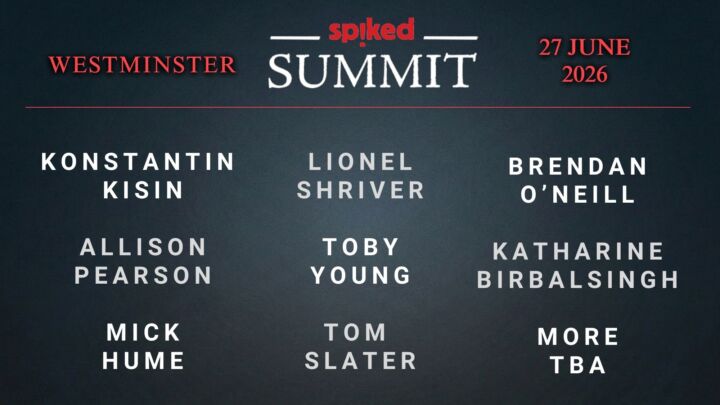
spiked summit 2026
10am-5pm, Saturday 27 June
Emmanuel Centre, London, SW1P 3DW
With Konstantin Kisin, Lionel Shriver, Brendan O'Neill, Katharine Birbalsingh, Toby Young, Allison Pearson, Tom Slater and more
Become a spiked supporter to get a discounted ticket
£80 or £50 for supporters
You’ve hit your monthly free article limit.
Support spiked and get unlimited access.
Support spiked and get unlimited access
spiked is funded by readers like you. Only 0.1% of regular readers currently support us. If just 1% did, we could grow our team and step up the fight for free speech and democracy.
Become a spiked supporter and enjoy unlimited, ad-free access, bonus content and exclusive events – while helping to keep independent journalism alive.
Monthly support makes the biggest difference. Thank you.





Comments
Want to join the conversation?
Only spiked supporters and patrons, who donate regularly to us, can comment on our articles.